
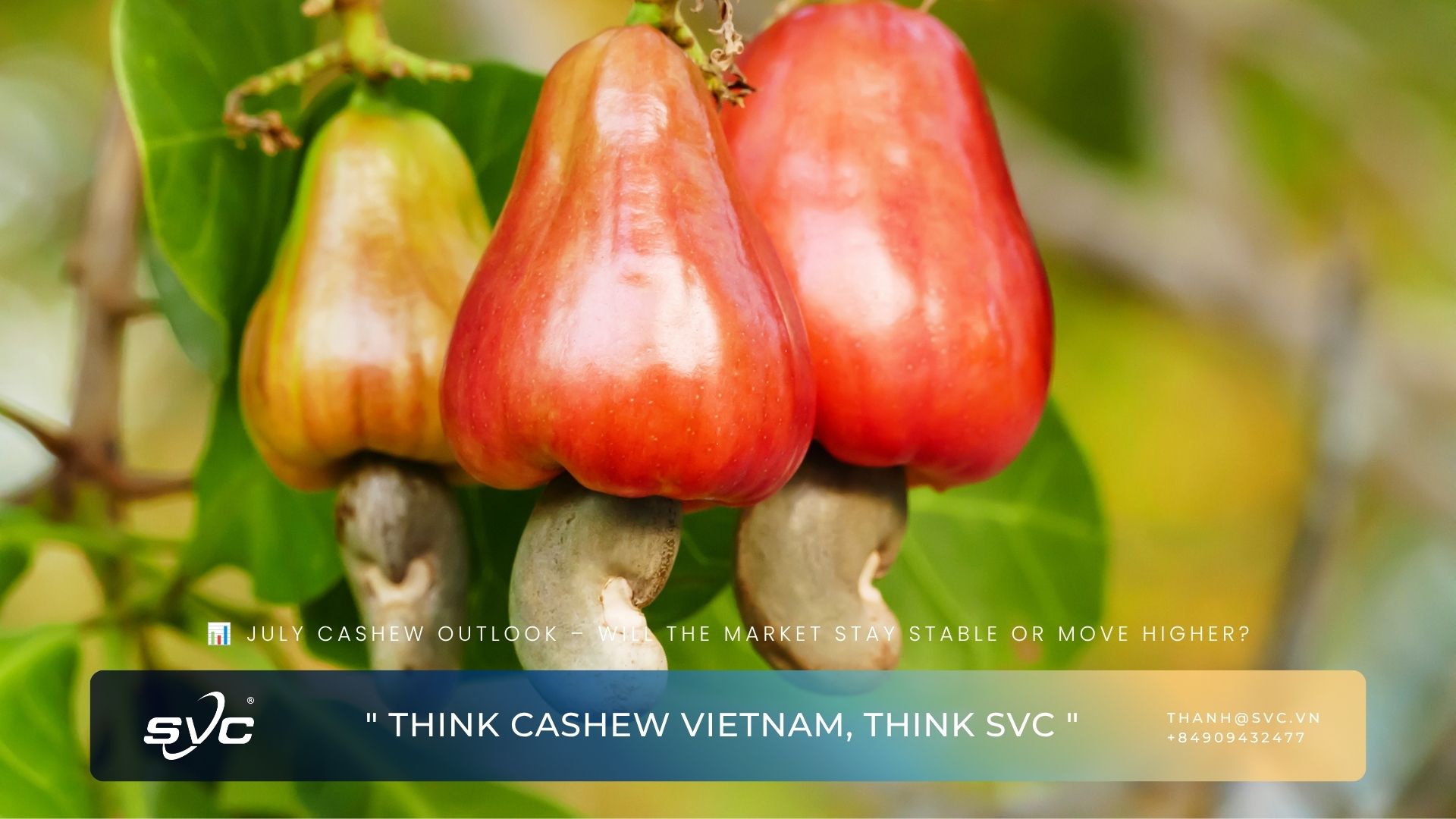
As the global cashew industry approaches July 2026, buyers, importers and distributors are facing a familiar question:
Has the market reached a stable equilibrium, or is the next move likely to be higher?
The answer matters because July often serves as an important bridge between first-half market adjustments and second-half procurement activity.
By this stage of the year, many importers have completed inventory corrections, retailers begin preparing for year-end sales cycles and procurement teams shift their attention from market observation to supply planning.
While the global cashew industry remains influenced by economic uncertainty and cautious purchasing behavior, several underlying indicators suggest that market conditions entering July are considerably healthier than they were at the beginning of 2026.
The key question is no longer whether the market is stabilizing.
The key question is whether stabilization will eventually lead to stronger demand and firmer market conditions during the second half of the year.
🎯 Executive Outlook
Entering July, the global cashew market is characterized by:
🟢 Improving buyer sentiment
🟢 More active procurement discussions
🟢 Better inventory balance
🟢 Stable supply conditions
🟢 Growing interest in private label programs
At the same time:
🟡 Consumer spending remains selective
🟡 Buyers continue avoiding speculative purchasing
🟡 Global economic uncertainty has not completely disappeared
The overall picture points toward a market that is becoming more balanced and predictable than it was during the first half of the year.
🌍 What Changed Between Q1 And Q2?
The difference between the first and second quarter is not necessarily visible in export statistics alone.
The most significant change has occurred in market behavior.
Q1: Defensive Purchasing
During the first quarter, many buyers focused primarily on:
• Reducing inventory
• Preserving cash flow
• Delaying procurement decisions
• Monitoring market conditions
Most purchasing activity was reactive rather than strategic.
Q2: Return Of Planning
By contrast, the second quarter saw increasing attention given to:
• Supply continuity
• Private label programs
• Retail planning
• Future inventory coverage
This shift indicates that buyers are beginning to look beyond immediate market uncertainty.
Historically, this type of transition often precedes stronger procurement activity.
🇪🇺 Europe Is Becoming More Active
Europe remains one of the most influential markets for global cashew consumption.
Several developments support a more positive outlook entering July:
Inventory Levels Have Normalized
Many European importers spent the last 12 months reducing stock positions.
That process is now largely complete.
Private Label Expansion Continues
Retailers continue investing in private label products to improve margins and strengthen consumer loyalty.
Healthy Snacking Remains Strong
Consumer demand for natural and premium snack products continues supporting long-term cashew consumption.
Taken together, these factors suggest that European demand could become increasingly supportive during the second half of 2026.
🌍 The Middle East Continues To Surprise
One of the strongest growth stories in recent years has been the Middle East.
Several countries continue expanding imports of:
• Premium cashews
• Roasted products
• Retail-ready snacks
• Gift packaging formats
• Private label products
Unlike some mature markets, consumption growth remains relatively dynamic.
For exporters, this region continues offering attractive long-term opportunities.
🏷️ Private Label Is Becoming A Demand Driver
A trend often overlooked in market forecasts is the growing influence of private label development.
Retailers increasingly prioritize:
• Brand ownership
• Product differentiation
• Margin improvement
• Consumer loyalty
This trend creates steady demand for OEM manufacturing and customized product solutions.
Unlike short-term trading activity, private label programs often require long-term production planning.
As a result, they contribute to greater market stability.
⚖️ What Could Keep The Market Stable?
Despite improving fundamentals, several factors continue preventing aggressive market growth.
Consumer Spending Remains Selective
Inflationary pressures have eased in many regions, but consumers remain careful with discretionary spending.
Procurement Teams Remain Disciplined
Importers are purchasing more strategically than in previous years.
Large speculative buying programs remain limited.
Competition Remains Strong
Global exporters continue competing aggressively for market share.
These factors help explain why the market may remain stable rather than experience a rapid upward move.
📈 What Could Push The Market Higher?
Several developments could strengthen market conditions during July and beyond.
Inventory Rebuilding Accelerates
As companies prepare for Q4 retail programs, inventory requirements may increase.
Demand Broadens Across Multiple Regions
When growth occurs simultaneously across Europe, North America and the Middle East, market momentum can strengthen quickly.
Value-Added Products Continue Expanding
Roasted, flavored and retail-ready products often generate stronger demand than traditional commodity categories.
Supply Discipline Remains Strong
Controlled production activity reduces the risk of oversupply.
🎲 July Market Probability Matrix
| Scenario | Probability |
|---|---|
| Stable Market | 50% |
| Moderate Upward Movement | 35% |
| Weaker Market Conditions | 15% |
Based on current indicators, stability remains the most likely outcome.
However, the probability of gradual strengthening is becoming increasingly meaningful.
💡 What Should Buyers Do?
For Importers
Maintain procurement flexibility while securing sufficient supply coverage.
For Retail Brands
Continue planning private label programs and year-end promotions early.
For Distributors
Monitor inventory levels closely and avoid relying solely on spot-market opportunities.
For Long-Term Buyers
Focus on supply continuity rather than attempting to perfectly time market movements.
The cost of waiting may eventually exceed the potential benefit.
🔮 SVC Outlook For July 2026
The global cashew market appears increasingly positioned for stability.
Demand is improving.
Supply remains balanced.
Inventory pressure is easing.
Market confidence continues recovering.
While a major rally remains unlikely in the immediate term, conditions increasingly support gradual strengthening rather than renewed weakness.
July is therefore likely to be remembered not as the month when the market surged, but as the month when confidence became more firmly established across the global cashew trade.
🌏 Global Supply Partnerships
Whether you are sourcing premium cashew kernels, developing a private label brand or securing long-term supply contracts, SVC supports buyers with reliable sourcing solutions, OEM manufacturing and international export expertise.
📩 thanh@svc.vn
📱 (+84) 909 432 477
🏭 Factory: Dong Nai Province, Vietnam
🏢 Representative Office: Ho Chi Minh City, Vietnam
🌐 Website: https://svc.vn
Sources
• Vietnam Cashew Association (VINACAS)
• International Nut & Dried Fruit Council (INC)
• International Trade Centre (ITC)
• Global Commodity Market Reports
• SVC Market Intelligence
Article tools
Continue reading