
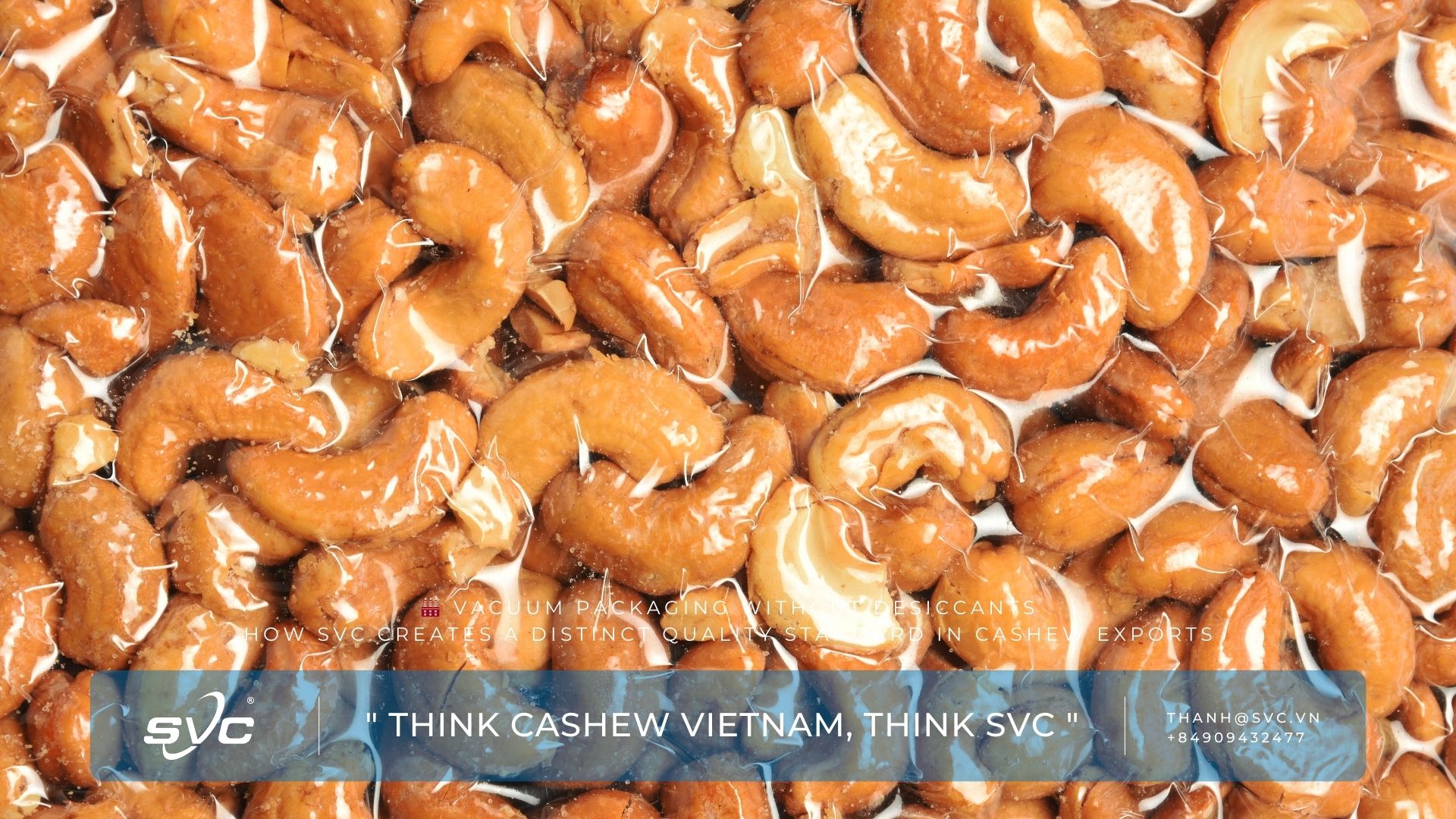
In cashew exports, packaging is not merely a technical step. It reflects how a factory understands product integrity, logistics risk, and long-term responsibility toward buyers. As global markets become increasingly quality-driven, differences in packaging philosophy are playing a growing role in supplier selection.
At SVC, a deliberate decision has been made to apply vacuum packaging while eliminating the use of desiccant bags inside export cartons. This approach represents a clear and disciplined quality standard that sets SVC apart in the market.
🌍 Rethinking Moisture Control in Cashew Logistics
Moisture remains one of the most critical risks in cashew transportation. Many exporters rely on desiccant bags as a secondary safeguard against humidity during transit. While common, this method often addresses moisture after it has already entered the packaging environment.
SVC’s approach focuses on preventive control at the source. By removing residual air through vacuum sealing, the internal environment of the package is stabilized before shipment begins. This significantly reduces moisture fluctuation, oxygen exposure, and the risk of condensation during long-distance transport.
📦 Why SVC Chooses Vacuum Packaging Over Desiccants
Vacuum packaging creates a sealed and controlled micro-environment around the cashew kernels. Instead of absorbing moisture reactively, SVC eliminates the conditions that allow moisture to form in the first place.
This method enables SVC to:
- Maintain stable kernel dryness without auxiliary materials
- Avoid variability associated with desiccant performance
- Deliver cleaner, more consistent packaging presentation
- Eliminate foreign materials inside cartons
For many international buyers, the absence of desiccant bags is viewed as a signal of confidence in process control and packaging discipline.
🏢 What This Choice Reveals About Factory Discipline
Choosing vacuum packaging without desiccants is not a cost-cutting decision. It reflects an operational mindset built on precision and accountability.
This approach indicates that SVC:
- Controls moisture at the core, not at the margins
- Designs packaging systems based on real logistics conditions
- Prioritizes consistency across all shipments
- Reduces variability rather than compensating for it
Such discipline is increasingly valued by buyers seeking suppliers who treat quality as a system rather than a checklist.
📊 Buyer Confidence and Market Perception
From a buyer’s perspective, vacuum-packed shipments without desiccants offer tangible advantages:
- Cleaner cartons with no additional materials
- Predictable product condition upon arrival
- Lower inspection risk related to moisture or contamination
- Greater confidence in repeat sourcing
As sourcing strategies evolve, packaging discipline is becoming a proxy for overall operational maturity.
🔍 A Clear Signal in a Competitive Market
The global cashew industry is moving toward execution-based differentiation. Buyers are evaluating suppliers not only on price, but on their ability to manage risk proactively and deliver consistency over time.
SVC’s vacuum packaging strategy without desiccants aligns closely with this shift, reinforcing its positioning as a supplier focused on long-term quality assurance rather than short-term fixes.
📌 Conclusion
In cashew exports, meaningful differentiation often lies in how quality risks are addressed before they arise. By adopting vacuum packaging and eliminating the need for desiccant bags, SVC demonstrates a preventive and disciplined approach to quality control.
This packaging philosophy protects kernel integrity throughout logistics, enhances buyer confidence, and strengthens SVC’s position in an increasingly selective global market.
📧 Contact for Market & Export Coordination
• Email: thanh@svc.vn
• WhatsApp: (+84) 909 432 477
🌍 Think Cashew Vietnam, Think SVC.