
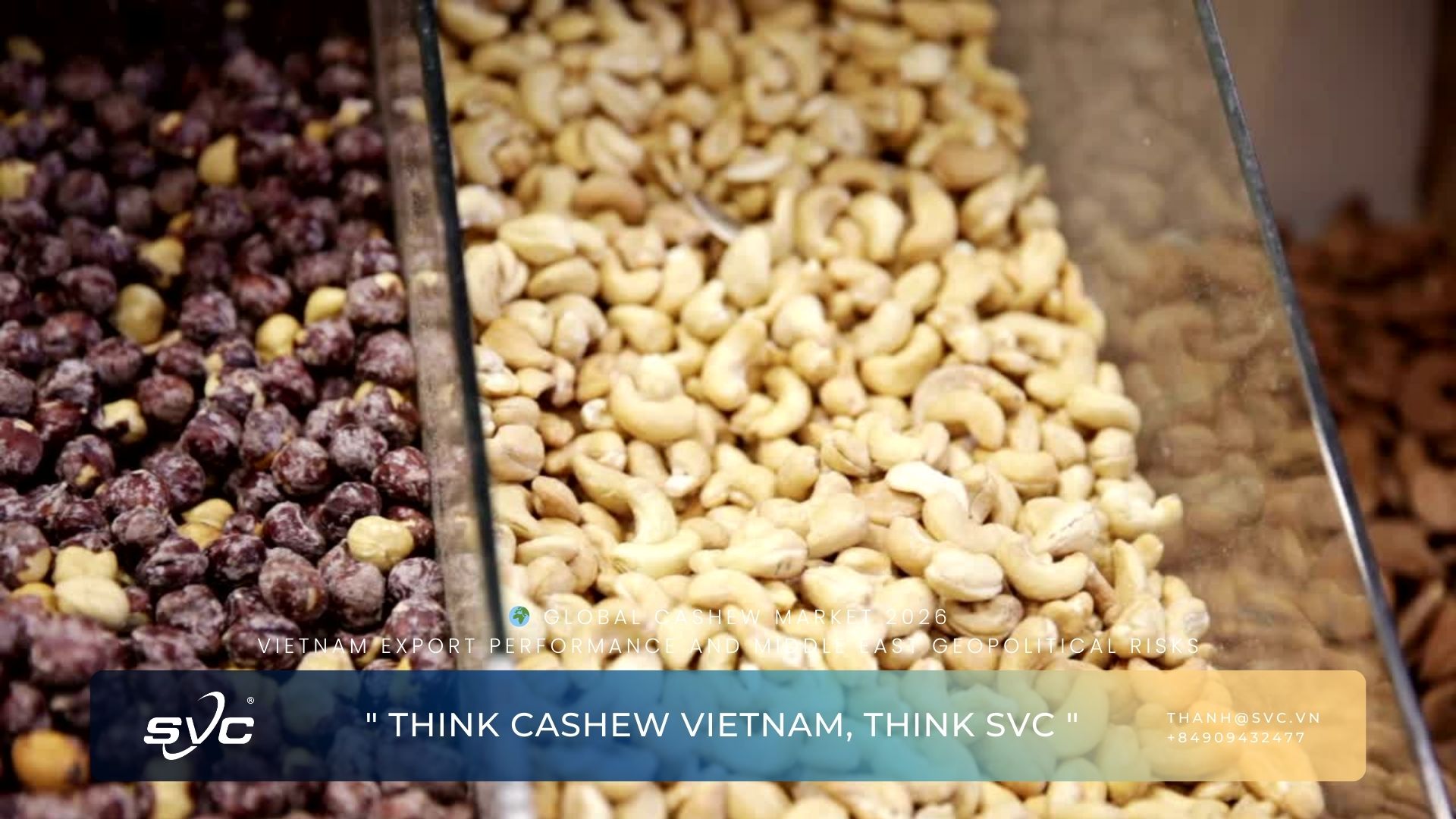
The global cashew market in 2026 is entering a new phase of cautious recovery following a turbulent year in 2025. While global demand for cashew kernels continues to grow steadily, exporters and buyers are navigating a more complex trade environment shaped by logistics uncertainty, supply adjustments, and geopolitical tensions.
For Vietnam — the largest cashew processing and exporting hub in the world — the first months of 2026 provide important signals about how the global cashew supply chain may evolve throughout the year.
Understanding the global cashew market outlook for 2026 is therefore essential for importers, distributors, and food manufacturers seeking stable sourcing strategies.
📊 Vietnam Cashew Export Performance in Early 2026
Vietnam continues to maintain its dominant position in the global cashew industry, processing more than 60% of the world’s cashew kernels.
After the Lunar New Year holiday period, export activity has gradually resumed as international buyers begin placing procurement orders for shipments scheduled in the second quarter of 2026.
Several trends characterize the export environment so far this year.
Buyers are increasingly cautious when placing orders, prioritizing supplier reliability and shipment execution rather than aggressive price negotiations. Standard grades such as WW320 and WW240 remain the most actively traded categories in global markets.
At the same time, demand for value-added cashew products continues to grow. Roasted cashews, flavored kernels, and retail-ready packaging formats are becoming increasingly popular as global consumers shift toward branded snack products.
Importers are also consolidating supplier networks, preferring long-term partnerships with exporters capable of maintaining consistent quality and stable supply.
For real-time export pricing, buyers can follow the official Vietnam Cashew Price Update page:
🌎 Structural Changes in the Global Cashew Supply Chain
The global cashew industry operates through a highly interconnected supply chain structure.
Raw cashew nuts are primarily produced in West Africa, particularly in Ivory Coast, Ghana, Nigeria, and Tanzania. These raw materials are then exported to Vietnam where large-scale processing transforms them into export-ready kernels.
Vietnam subsequently exports processed cashew products to major consumption markets including:
• United States
• European Union
• China
• Middle East
• Australia
Because of this structure, Vietnam effectively functions as the central processing and distribution hub of the global cashew industry.
Any disruption in raw material supply, logistics networks, or international trade routes can therefore influence global cashew market dynamics.
⚠️ Middle East Geopolitical Tensions and Global Trade Risks
One of the emerging macroeconomic risks influencing the global cashew market in 2026 is the escalation of geopolitical tensions between the United States and Iran.
Although cashew products themselves are not directly linked to these conflicts, instability in the Middle East can affect global trade logistics.
The Strait of Hormuz, located between Iran and the Arabian Peninsula, remains one of the most critical maritime corridors for global shipping.
Escalating tensions in this region may affect international trade in several ways.
Higher oil prices could increase transportation costs across global shipping networks. Shipping insurance premiums may also rise due to increased geopolitical risk. In addition, shipping routes could become longer if vessels avoid certain high-risk maritime corridors.
These developments would indirectly influence export costs for agricultural commodities, including cashew kernels.
🚢 Logistics and Freight Market Implications
Shipping and logistics remain one of the most sensitive variables for the international cashew industry.
Over the past several years exporters have faced disruptions related to container shortages, fluctuating freight rates, and port congestion. Geopolitical uncertainty in the Middle East could further complicate global logistics planning.
For cashew exporters, these challenges translate into several operational considerations.
Freight costs may become more volatile if global fuel prices rise. Transit times may lengthen if shipping routes change. Delivery schedules could also become less predictable for long-distance shipments.
For buyers, logistics stability has therefore become a central component of procurement planning.
📈 Buyer Strategy Shifts in 2026
In response to these uncertainties, global cashew buyers are increasingly prioritizing risk management and supplier reliability.
Importers are focusing on exporters that demonstrate:
• consistent shipment execution
• transparent pricing communication
• stable production capacity
• long-term partnership reliability
This shift benefits exporters who maintain disciplined operations and structured export coordination.
Leading exporters such as SVC International JSC, a trusted cashew supplier in Vietnam, continue to support international buyers through reliable supply and transparent export communication.
Vietnam also supplies a wide range of Vietnamese cashew nuts for export, including premium kernel grades and roasted cashew products.
🏭 Vietnam’s Strategic Role in Supply Stability
Despite external uncertainties affecting global trade, Vietnam continues to play a stabilizing role in the international cashew industry.
The country’s large-scale processing infrastructure, skilled workforce, and export-oriented production systems enable Vietnam to maintain supply continuity even during periods of market volatility.
Exporters that combine operational efficiency, international certification standards, and reliable shipment execution are increasingly strengthening long-term partnerships with global buyers.
📊 Global Cashew Market Outlook for 2026
Looking ahead, several key factors will shape the trajectory of the global cashew market in 2026.
Raw cashew nut production in West Africa will remain a major determinant of global supply levels. Freight costs and logistics stability will continue to influence export operations. Geopolitical developments may also affect energy prices and shipping routes.
Despite these uncertainties, the long-term outlook for the cashew industry remains positive.
Global demand for healthy snacks, plant-based ingredients, and premium nut products continues to grow across both developed and emerging markets.
Vietnam is therefore expected to remain the primary processing and export hub for the global cashew industry for the foreseeable future.
❓ FAQ – Global Cashew Market 2026
What factors influence the global cashew market in 2026?
The global cashew market is influenced by raw cashew nut supply, freight costs, logistics stability, geopolitical risks, and global demand for nut-based food products.
Why is Vietnam important in the global cashew industry?
Vietnam processes more than 60% of the world’s cashew kernels and serves as the central processing hub for global cashew exports.
How could Middle East tensions affect the cashew trade?
Geopolitical tensions may influence oil prices, shipping insurance costs, and global freight routes, indirectly impacting agricultural exports including cashews.
Is global demand for cashews expected to grow?
Yes. Increasing demand for healthy snacks and plant-based foods continues to drive global consumption of cashew products.
📧 Market & Export Coordination
📩 Email: thanh@svc.vn
📱 WhatsApp: (+84) 909 432 477
🌍 Think Cashew Vietnam, Think SVC.
Sources
International Nut and Dried Fruit Council
Vietnam Cashew Industry Reports
Global Shipping and Trade Analysis
International Commodity Market Data
Article tools
Continue reading