
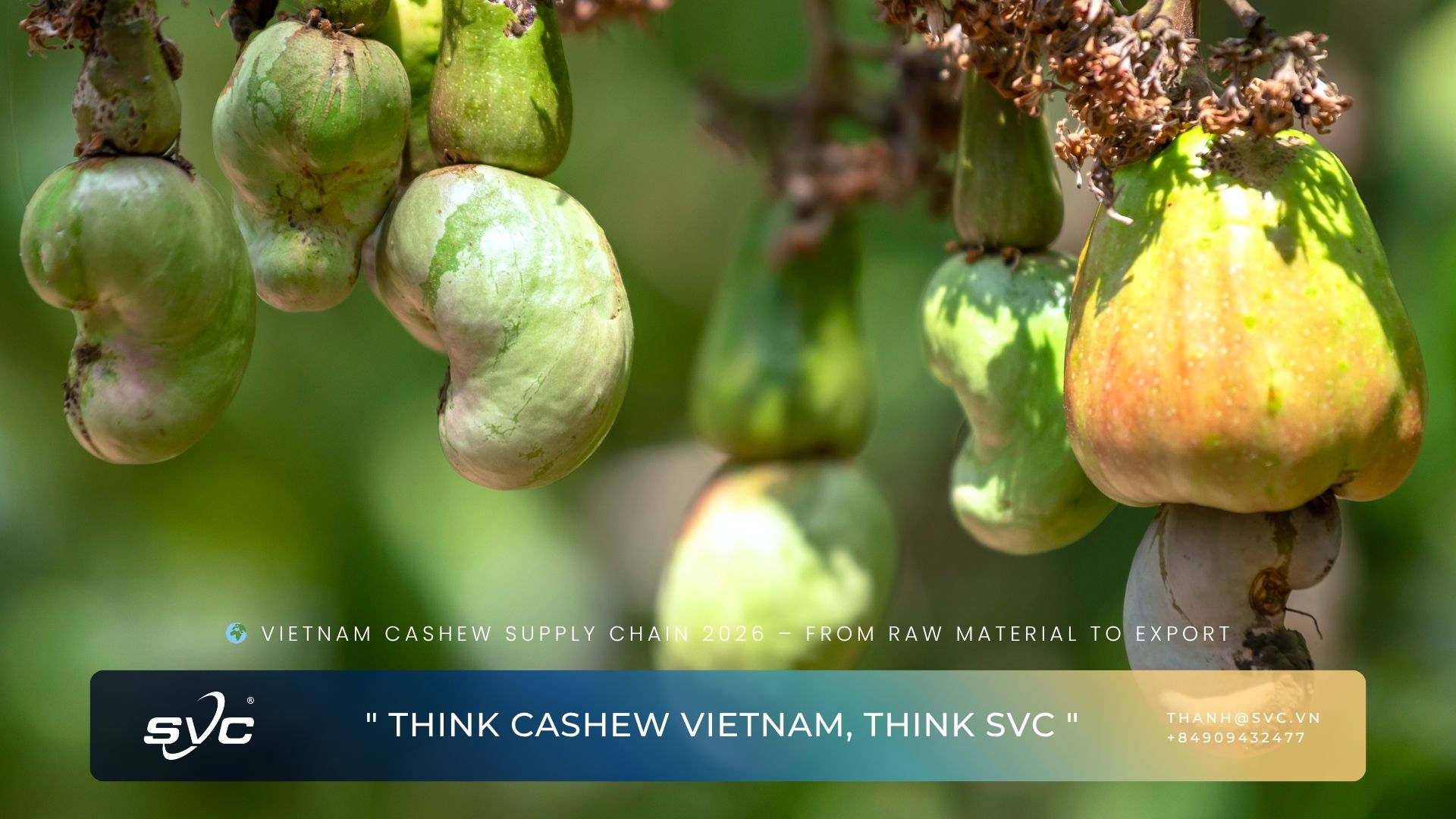
Vietnam remains the world’s leading cashew processing and export hub, supplying a major share of global cashew kernel demand across Europe, the United States, the Middle East and Asia.
Behind this position is a highly integrated supply chain system that connects raw material sourcing, processing, quality control, logistics and international export operations into one coordinated ecosystem.
In 2026, understanding the Vietnam cashew supply chain has become increasingly important for importers seeking stable, scalable and reliable sourcing solutions.
📊 Vietnam’s Role in the Global Cashew Industry
Vietnam has developed one of the most advanced cashew processing industries globally thanks to:
• large-scale processing infrastructure
• experienced export ecosystem
• international certification standards
• strong logistics capability
The country processes both:
• domestic raw cashew nuts
• imported raw materials from Africa and other origins
This allows Vietnam to maintain year-round production capability and stable export supply.
🌱 Step 1 – Raw Material Sourcing
The supply chain begins with raw cashew nuts sourced from:
Domestic Vietnam Supply
Vietnam continues maintaining local raw cashew production in several agricultural regions.
Imported Raw Cashew
To support large-scale processing demand, Vietnam also imports raw cashew nuts from:
• Ivory Coast
• Ghana
• Nigeria
• Tanzania
• Cambodia
This diversified sourcing structure helps reduce dependency on a single origin and supports stable factory operations.
🚢 Raw Material Logistics & Processing Flow
Once raw cashew arrives at factories, the material enters a structured production flow:
| Supply Chain Stage | Main Activity |
|---|---|
| Raw Material Intake | Inspection & sorting |
| Steaming Process | Shell softening |
| Cracking | Kernel extraction |
| Drying | Moisture stabilization |
| Peeling | Skin removal |
| Grading | Size & quality classification |
| Packaging | Export preparation |
This industrialized process ensures consistency and scalability across shipments.
🏭 Processing System – The Core Strength of Vietnam
Vietnam’s strongest advantage lies in its processing capability.
Modern factories operate with:
• semi-automated production systems
• standardized grading methods
• export-oriented quality control
• scalable production planning
This allows suppliers to produce consistent grades such as:
• WW180
• WW210
• WW240
• WW320
• LP
• SP
• WS
The ability to maintain consistent specifications across large volumes is one of the key reasons importers prefer Vietnam.
📦 Quality Control & Food Safety
Quality management has become one of the most important components of the modern cashew supply chain.
Leading suppliers operate under international standards including:
• BRC
• HACCP
• FSPCA
• Halal
• Kosher
• SMETA
Quality control systems focus on:
• moisture management
• defect control
• aflatoxin prevention
• microbiological safety
• packaging integrity
This reduces operational risk for buyers and supports access to regulated retail markets.
🌍 Export Packaging & OEM Production
Vietnam’s supply chain has evolved far beyond bulk commodity exports.
Factories now support:
• retail-ready packaging
• OEM production
• private label development
• customized specifications
Common packaging formats include:
| Packaging Type | Market Use |
|---|---|
| Vacuum Bag | Bulk export |
| Tin Packaging | Traditional markets |
| Zip Pouch | Retail snack |
| PET Jar | Premium retail |
This flexibility enables importers to build branded product lines with scalable manufacturing support.
🚢 International Logistics & Export Execution
Vietnam’s export infrastructure is one of the strongest in Southeast Asia.
Major export advantages include:
• international shipping connectivity
• container handling capability
• experienced export documentation systems
• efficient customs processing
Key export ports include:
• Ho Chi Minh City
• Cat Lai Port
• Hai Phong
This supports stable shipment schedules for global buyers.
📈 Supply Chain Challenges in 2026
Despite its strengths, the global cashew supply chain continues facing several challenges:
Raw Material Volatility
African crop conditions and logistics continue impacting raw material pricing.
Currency Fluctuation
Exchange rate movements affect export competitiveness.
Global Freight Conditions
Shipping cost fluctuations still influence procurement timing.
ESG & Compliance Pressure
Retailers increasingly require ethical sourcing and transparent production systems.
As a result, supply chain transparency is becoming more important than ever.
🧠 Why Importers Prioritize Vietnam
Importers increasingly choose Vietnam because the supply chain provides:
• scalability
• consistency
• processing expertise
• export reliability
• compliance capability
Vietnam suppliers are no longer viewed only as processors, but as strategic sourcing partners capable of supporting long-term growth.
🚀 SVC’s Role in the Vietnam Cashew Supply Chain
SVC operates within this ecosystem as a globally export-oriented supplier supporting:
• stable kernel supply
• OEM and private label production
• international quality standards
• transparent market communication
With exports to 72+ countries, SVC focuses on building long-term partnerships through:
• consistent execution
• scalable production
• supply chain reliability
This allows buyers to secure dependable sourcing support in a changing global market.
📊 Future Outlook – Supply Chain Transformation
The Vietnam cashew industry is expected to continue evolving toward:
• higher automation
• greater traceability
• stronger ESG compliance
• more value-added production
• deeper OEM integration
Future competitiveness will increasingly depend not only on price, but on:
• transparency
• operational efficiency
• long-term reliability
📧 Contact for Supply & OEM
📩 thanh@svc.vn
📱 (+84) 909 432 477
Get quotation, OEM support and updated export information.