
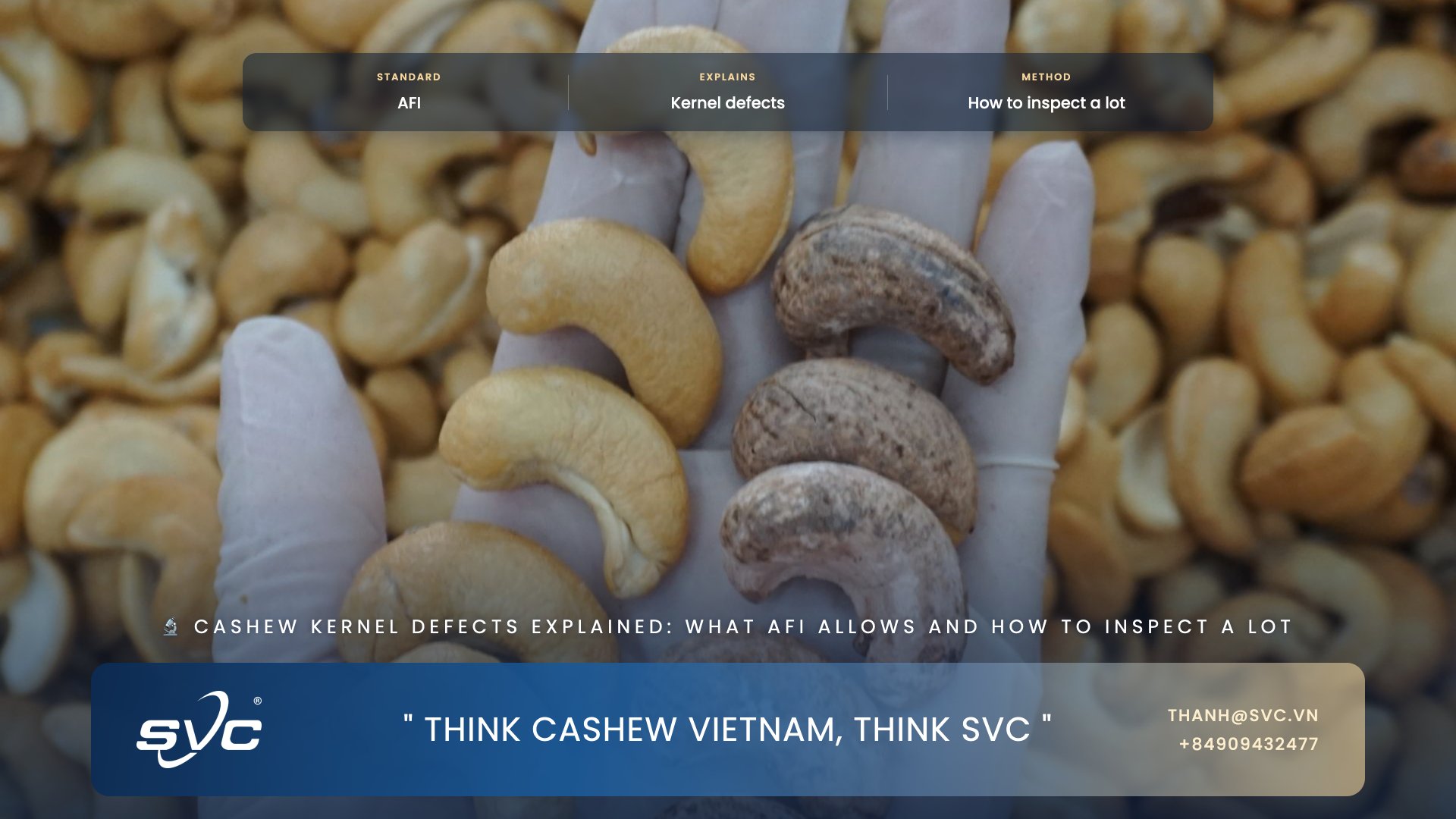
Cashew kernel defects fall into three groups: serious damage (insect damage, mould, rancidity, decay), colour and surface defects (scorching, dessert kernels, adhering skin, scrapes) and size defects (broken kernels and lower sizes). The AFI specification allows first-quality white wholes up to 1.0% serious damage, 10% broken kernels, 10% lower-size wholes and 8.0% total defects, with no live infestation at all.
What are the main types of cashew defect?

Every kernel in a carton should match the grade on the label. The AFI cashew specification (September 2023 edition) defines what a kernel of each grade should look like and how many kernels outside that description a lot may contain. Defects are measured by weight, as a percentage of the sample.
| Group | Defects | Why it matters |
|---|---|---|
| Serious damage | Insect damage, mould, rancidity, decay, adhering foreign matter | Food safety and taste |
| Colour and surface | Scorched, dessert, adhering testa (skin), superficial damage and scrapes | Appearance and grade value |
| Size | Broken kernels, pieces, lower-size wholes | Price: wholes cost more than pieces |
| Foreign matter | Harmless extraneous matter; hard or sharp objects | Safety: hard objects are not allowed at all |
Which defects count as serious damage?
- Insect damage — holes, tunnels or frass from insects, whether or not insects are present.
- Mould — visible mould growth, inside or outside the kernel.
- Rancidity — oxidised oil, giving a stale or paint-like taste; often confirmed by free fatty acid and peroxide tests.
- Decay — decomposed or soft tissue.
- Adhering matter — material stuck to the kernel that cannot be brushed off.
AFI allows first-quality kernels up to 1.0% serious damage in total, and up to 2.0% in second-quality and dessert grades. Live infestation is not allowed in any grade. The chemical side — free fatty acids of 1.5% max and peroxide value of 5 meq/kg max — is reported on the certificate of analysis; see how to read a cashew certificate of analysis.
What are scorched and dessert kernels?
Scorched kernels are discoloured by overheating during shelling or drying. AFI allows them to be yellow, light brown, light ivory, light ash-grey or deep ivory. They are sold as a separate, cheaper grade (SW) and are perfectly good to eat; in a white-wholes lot they are a defect.
Dessert kernels may be deep yellow, brown, amber or light to deep blue, and may be slightly shrivelled, immature or show dark lines or spots. They are used where appearance matters less, such as in processing.
Adhering testa is the thin brown skin left on after peeling. AFI limits skin larger than 2 mm to 3.0% in most grades. Superficial scrapes and marks are limited to 1.0% in first quality.
How are broken and lower-size kernels counted?
A whole kernel has its natural shape with no more than one-eighth broken off. Anything more is a broken kernel or a piece. In whole grades, AFI allows up to 10% broken kernels or pieces and up to 10% wholes of a lower size. Size is measured as kernels per pound — 300 to 320 for size 320, 220 to 240 for size 240.
Breakage is the defect buyers notice most, because a lot with many pieces is worth less than its label. The trade-offs between sizes are covered in WW320 vs WW240.
What does the AFI specification allow?
| Defect | First quality (white wholes) | Scorched second | Dessert & blemished |
|---|---|---|---|
| Serious damage | 1.0 | 2.0 | 2.0 |
| Harmless extraneous matter | 0.01 | 0.01 | 0.01 |
| Lower grade (second quality) | 5.0 | — | — |
| Third quality and light blemishes | 1.5 | 5.0 | — |
| Dessert kernels | 0.5 | 2.5 | — |
| Adhering testa >2 mm | 3.0 | 3.0 | — |
| Superficial damage and scrapes | 1.0 | 2.0 | — |
| Total defects | 8.0 | 11.0 | As agreed |
Source: AFI Cashew Specifications, September 2023. Dessert and blemished grades must be merchantable and no worse than the approved pre-shipment sample. Size and breakage limits apply on top of these: 10% broken kernels in wholes and 10% lower-size wholes.
How do you inspect a lot for defects?
Record the carton lot codes you sampled and photograph each pile next to a scale. If you later need to make a claim, that record is your evidence; see why some offers sit below market price for the defects that low prices often hide.
What happens when a lot fails?
AFI sets specific remedies for two problems. If live infestation is found in two or more cartons, the whole shipment is frozen at −18°C (0°F) for at least 21 days. If severe blocking — kernels stuck together in a solid mass — is found in two or more cartons, the shipment is frozen for about 21 days and then tempered in cold storage for about five days.
For other defects, the usual remedies are a price allowance, re-sorting at the seller’s cost or replacement, depending on the contract. Aflatoxin is a separate test with limits set by the destination market; see aflatoxin limits in the EU and US.
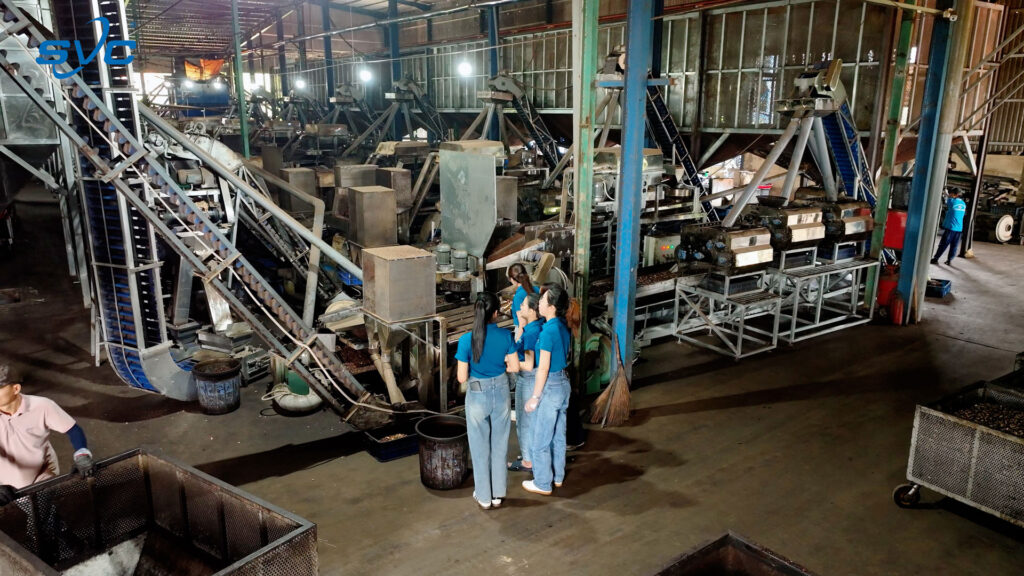
SVC grades kernels to the AFI specification, checks colour and breakage after grading and makes a final manual inspection before packing. Independent inspection by SGS or Vinacontrol can be arranged for any shipment.
Are scorched kernels unsafe?
No. Scorching is a colour change from heat during processing. Scorched kernels are sold as their own grade; they are a defect only in a white-wholes lot.
Is adhering skin a food safety issue?
No, it is a visual defect. It matters for appearance and for some applications, which is why AFI limits it.
How many cartons should I open?
Enough to represent the whole container: open cartons from several rows and lot codes, not only the ones nearest the doors.
Want a sample graded against your specification? Request a quotation →
Article tools
Continue reading