
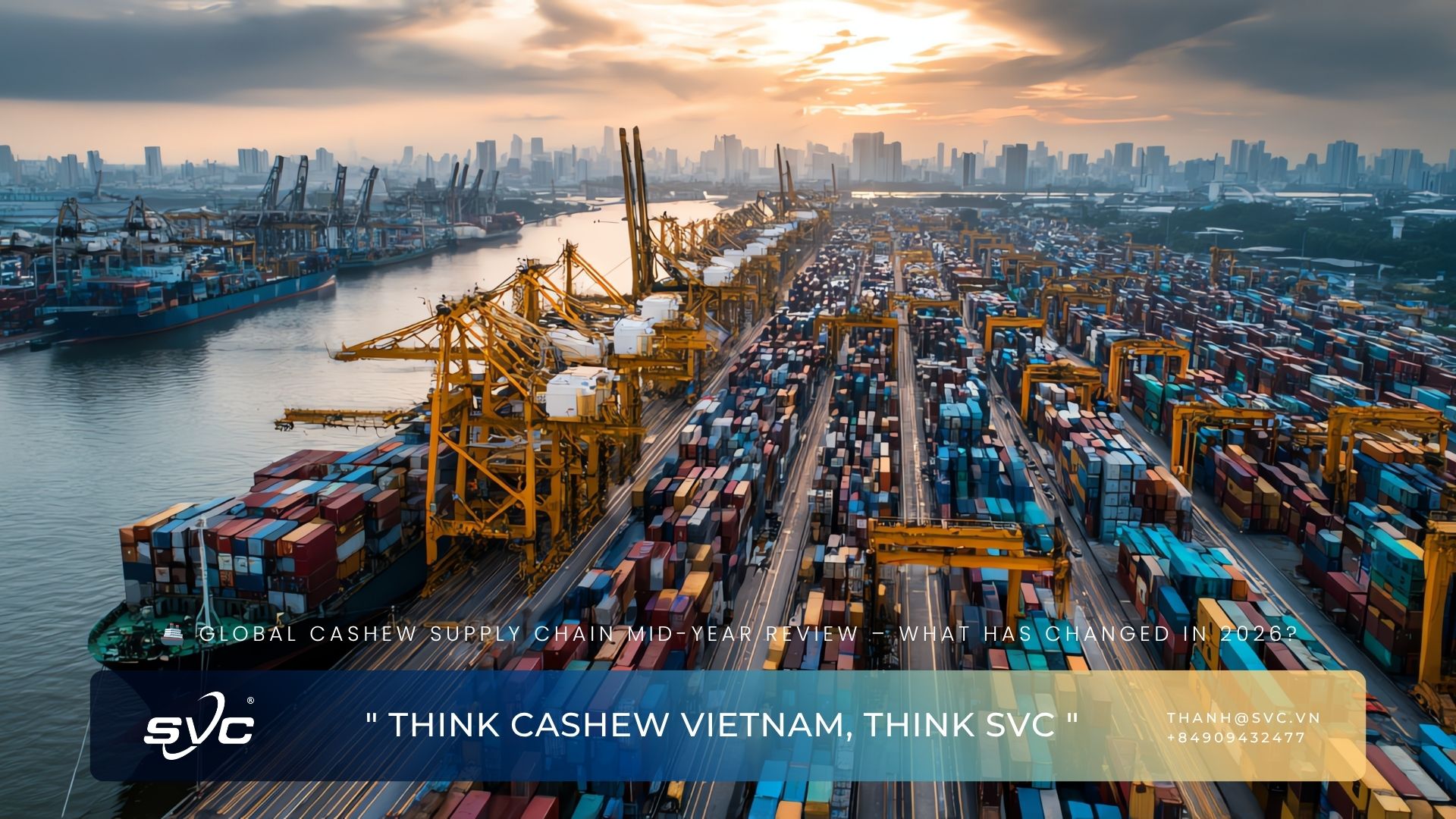
The first half of 2026 has been a period of adjustment, recalibration and transformation for the global cashew supply chain.
Unlike previous years, the biggest story has not been extreme price volatility or major disruptions. Instead, the industry has been quietly adapting to a new reality where efficiency, resilience and supply security are becoming more important than volume growth alone.
From raw cashew nut origins in Africa to processing hubs in Vietnam and final retail destinations across Europe, North America and the Middle East, nearly every segment of the supply chain has experienced meaningful change.
As the industry enters the second half of the year, understanding these shifts is essential for importers, processors, distributors and retailers planning long-term procurement strategies.
🌍 The Supply Chain Is Becoming More Strategic
Historically, the cashew supply chain was primarily focused on one objective:
Moving product efficiently from origin to market.
Today, the priorities are broader.
Supply chain decisions increasingly involve:
• Risk management
• Supply continuity
• Food safety
• Traceability
• Sustainability
• Inventory optimization
Global buyers are no longer evaluating suppliers solely on price.
They are evaluating the resilience of the entire supply chain.
This shift is changing procurement strategies across the industry.
🌰 Raw Cashew Nut Supply Remains Stable
The first half of 2026 demonstrated relatively stable raw cashew nut availability across major producing regions.
African origins continue playing a crucial role in supplying raw materials to global processors.
Key producing countries remain central to global trade flows:
• Côte d’Ivoire
• Benin
• Ghana
• Nigeria
• Tanzania
• Guinea-Bissau
Although weather conditions and harvest performance vary between regions, overall supply availability remained sufficient to support industry requirements during the first half of the year.
The market did not experience the severe raw material shortages that some participants feared entering 2026.
🏭 Processing Efficiency Has Become A Competitive Advantage
One of the most important developments in 2026 is the growing importance of processing efficiency.
As margins become tighter and buyers become more demanding, processors are increasingly focused on:
• Yield optimization
• Quality consistency
• Production planning
• Automation
• Cost control
• Food safety systems
The most competitive processors are no longer simply those with the largest capacity.
They are the companies capable of producing consistent quality while maintaining operational efficiency.
This trend is particularly evident in Vietnam, which continues to lead global processing activity.
🇻🇳 Vietnam Continues To Anchor The Global Supply Chain
No discussion of the global cashew supply chain is complete without Vietnam.
The country remains the industry’s most important processing and export hub.
During the first half of 2026, Vietnam continued strengthening its role through:
🏭 Processing Scale
Vietnam remains the world’s largest processor of cashew kernels.
📦 OEM Manufacturing
Private label and customized production programs continue expanding.
🛡️ Food Safety Compliance
International certifications remain increasingly important.
🚢 Export Infrastructure
Strong logistics networks support efficient global distribution.
As sourcing requirements become more sophisticated, Vietnam’s combination of scale, expertise and reliability remains difficult to replicate.
📦 Inventory Management Became Smarter
One of the biggest lessons from recent years has been the importance of inventory management.
During the first half of 2026, many buyers shifted toward more disciplined inventory strategies.
Instead of maintaining excessive stock levels, companies increasingly focused on:
• Demand forecasting
• Inventory optimization
• Flexible procurement
• Supply diversification
This approach reduces financial risk while maintaining supply security.
The result is a healthier and more balanced market environment.
🚢 Logistics Have Improved Significantly
Compared with previous years, logistics conditions improved considerably throughout the first half of 2026.
Positive developments included:
• Better container availability
• More predictable shipping schedules
• Improved port operations
• Enhanced supply chain visibility
• Reduced transportation uncertainty
Although freight costs remain an important consideration, logistics have become less disruptive than during previous periods.
This improvement supports more effective procurement planning and strengthens global trade efficiency.
🏷️ Private Label Is Reshaping Supply Chain Requirements
One of the most important structural changes in 2026 is the continued growth of private label programs.
Retailers increasingly demand:
• Customized packaging
• Product differentiation
• Faster product development
• Traceability
• Consistent specifications
As a result, supply chains are becoming more integrated and collaborative.
Manufacturers are expected to provide solutions rather than simply products.
This trend is redefining relationships throughout the industry.
🌱 Sustainability And Traceability Continue Gaining Importance
Sustainability is no longer a future consideration.
It is becoming an operational requirement.
Global buyers increasingly evaluate suppliers based on:
• Responsible sourcing
• Traceability systems
• Environmental practices
• Compliance standards
• Supply chain transparency
As regulations and consumer expectations continue evolving, sustainability will likely become a major competitive factor throughout the coming years.
🌍 Regional Demand Patterns Are Changing
The supply chain is also adapting to evolving demand dynamics.
🇪🇺 Europe
Demand increasingly driven by healthy snacks and private label products.
🇺🇸 North America
Focus on premium products, convenience and functional nutrition.
🌍 Middle East
Growing demand for premium retail formats and value-added products.
🌏 Asia-Pacific
Expanding middle-class consumption supports long-term growth.
This diversification strengthens the industry’s resilience and reduces dependence on any single market.
🔮 What Will Define The Second Half Of 2026?
Several themes are likely to shape supply chain developments during the remainder of the year.
Supply Security
Buyers will continue prioritizing reliable sourcing partners.
Procurement Planning
Inventory rebuilding may gradually increase purchasing activity.
Private Label Expansion
OEM manufacturing will remain a major growth driver.
Operational Efficiency
Processors will continue investing in productivity and quality improvements.
Sustainability
Compliance and traceability expectations will become increasingly important.
These factors are expected to influence strategic decision-making throughout the industry.
📊 The Biggest Change Nobody Is Talking About
The most important transformation in 2026 may not be related to production, logistics or demand.
It is the industry’s shift from transactional thinking to strategic thinking.
Supply chains are becoming less focused on individual shipments and more focused on long-term partnerships.
Importers are seeking reliability.
Retailers are seeking differentiation.
Manufacturers are seeking sustainable growth.
The companies that adapt to this new environment will be best positioned for success during the years ahead.
🌍 Conclusion
The global cashew supply chain in 2026 is more stable, more disciplined and more sophisticated than it was only a few years ago.
Raw material supply remains available.
Processing capabilities continue improving.
Logistics are functioning more efficiently.
Private label programs are reshaping demand.
Sustainability expectations are rising.
Most importantly, buyers and suppliers are increasingly focused on building resilient, long-term partnerships.
As the industry enters the second half of the year, these structural changes may prove far more important than short-term market fluctuations.
🌏 Global Supply Partnerships
Whether you are sourcing premium cashew kernels, developing a private label brand or securing long-term supply contracts, SVC supports buyers with reliable sourcing solutions, OEM manufacturing and international export expertise.
📩 thanh@svc.vn
📱 (+84) 909 432 477
🏭 Factory: Dong Nai Province, Vietnam
🏢 Representative Office: Ho Chi Minh City, Vietnam
Sources
• International Nut & Dried Fruit Council (INC)
• International Trade Centre (ITC)
• Vietnam Cashew Association (VINACAS)
• African Cashew Alliance (ACA)
• SVC Market Intelligence