📉 Price Intelligence · Supporting
📅 17 August 2026 ·
🕐 8 min read ·
📍 SVC Group, Vietnam
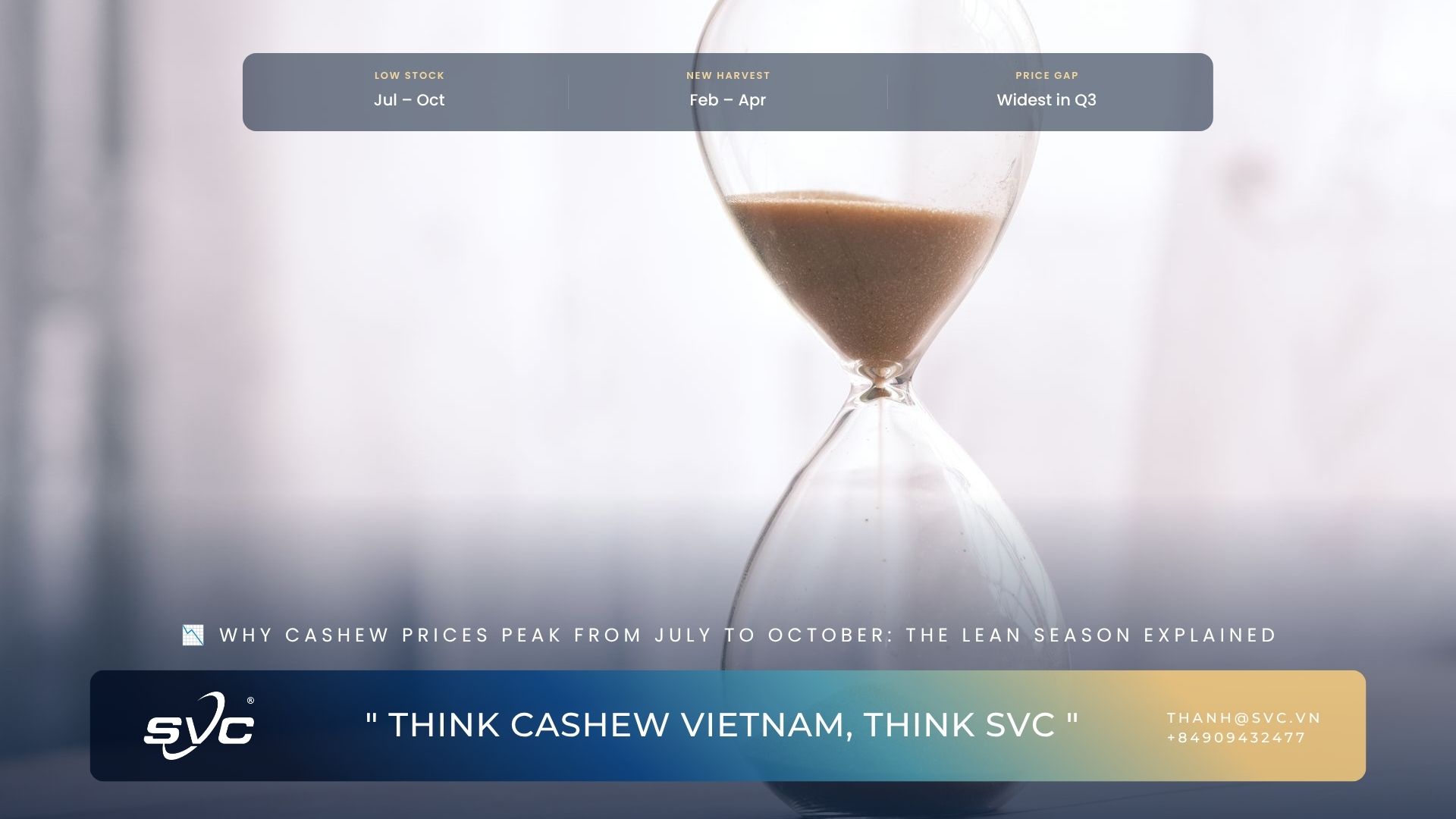
Jul–Oct
Annual lean season
Every year, predictable
Nov–Jun
Peak RCN availability
Main harvest window
Feb–Jun
Main origin harvests
CI, India, VN, Cambodia
Sep–Nov
EU peak delivery
Demand meets low supply
Cashew prices rise between July and October almost every year. Buyers who track the market notice the pattern; buyers who do not often interpret each year's increase as a supply crisis or a supplier pushing price.
It is neither. It is the lean season — a structural feature of the global cashew crop calendar that repeats annually with reasonable predictability. Understanding it turns an annual frustration into an annual planning input.
📆 The crop calendar
Why Supply Concentrates November To June
Raw cashew nut availability is driven by harvest timing across producing countries — and those harvests are not evenly distributed through the year.
| Origin | Harvest window | Role in global supply |
|---|
| Côte d'Ivoire | February – June | Largest RCN producer globally; sets the tone for the main season |
| Cambodia | February – June | Vietnam's most reliable origin; concentrated in the same window |
| India | February – June | Second-largest producer; largely consumed by domestic processing |
| Vietnam (domestic) | February – June | ~10% of Vietnam's processing needs; same seasonal window |
| Ghana, Benin, Nigeria | February – June | West African supply, same concentration |
| Tanzania | September – January | Counter-seasonal — one of the few origins supplying the lean period |
| Indonesia, Brazil | September – February | Also counter-seasonal, but smaller volumes |
The pattern is clear: the majority of global RCN volume harvests within the same February–June window. Tanzania, Indonesia and Brazil provide counter-seasonal supply, but not at sufficient scale to offset the concentration.
Global RCN supply is concentrated between November and June. July to October is the lean period, when limited harvest activity coincides with processors drawing down stored inventory rather than receiving fresh arrivals.
Why Prices Peak Exactly When Supply Is Lowest
The lean season alone would create modest upward pressure. What makes July–October the reliable annual price peak is that it coincides with rising demand.
📉
Supply Side: Inventory Drawdown
Processors are working through stored RCN rather than fresh arrivals. Input flexibility narrows, and processors become less willing to discount finished kernel to win volume
📈
Demand Side: Q4 Forward Buying
European peak deliveries run September to November for Christmas retail. Buyers covering that window are booking during exactly the tightest supply period of the year
🎉
Festival Demand Layering
Indian festival season, Middle East seasonal demand, and Chinese year-end consumption all build through Q3 and Q4, adding demand precisely as supply availability is at its annual minimum
📦
Capacity Competition
Production slots become the constraint, not just raw material. Buyers who book late compete for whatever capacity remains — and pay accordingly
🎯 Planning around it
How Experienced Buyers Use The Cycle
Book Q4 coverage in Q2, not Q3: The April–June window sits within peak harvest availability. Contracts negotiated then are consistently better positioned than those negotiated in August or September
Split volume across the year: Rather than a single large annual purchase, splitting into two or three contracts timed around harvest availability smooths average cost
Build lean-season pricing into annual budgets: Treating July–October pricing as an anomaly leads to reactive decisions. Treating it as expected leads to better planning
Watch counter-seasonal origins: Tanzania's September–January harvest is one of the few supply inputs during the lean window — its crop outlook is a useful signal for how tight the period will be
Secure capacity, not just price: During the lean season, production slot availability can matter more than the per-kilogram number. Confirm delivery windows explicitly
💬 CEO Perspective
💬 CEO Perspective
The lean season catches out the same buyers every year, and it does not have to. It is the most predictable feature of this industry — the crop calendar has not changed. Buyers who plan around it get better terms not because they negotiate harder, but because they negotiate earlier.
— 𝐂𝐄𝐎, 𝐒𝐕𝐂 𝐈𝐧𝐭𝐞𝐫𝐧𝐚𝐭𝐢𝐨𝐧𝐚𝐥 𝐉𝐒𝐂
🏭
About SVC Group
BRC · SMETA · Halal · Kosher · HACCP · FSPCA · 700+ MT/month · 72+ countries · Dong Nai Province, Vietnam
Read next
Vietnam Cashew Authority · Hub