
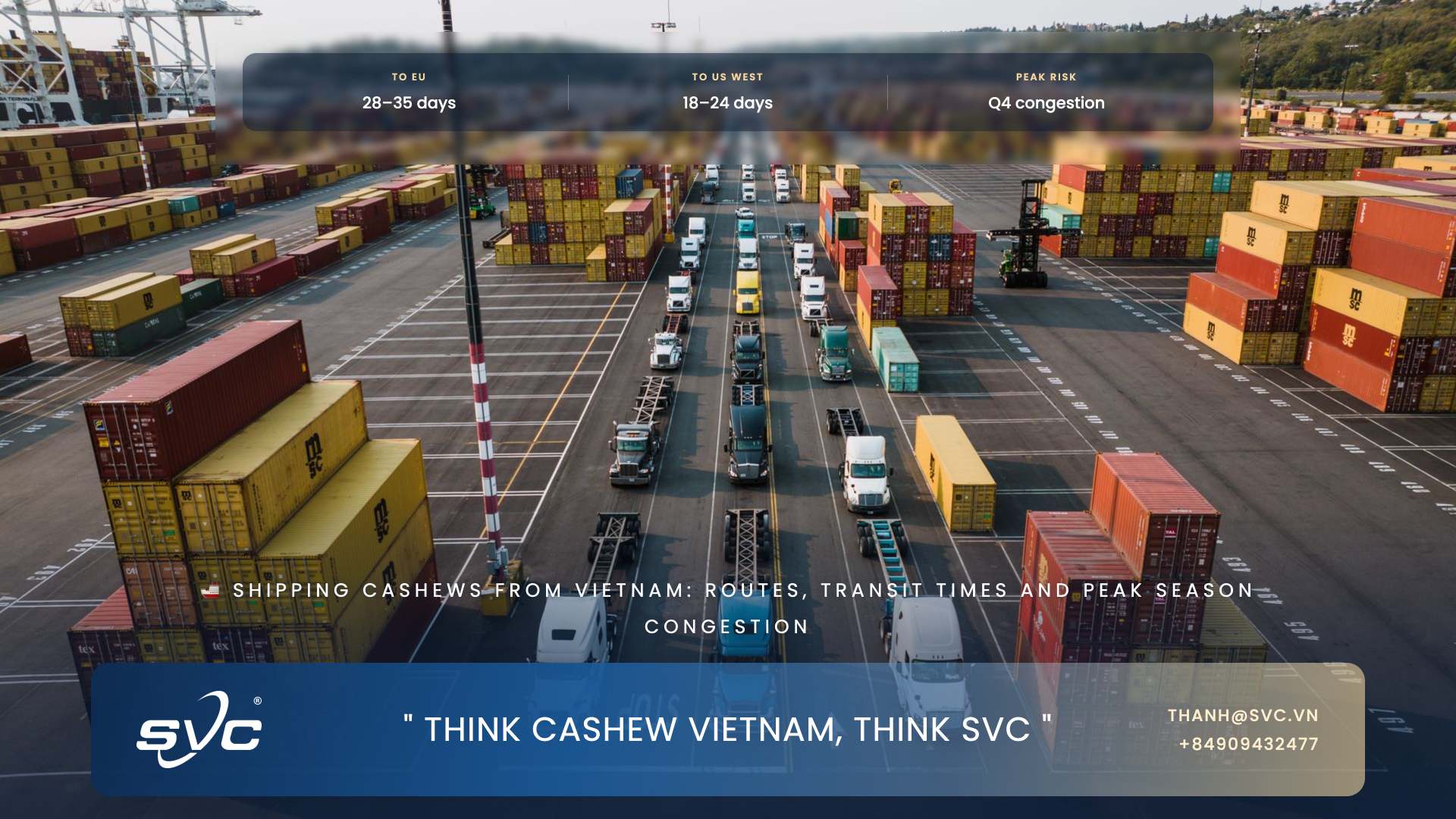
Two buyers can order the identical product, on the identical week, and receive their containers eleven days apart — because one ships to a destination reachable in a direct line across the Indian Ocean, and the other ships to a destination that currently requires routing around Africa rather than through the Suez Canal.
Transit time is not a fixed number attached to a trade lane. It is a function of route, routing decisions currently in effect, and the season. This article covers the realistic transit times from Vietnam to major cashew destination markets, what is currently affecting those times, and what September specifically means for congestion.
🚢 By destinationRealistic Transit Times From Ho Chi Minh City
| Destination | Typical transit | Route notes |
|---|---|---|
| China (Shanghai, Shenzhen) | 3–6 days | Short intra-Asia routing, frequent direct sailings |
| Middle East (Jebel Ali, Jeddah) | 18–22 days | Fastest of SVC's major long-haul lanes — direct across the Indian Ocean |
| North Europe (Rotterdam, Hamburg) | ~28 days | Historically via Suez Canal; currently affected by Cape of Good Hope rerouting on many services |
| Mediterranean Europe | 24–27 days | Somewhat shorter than North Europe under normal Suez routing; more exposed to rerouting delay when in effect |
| US West Coast (LA / Long Beach) | 18–22 days | Transpacific direct or via intra-Asia transhipment hub |
| US East Coast (NY / NJ, Savannah) | 30–35 days | Via Suez/Mediterranean or Panama Canal, depending on service — the longest standard lane in SVC's network |
These figures are port-to-port ocean transit only. Add pre-carriage from factory to port, vessel loading windows, and destination customs clearance time on top — the total door-to-door timeline is meaningfully longer than the transit figure alone.
Why Europe-Bound Transit Has Been Running Longer Than The Historical Norm
For several years, security conditions in the Red Sea corridor have led many major carriers to route Europe-bound vessels around the Cape of Good Hope rather than through the Suez Canal — the historically standard route for Asia-Europe trade. This adds roughly ten to fourteen days to affected sailings.
Whether a specific service uses Suez or Cape routing varies by carrier and by week, and has continued to evolve. Buyers planning Europe-bound shipments should confirm current routing with their forwarder at time of booking rather than assuming the shorter, historical Suez transit time — the gap between the two routings is large enough to materially affect a Q4 delivery deadline.
📦 Peak seasonWhat September Specifically Means For Congestion
September sits inside the annual peak shipping period — the point where European and North American retailers are moving volume for Christmas-season stocking, and where global container demand across all commodities, not just cashew, is running at its yearly high.
The realistic implication for September and October bookings: confirm vessel space early, expect longer total transit than the base ocean transit figure suggests, and build the peak season surcharge into landed cost calculations rather than treating it as a variable to be discovered later.
What To Confirm At Booking, Not After
Read next