

A tapioca starch specification sets the purity, physical, chemical and microbiological limits a lot must meet, each with a test method. For food-grade native starch, the core numbers are starch content, moisture, whiteness, viscosity, pH, fineness, ash, pulp and SO2, plus microbiology and heavy metals. SVC’s food-grade native tapioca starch is specified at 85% min starch, 13% max moisture, 92% min whiteness, 700 BU min viscosity, pH 5.0–7.0 and 98% min through 100 mesh.
What does a tapioca starch specification cover?
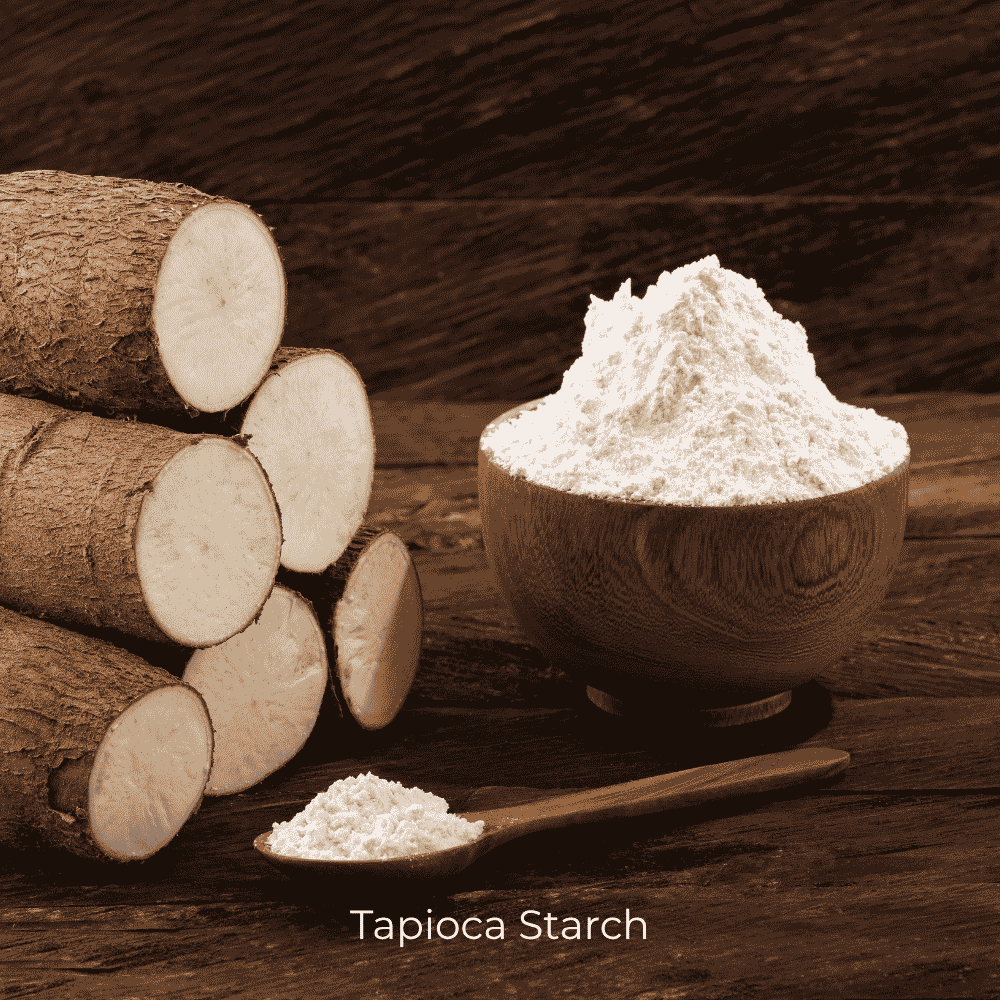
A full specification answers four questions about a lot:
- Purity — how much of it is starch, and how much is ash, fibre or sand.
- Physical properties — moisture, colour, particle size and paste viscosity.
- Chemical limits — pH, sulphur dioxide, heavy metals and, for some markets, hydrocyanic acid.
- Microbiology — total counts and pathogens.
Each figure should come with a test method. A whiteness or viscosity number measured one way cannot be compared with one measured another way, and a contract that names the method leaves nothing to argue about. The figures below are SVC’s specification for food-grade native tapioca starch. Modified starches are made for specific functions and come with their own specifications, usually with additional parameters for the modification itself.
Starch content, ash and pulp: how pure is the starch?
| Parameter | Method | Limit | What it tells you |
|---|---|---|---|
| Starch | AOAC 945.37 | 85.00% min | The share of the product that is starch |
| Ash | AOAC 923.03 | 0.20% max | Mineral residue, for example from soil |
| Pulp | 3B14-H/TT2 | 0.20% max | Fibre left from the root |
| Sand & silica | AOAC 941.12 | Nil | Gritty contamination |
Starch content and moisture work together: in a lot at the 13% moisture limit, most of the remaining dry matter is starch. Ash and pulp show how well the root was washed and the starch separated; high values can give a grey tone or specks in a white product.
Why does moisture matter so much?
Moisture is water you pay for. SVC’s limit is 13.00% max, tested by AOAC 925.10. It also affects how the starch keeps: damp starch can cake in the bag and is more exposed to mould.
Worked example: an 18 MT container at 13% moisture holds about 15.66 MT of dry matter; at 12% it would hold 15.84 MT — 180 kg more starch for the same price. That is why moisture is written as a maximum, and why buyers check it on arrival.
Store bags cool, dry and off the floor. SVC quotes a shelf life of 24 months from production under those conditions.
What do whiteness and fineness tell you?
Whiteness — 92.00% min on a whiteness meter — matters wherever the starch shows: rice paper, glass noodles, white sauces and bakery. It is read against a white reference, so ask which instrument and reference the mill uses.
Fineness — 98% min through 100 mesh on ASTM sieves — describes particle size. A 100-mesh sieve has openings of about 150 micrometres; a fine, even powder disperses more easily and gives a smoother paste.
What does a viscosity figure in BU mean?
Viscosity shows how thick a starch paste becomes when heated in water. SVC specifies 700 BU min on a Brabender viscometer, where BU stands for Brabender units. A higher figure means a thicker paste — important for thickening, noodles and binding.
Brabender results depend on the test conditions, especially the starch concentration and the heating profile. Ask any supplier for those conditions alongside the figure, and use the same method in your own laboratory; otherwise a “700 BU” from two suppliers may not mean the same paste.
Which chemical limits matter for your market?
| Parameter | Method | Limit |
|---|---|---|
| pH | AOAC 943.02 | 5.00–7.00 |
| SO2 | AOAC 990.28 | 10 ppm max |
| Odour | Physical method | Nil |
| Arsenic | AOAC 2013.06 | 1 mg/kg max |
| Cadmium | AOAC 2013.06 | 0.1 mg/kg max |
| Lead | AOAC 2013.06 | 0.2 mg/kg max |
| Mercury | AOAC 2013.06 | 0.1 mg/kg max |
Sulphur dioxide. In the EU, sulphites must be declared as an allergen on the label when they exceed 10 mg/kg, expressed as total SO2. A 10 ppm maximum keeps the starch at that threshold.
Hydrocyanic acid. Cassava contains compounds that release hydrocyanic acid. The EU limit for cassava flour and tapioca flour is 10 mg/kg, under Regulation (EU) 2022/1364, now part of Regulation (EU) 2023/915. HCN is not on SVC’s standard specification; for EU-bound lots, add it to the contract and ask for a result on the certificate of analysis.
Which microbiological limits apply?
| Parameter | Method | Limit |
|---|---|---|
| Total plate count | ISO 4833-1:2013 | 10,000 CFU/g max |
| Yeast & mould | ISO 21527-2:2008 | 200 CFU/g max |
| Coliforms | ISO 4832:2006 | Not detected / 0.1 g |
| E. coli | ISO 16649-2:2001 | Not detected / 0.1 g |
| Salmonella | ISO 6579-1:2017 | Not detected / 25 g |
These limits matter most where the starch is not heated further before eating, or where it goes into products with a long shelf life. If your product needs tighter limits — for example infant or medical food — agree them before the order, not on arrival.
What does a complete specification look like?
| Parameter | Method | Specification |
|---|---|---|
| Appearance | Visual | White powder |
| Starch | AOAC 945.37 | 85.00% min |
| Moisture | AOAC 925.10 | 13.00% max |
| Whiteness | Whiteness meter | 92.00% min |
| pH | AOAC 943.02 | 5.00–7.00 |
| Odour | Physical method | Nil |
| Fineness (through 100 mesh) | ASTM sieves | 98% min |
| Viscosity | Brabender viscometer | 700 BU min |
| Ash | AOAC 923.03 | 0.20% max |
| Pulp | 3B14-H/TT2 | 0.20% max |
| SO2 | AOAC 990.28 | 10 ppm max |
| Sand & silica | AOAC 941.12 | Nil |
| Total plate count | ISO 4833-1:2013 | 10,000 CFU/g max |
| Yeast & mould | ISO 21527-2:2008 | 200 CFU/g max |
| Coliforms | ISO 4832:2006 | Not detected / 0.1 g |
| E. coli | ISO 16649-2:2001 | Not detected / 0.1 g |
| Salmonella | ISO 6579-1:2017 | Not detected / 25 g |
| Arsenic | AOAC 2013.06 | 1 mg/kg max |
| Cadmium | AOAC 2013.06 | 0.1 mg/kg max |
| Lead | AOAC 2013.06 | 0.2 mg/kg max |
| Mercury | AOAC 2013.06 | 0.1 mg/kg max |
How do you write the specification into a contract?
- List every parameter with its limit and its test method, including the Brabender test conditions.
- Add market-specific limits, such as HCN for the EU.
- State how the lot is sampled and which laboratory’s result decides a dispute.
- Require a certificate of analysis for every lot, with the lot number and production date.
- Keep a retained sample from each lot until the starch is used.
- Name the packing, net weight per bag and the number of bags.
Our guide to importing tapioca starch from Vietnam covers the rest of the contract — packing, container loads, terms and documents.
Every figure in our tapioca starch specification comes with its test method. If your process needs a tighter limit or an extra test, tell us before the order and we will confirm whether the mill can meet it.
Need the full specification or a sample? Request a quotation →
Article tools
Continue reading