🌱 Market Intelligence · Quarterly Anchor
📅 30 September 2026 ·
🕐 9 min read ·
📍 SVC Group, Vietnam
Oct–Dec
Early signal window
Flowering, rainfall data
Feb
2027 harvest begins
Main origins
Nov–Dec
First crop assessments
Industry body reports
3
Origins to watch first
Côte d'Ivoire, Cambodia, Vietnam
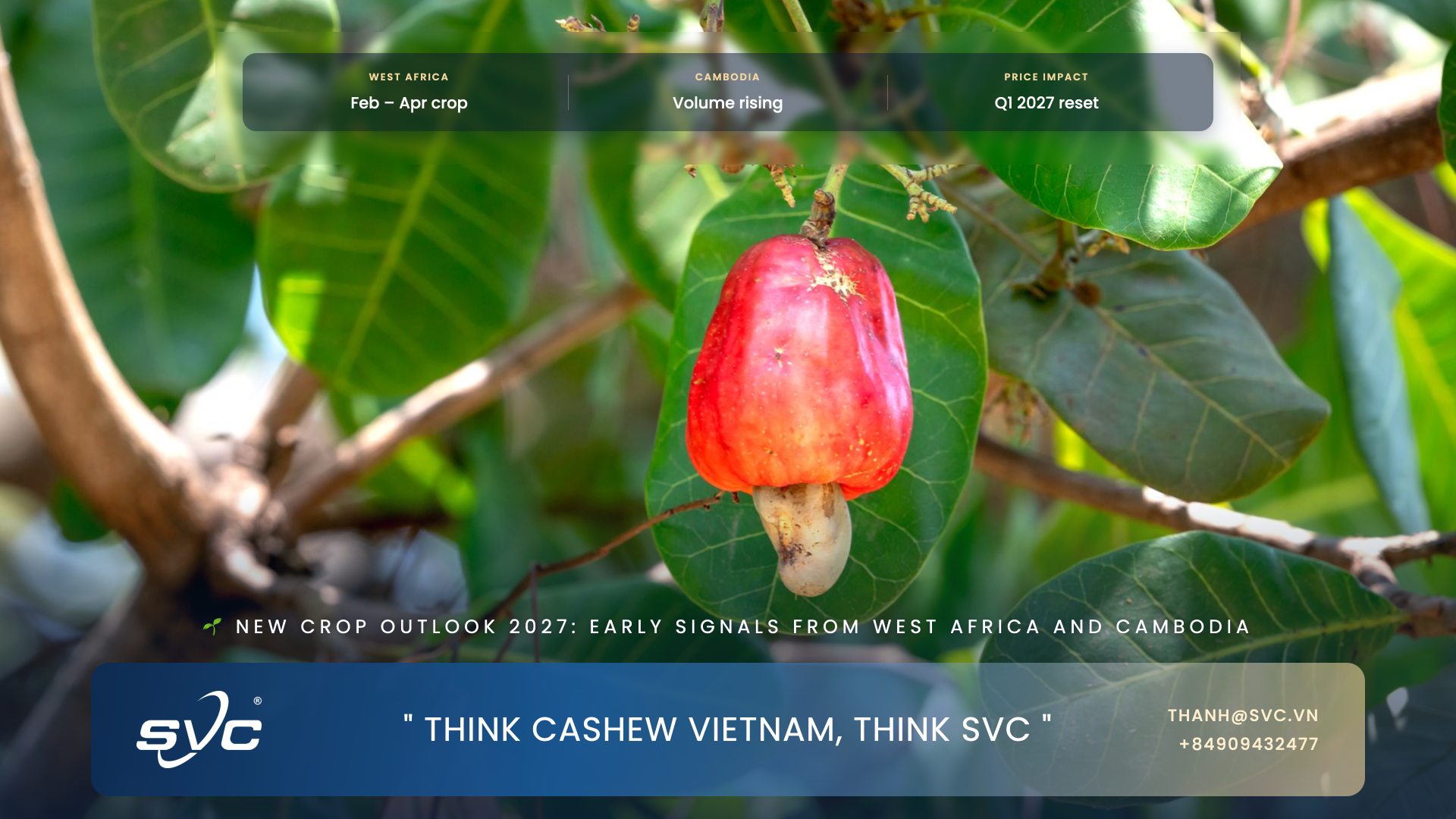
The 2027 cashew crop has not been harvested. It has, at the point this is published, barely finished flowering in most origins. But the earliest read on next year's supply picture does not wait for the harvest itself — it starts with conditions that are visible now, in October, November and December.
This article sets out the framework SVC uses to read early crop signals, what specifically to watch for over the next three months, and the structural context — carried over from 2026 — that will shape how any given harvest outcome actually plays out in pricing.
This is a framework for reading the signals as they emerge, not a yield forecast. Specific 2027 volume estimates firm up only as flowering and early pod development data comes in through the season — buyers should treat any early figure, from any source, as directional rather than final.
What Actually Predicts A Harvest Three Months Out
Cashew trees flower ahead of the main harvest, and flowering quality is the first meaningful indicator of what the eventual crop will look like. Three factors observed during this window carry the most predictive weight:
🌼
Flowering Timing And Density
Early, dense flowering across a growing region is a positive early signal. Delayed or sparse flowering — often linked to irregular rainfall in the preceding months — tends to translate into a smaller or later harvest
🌧️
Rainfall Pattern Through The Dry Season Onset
Cashew flowering and early pod-set are sensitive to rainfall timing. Unseasonal rain during flowering can damage blossom and reduce fruit set; drought stress at the wrong moment does the same from the opposite direction
📈
Pod Set Reports From The Field
As flowering converts to early fruit, field reports on pod set density — typically emerging from November into December — give the first genuinely volume-indicative read, ahead of any formal harvest estimate
🔍 Origins to watch
Where The Earliest Reliable Signals Come From
Not all origins report at the same pace or with the same reliability. For Vietnam-based buyers, three origins matter most for early positioning:
Côte d'Ivoire
The largest single RCN producer globally, and the origin whose crop outlook moves the broader African supply picture most
Industry body assessments (typically published by regional cashew trade associations) tend to emerge from November, giving the earliest formal indication among the major African origins
Cambodia
Vietnam's most structurally reliable RCN origin, and the one where SVC and other Vietnamese processors have the most direct field visibility through established sourcing relationships
Early flowering reports from Cambodian growing regions are typically the fastest to reach Vietnamese processors directly, ahead of formal published assessments
Vietnam domestic (Binh Phuoc)
Only around 10% of processing input, but the most directly observable origin for Vietnam-based processors — and often an early read on regional weather conditions shared with parts of the Cambodian growing area
📊 What carries over from 2026
The Structural Context Any 2027 Harvest Will Land Into
Whatever the 2027 harvest turns out to be, it will be priced against a market shaped by conditions that were already structural through 2026, not new to next year:
African RCN protectionism is a multi-year policy shift, not a one-season event. Export restrictions and rising tariffs aimed at capturing more processing value domestically, covered in depth in our Vietnam industry analysis, are structural and should be expected to persist into the 2027 season regardless of crop size
The premium-ingredient grade divergence seen through 2026 may or may not reset with new supply. Whether the WW240–WW320 spread and the broken-grade tightening observed in Q3 reflect a temporary supply condition or a genuine demand-side shift will become clearer as new-crop material starts moving through processing from February
RCN cost pressure has been structural, not cyclical, through 2025 and 2026. A strong 2027 harvest would ease this pressure at the margin; it is unlikely to reverse the underlying cost structure processors have been operating under for two consecutive years
A good 2027 harvest and continued structural tightness are not contradictory outcomes. Buyers should watch crop signals for volume, and watch the structural factors above for what that volume actually means for price.
Our Own Monitoring Through Q4
Direct field reports from established Cambodian and domestic growing relationships as flowering data emerges through October and November
Published industry body assessments for Côte d'Ivoire and broader West African conditions as they become available from November
Whether the whole-kernel price equilibrium observed through Q3 2026 holds, narrows, or breaks as Q4 peak demand plays out — a signal in its own right for how tight current-season supply actually is heading into the new crop
SVC will publish an updated crop outlook as meaningful field data comes in through Q4, ahead of the 2027 harvest itself beginning in February. Buyers planning Q1 2027 programs, as covered in our planning guide, should treat this as a living picture rather than a single fixed forecast.
💬 CEO Perspective
💬 CEO Perspective
We are cautious about putting a confident number on a crop that has not been grown yet. What we can do honestly is tell buyers what we are watching, and why, so they can read the same signals as they emerge rather than waiting for a single forecast handed down in February. That is a more useful way to plan than pretending we know today what October's rainfall has not yet told anyone.
— 𝐂𝐄𝐎, 𝐒𝐕𝐂 𝐈𝐧𝐭𝐞𝐫𝐧𝐚𝐭𝐢𝐨𝐧𝐚𝐥 𝐉𝐒𝐂
🌱
Planning Around The 2027 Harvest?
SVC shares field-level sourcing updates directly with buyers planning Q1 2027 programs. Get in touch to be included as new signals come in through Q4.
Read next
OEM & Private Label · Conversion
Vietnam Cashew Authority · Hub