
Native vs modified tapioca starch: native starch is extracted from cassava by washing, grinding, separating and drying, with no chemical treatment; modified starch has been treated further — chemically, physically or with enzymes — to change how it behaves under heat, acid, shear or freezing. In the EU, chemically modified starches are food additives numbered E 1404 to E 1452. Native starch is the simpler, cheaper ingredient and suits many foods; modified starch is chosen when a process is too demanding for it. SVC supplies both: food-grade native starch and five modified tapioca starches, plus RS4 resistant starch.
What is native tapioca starch?
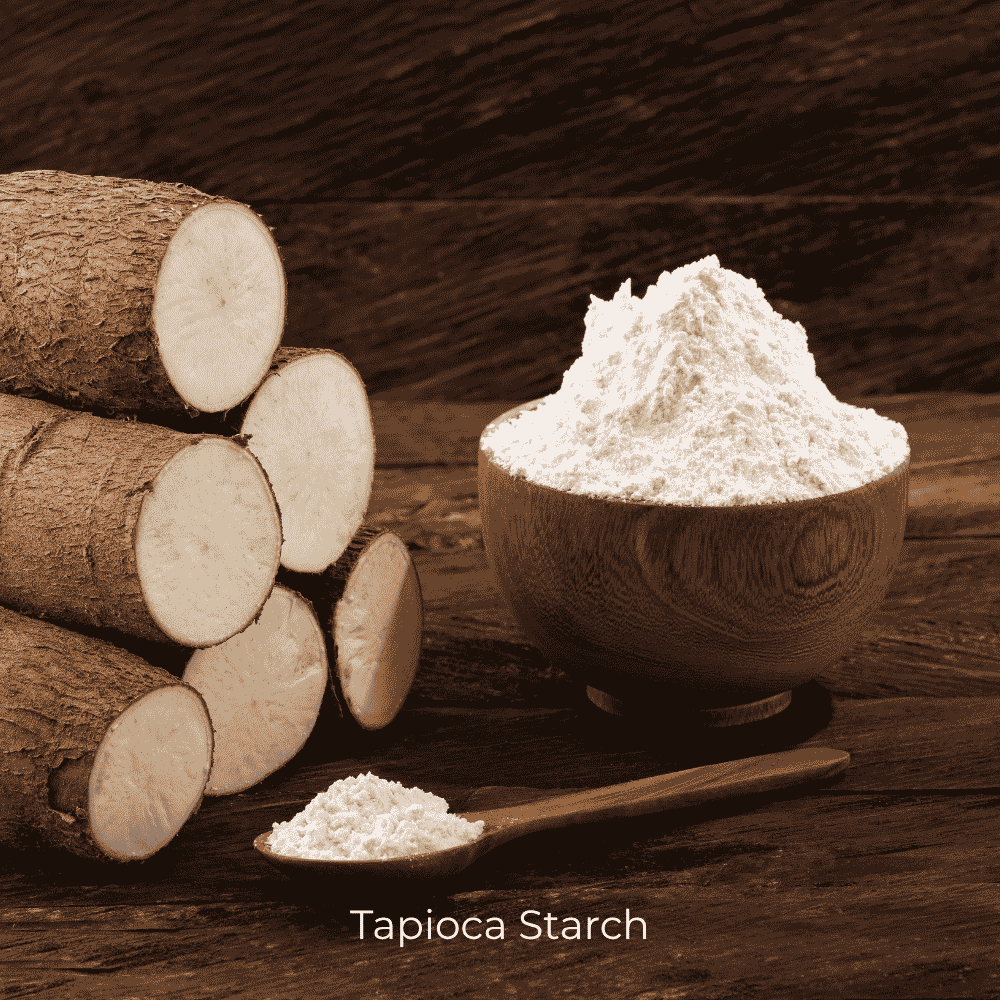
Native tapioca starch is the starch of the cassava root, separated from fibre and water and dried. At the mill that produces SVC’s starch, the process is mechanical and water-based: fresh roots are washed, chopped and ground, the starch is separated and centrifuged, then dried, sieved and packed. Nothing is added to change the starch itself.
The result is a fine white powder with a neutral taste. SVC’s food-grade native starch is specified at 85% min starch, 13% max moisture, 92% min whiteness and 700 BU min viscosity; it forms a clear, viscous paste, which is why it is widely used in noodles, rice paper, snacks and sauces. The full figures are in our tapioca starch specification guide.
What is modified tapioca starch?
Modified starch is native starch that has been treated to change its properties. EU law describes chemically modified starches as “substances obtained by one or more chemical treatments of edible starches”; the most common treatments are oxidation, esterification and etherification, often combined with cross-linking. The EU lists 12 of them as food additives:
| E-number | Name | Type of treatment |
|---|---|---|
| E 1404 | Oxidised starch | Oxidation |
| E 1410 | Monostarch phosphate | Esterification (phosphate) |
| E 1412 | Distarch phosphate | Cross-linking |
| E 1413 | Phosphated distarch phosphate | Cross-linking and esterification |
| E 1414 | Acetylated distarch phosphate | Cross-linking and acetylation |
| E 1420 | Acetylated starch | Esterification (acetylation) |
| E 1422 | Acetylated distarch adipate | Cross-linking and acetylation |
| E 1440 | Hydroxypropyl starch | Etherification |
| E 1442 | Hydroxypropyl distarch phosphate | Etherification and cross-linking |
| E 1450 | Starch sodium octenyl succinate | Esterification |
| E 1451 | Acetylated oxidised starch | Oxidation and acetylation |
| E 1452 | Starch aluminium octenyl succinate | Esterification |
Modification adds steps at the mill. For SVC’s starches, native starch is produced by washing, chopping, grinding, separating, centrifuging, drying, sieving and packing; modified starch goes through the same line with a reaction step after the first separation, then is separated again before centrifuging and drying.
Starch can also be modified physically — for example pre-cooked and dried so it thickens in cold water — or with enzymes. The EU does not treat physically modified starch and starch treated by amylolytic enzymes as food additives.
Why do manufacturers modify starch?
Native starch thickens and binds well, but a demanding process can push it beyond what it handles. Modification is used to make a starch paste:
- Hold up under long cooking or high shear — as in retorted sauces or pumped fillings.
- Stay stable in acid — as in fruit fillings or dressings.
- Survive freezing and thawing — without weeping water in frozen meals.
- Thicken without cooking — in instant mixes, using pre-cooked starch.
- Emulsify or encapsulate — as octenyl succinate starches do in beverages and flavours.
Each of these adds a processing step, so modified starch usually costs more than native starch from the same root.
How do native and modified tapioca starch compare?
| Native tapioca starch | Modified tapioca starch | |
|---|---|---|
| How it is made | Mechanical, water-based extraction; no chemical treatment | Native starch treated chemically, physically or with enzymes |
| EU status | Food ingredient | Chemically modified types are additives E 1404–E 1452 |
| EU label wording | “Starch” | “Modified starch” for chemically modified types |
| Strengths | Clear paste, neutral taste, good thickening and binding | Tolerance of heat, shear, acid, freezing; cold-water swelling; emulsifying |
| Typical uses | Noodles, rice paper, snacks, bakery, sauces, meat binders | Retorted and frozen foods, acidic fillings, instant mixes, emulsions |
| Cost | Lower — no extra processing step | Higher — extra processing and quality control |
How are they labelled in the EU?
Under the EU food information rules, Regulation (EU) No 1169/2011, native starch — and starch modified only by physical means or enzymes — can be declared simply as “starch”. Chemically modified starches can be declared under the category name “modified starch”. Where the starch may contain gluten, its specific plant origin must be stated; tapioca is naturally gluten-free.
This is why some brands look for native or physically modified starch: the ingredient list reads “tapioca starch” rather than “modified starch”.
Which modified tapioca starches does SVC supply?
Alongside native starch, SVC supplies five chemically modified tapioca starches and one resistant starch, all food grade, from the same partner mill and in the same bag sizes — 25 kg PP/PE or kraft paper, 50 kg PP/PE with liner, or 850 kg jumbo bags:
| Code | Starch | What it does | Typical uses |
|---|---|---|---|
| E 1404 | Oxidised starch | Film-forming; glossy, smooth, high-clarity gels with good adhesion | Paper industry and food |
| E 1412 | Distarch phosphate | Stabilises, thickens and gels; improves hydration and process resistance | Foods that must resist breakage and cooking loss, such as noodles |
| E 1414 | Acetylated distarch phosphate | Thickens, stabilises and texturises; process resistance and freeze-thaw stability; reduces syneresis | Frozen foods, sauces, creamy textures |
| E 1420 | Acetylated starch | Better stability, texture and moisture retention; lower gelling point, improved transparency, higher viscosity | A wide range of foods |
| E 1422 | Acetylated distarch adipate | Process resistance and moisture retention; soft, creamy texture | Dairy products, meat products, sauces |
| RS4 | Resistant starch | Heat-stable dietary fibre; gluten-free | Low-calorie and prebiotic foods; fibre enrichment |
RS4 is used for a different purpose from the others: rather than thickening, it adds dietary fibre that survives heating. Each modified starch is quoted against its own specification; tell us your application and we will send the matching one.
Which one does your product need?
| Application | Native usually works when… | Consider modified when… |
|---|---|---|
| Noodles, vermicelli, rice paper | Standard cooking and drying | Special texture targets or long shelf life after cooking |
| Snacks, crackers, extruded products | Normal frying, baking or extrusion | Specific expansion or crispness targets |
| Bakery and gluten-free blends | Baked and eaten fresh | Long shelf life or frozen dough |
| Sauces, soups, gravies | Cooked and served, or chilled briefly | Retorted, acidic, or frozen and thawed |
| Meat products | Binding in cooked products | Freeze-thaw stability or brine injection |
| Paper, textile, adhesives | Simple sizing and binders | Process-specific performance demands |
If your current recipe uses modified starch, a native starch will not always be a drop-in replacement — but for many cooked, fresh or chilled foods it is enough, at a lower cost and with simpler labelling. Where it is not, match the modified starch to the problem: freeze-thaw and syneresis point to acetylated distarch phosphate (E 1414); breakage and cooking loss to distarch phosphate (E 1412); clarity and film-forming to oxidised starch (E 1404).
How do you test a switch to native starch?
SVC supplies native and modified tapioca starch in 25 kg, 50 kg and 850 kg bags. See the SVC tapioca starch page for the native starch profile, or our guide to importing tapioca starch from Vietnam for packing, container loads and documents.
Because we supply both native and modified tapioca starch, we have no reason to push one over the other. Tell us the application and the harshest step in your process, and we will suggest which starch to trial first.
Want to trial native or modified tapioca starch? Request a quotation →
Article tools
Continue reading