
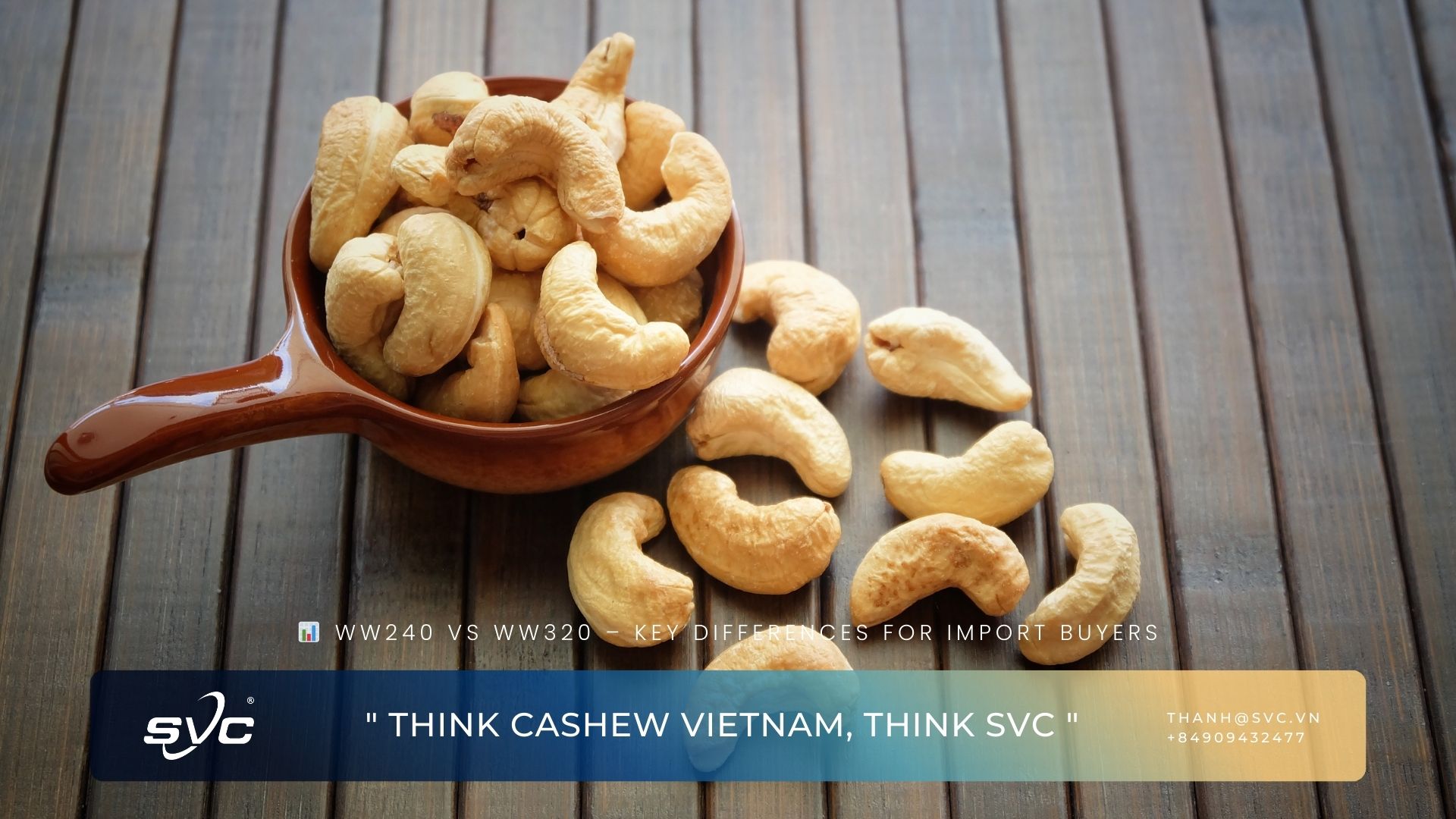
In the global cashew trade, kernel grading is one of the most important factors influencing pricing, product positioning, and buyer purchasing decisions. Among the many grades exported from Vietnam, WW240 and WW320 remain two of the most widely traded cashew kernel grades in international markets.
For importers and food manufacturers, understanding the difference between WW240 vs WW320 is essential when evaluating supplier offers, planning retail packaging, or calculating cost structures for processed food products.
Both grades belong to the White Whole (WW) category, meaning the kernels remain intact after shelling and maintain a light color suitable for export standards. However, they differ in kernel size, pricing, and typical commercial applications.
Understanding these differences allows global buyers to select the most suitable grade for their target markets and product positioning strategies.
🌍 Understanding the Cashew Grading System
Cashew kernels are graded according to size, color, and integrity. The grading system used by the international cashew industry ensures consistency across exporting countries such as Vietnam, India, and Ivory Coast.
The WW classification stands for White Whole kernels, indicating that the cashew remains whole and maintains a light cream color after processing.
The number attached to each grade represents the approximate number of kernels per pound.
Typical classification includes:
• WW240: approximately 220–240 kernels per pound
• WW320: approximately 300–320 kernels per pound
Because fewer kernels fit into one pound for WW240, WW240 kernels are naturally larger than WW320 kernels.
This difference directly influences visual appearance, product positioning, and export pricing.
📦 Key Size Differences Between WW240 vs WW320
The most noticeable difference between WW240 vs WW320 is the kernel size.
WW240 cashews are larger and often considered more premium in visual appearance, making them attractive for retail packaging and high-end snack products.
Key characteristics of WW240:
• Larger kernel size
• Premium appearance
• Often used in retail snack packaging and gift products
Meanwhile, WW320 kernels are slightly smaller but significantly more versatile in large-scale food production.
Key characteristics of WW320:
• Medium kernel size
• Highly efficient for bulk food manufacturing
• Most widely traded cashew grade globally
Because of this balance between size and affordability, WW320 is considered the global benchmark grade in the cashew industry.
💰 Price Differences Between WW240 and WW320
The price difference between WW240 vs WW320 is primarily driven by kernel size and production yield.
Larger kernels are naturally less abundant, which increases their market value.
Recent export indications from Vietnam show approximate FOB pricing levels of:
• WW240: around 7.50 USD/kg
• WW320: around 6.85 USD/kg
Although the difference may appear moderate, it significantly impacts procurement strategies for large-volume buyers.
Importers looking for the latest market updates can refer to the official SVC cashew price update page:
🏭 Applications Across the Global Food Industry
Different cashew grades serve different segments of the international food industry.
WW240 is commonly used in:
• premium snack packaging
• luxury food gift products
• whole-kernel retail cashew products
Meanwhile, WW320 is widely used in:
• snack manufacturing
• chocolate and confectionery production
• bakery and processed food industries
Because of its competitive pricing and consistent supply availability, WW320 dominates the majority of global cashew trading volume.
📊 How Buyers Choose Between WW240 vs WW320
Importers typically evaluate several factors before deciding which grade to purchase.
Common decision criteria include:
• retail product positioning
• target consumer price points
• production yield requirements
• overall cost structure
Retail brands often prefer WW240 for its larger visual appearance, while manufacturers and bulk importers frequently select WW320 for its efficiency and cost competitiveness.
Understanding the difference between WW240 vs WW320 therefore helps buyers optimize procurement strategies while maintaining product quality.
📈 Market Outlook for Cashew Kernel Grades
Global cashew consumption has steadily increased due to the growing popularity of healthy snacks and plant-based foods.
As a result:
• WW320 remains the most liquid grade in international trade
• WW240 continues to serve premium retail segments
Vietnam, as the world’s leading cashew processing hub, continues to supply both grades with consistent quality and reliable export execution.
📧 Market & Export Coordination
Email: thanh@svc.vn
WhatsApp: (+84) 909 432 477
🌍 Think Cashew Vietnam, Think SVC.