
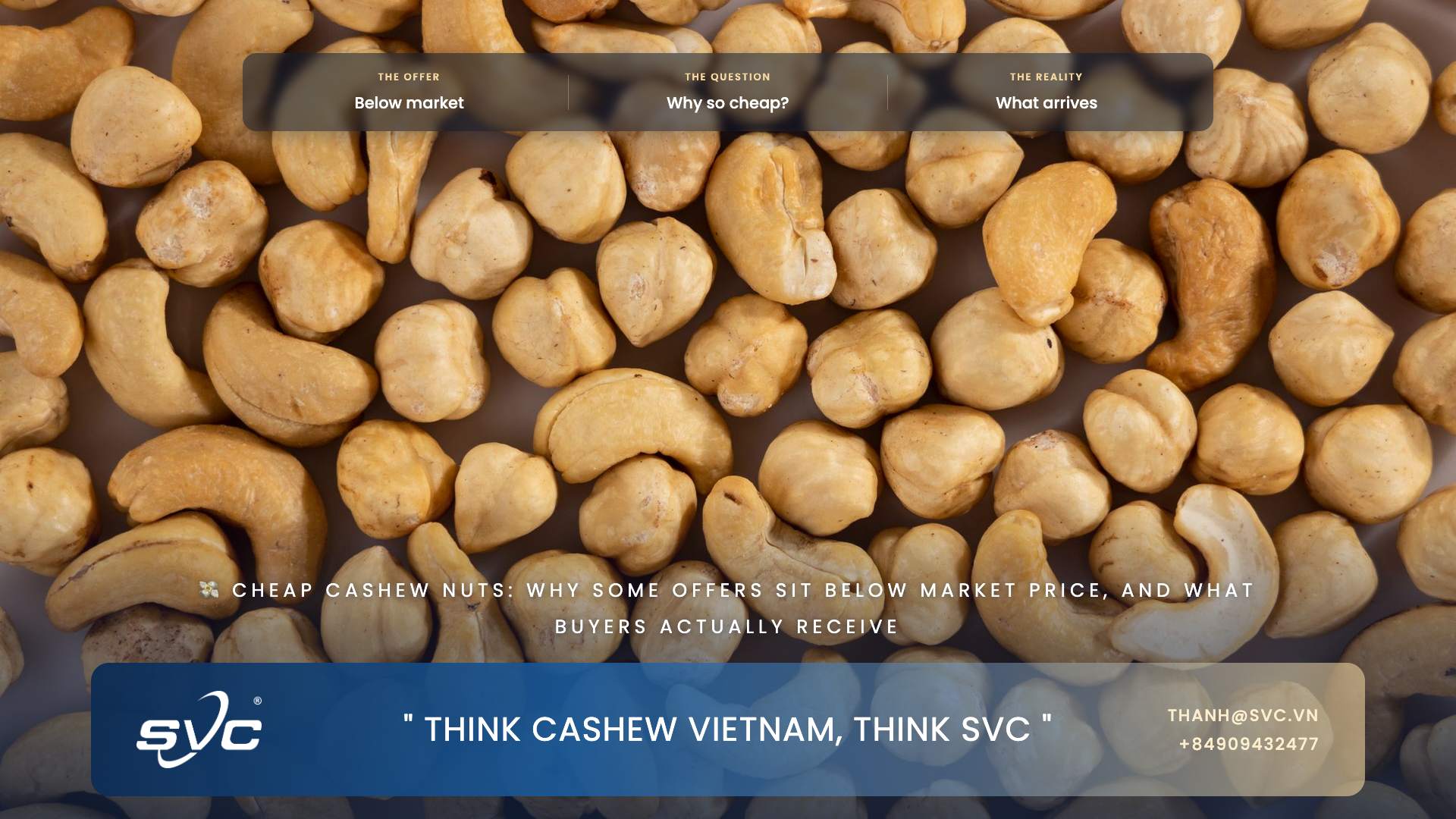
Cheap cashew nuts are usually cheaper for a reason you can check: a lower colour class than the name suggests, more broken or undersized kernels, a different net weight per carton, different delivery terms, older stock, or no lot testing. Put every offer on the same basis — grade, AFI class and tolerances, packing, Incoterm, shipment month and certificate of analysis — before comparing. As a benchmark, SVC’s bulletin of 7 October 2026 quoted WW320 at US$7.15/kg FOB Ho Chi Minh.
Why would an offer sit below the market?
1. A lower colour class
Under the AFI specification, first-quality kernels are white, light yellow or pale ivory. Scorched and dessert kernels are darker and sell for much less. An offer for “320” may be a DW320 or SW320 rather than a WW320 — in SVC’s bulletin of 4 September, DW320 was US$1.80/kg below WW320.
2. More broken kernels
The AFI specification allows up to 10% broken kernels or pieces in a whole grade. A lot at that limit, or beyond it, is worth less than a lot with almost none — pieces such as LP sold at US$1.90/kg below WW320 in the same bulletin.
3. Undersized kernels mixed in
AFI also allows up to 10% of wholes from a lower size grade. A “WW240” with a large share of 320-size kernels costs the seller less to produce — WW240 carried a US$0.85–0.90/kg premium over WW320 in SVC’s recent bulletins.
4. A different net weight
A price per carton only compares once you know the net weight. US$150 per carton is about US$6.61/kg for a 22.68 kg carton but US$7.50/kg for a 20 kg carton. Always convert to price per kg.
5. Different terms
An FOB price excludes freight and insurance; a CIF price includes them. A later shipment month, a forward price fixed weeks earlier, or different payment terms also change the number — see FOB vs CIF explained.
6. Older stock or no lot testing
The AFI storage life for raw kernels is about 24 months at 0–10°C. Kernels stored longer or warmer develop higher free fatty acids and peroxide values and can turn rancid. An offer without a certificate of analysis also leaves the aflatoxin risk with you; EU limits are low, as our aflatoxin guide shows.
How much is each difference worth?
Using SVC’s bulletin of 4 September 2026 — the last one that quoted pieces and dessert grades — the gaps add up quickly over a 15,876 kg container:
| Grade | US$/kg | Difference to WW320 | Per 20ft container |
|---|---|---|---|
| WW240 | 7.90 | +0.90 | +US$14,288 |
| WW320 | 7.00 | — | — |
| DW320 | 5.20 | −1.80 | −US$28,577 |
| LP | 5.10 | −1.90 | −US$30,164 |
Worked example: a “WW320” lot that is in fact 80% WW320 and 20% LP is worth about US$6.62/kg at those prices (0.8 × 7.00 + 0.2 × 5.10) — US$0.38/kg, or US$6,033 per container, below a clean WW320.
A low offer that matches one of these gaps is not necessarily dishonest — it may simply be a different product. The point is to know which product you are buying.
How do you compare offers on the same basis?

| Item | What to ask for |
|---|---|
| Grade and class | Grade code and AFI colour class, e.g. WW320 first quality |
| Tolerances | Maximum broken kernels and lower-size kernels |
| Packing | Net weight per carton and packing type |
| Price | US$ per kg, with Incoterm and named port |
| Shipment | Shipment month |
| Payment | Payment terms |
| Testing | Certificate of analysis per lot, including aflatoxin and microbiology |
Once every offer is on the same basis, compare it with a dated market reference such as our cashew price today page. Our guide to cashew prices per kg explains what moves each grade. A gap that remains after that deserves a direct question to the seller.
What should you check in the sample?
- Count per pound — weigh 454 g of kernels and count them; a 320 grade should fall within 300–320, a 240 within 220–240.
- Broken and undersized kernels — separate and weigh them as a share of the sample.
- Colour — compare against the class named in the offer.
- Smell and taste — any rancid note is a sign of oil breakdown.
- Lot reference — the sample should come from the lot you will buy, not a showroom sample.
When the lot ships, check the certificate of analysis against your specification — our guide to reading a cashew certificate of analysis explains each line.
What should the contract say?

- Grade, AFI colour class and the tolerances for broken and lower-size kernels.
- Quantity in cartons and net kilograms, with the packing format.
- The aflatoxin limit for your market and the microbiological limits.
- A certificate of analysis for every lot.
- Pre-shipment inspection by an independent company if you want one, such as SGS or Vinacontrol.
- Incoterm with named port, shipment month and payment terms.
A price written against this specification can be compared with any other written the same way.
What if the delivered lot does not match?
Disputes are easier to settle when the evidence was planned before shipment. Three things carry most of the weight:
- The contract specification — grade, class and tolerances written as numbers, not as “good quality”.
- An inspection or test report — from a pre-shipment inspection, or from an accredited laboratory on arrival, sampling the lot as the contract requires.
- Retained samples and lot codes — the AFI specification requires lot or date codes on cartons and packing lists, so a complaint can be traced to a lot.
Raise a complaint quickly, with photographs of cartons and lot codes, the test report and the contract clause it relates to. Our import guide covers what to agree on inspection and documents before you sign.
Can a cheaper offer still be the right buy?
Yes, when it is the right product for the use. Dessert or scorched wholes can be the sensible choice for roasting, flavouring or ingredients where colour is hidden; pieces are the economical choice for bakery and plant-based products. A cheaper offer goes wrong only when it is presented — or bought — as something it is not.
A low price is a fair question, not an accusation. We quote grade, class, packing, terms and shipment period together so that any buyer can put our price next to another on the same basis.
Want an offer you can compare line by line? Request a quotation →
Article tools
Continue reading