
To import tapioca starch from Vietnam, fix the specification first — starch content, moisture, whiteness, viscosity and microbiological limits — then choose the bag size, which sets how much fits in a 20ft container, and agree the documents. SVC supplies food-grade native and modified tapioca starch made from fresh cassava grown in Tay Ninh Province by an FSSC 22000-certified partner mill. Its native starch is specified at 85% min starch, 13% max moisture, 92% min whiteness, 18 MT per 20ft in 25 kg bags, shipped with a certificate of analysis and phytosanitary certificate.
Why source tapioca starch from Vietnam?
Vietnam is one of the world’s largest cassava exporters. In 2025 it exported more than 3.9 million tonnes of cassava and cassava products, earning about US$1.26 billion, and ranked as the world’s third-largest cassava exporter, according to the Ministry of Industry and Trade. China took 94.1% of that volume.
Starch is a large part of the trade. In the first five months of 2025, China’s imports of cassava starch from Vietnam rose 36.1% to US$409 million, making Vietnam China’s largest supplier ahead of Thailand, according to China’s customs data reported by the Ministry of Industry and Trade. The country has more than 140 cassava starch plants with a designed capacity of 13.4 million tonnes of fresh roots a year, according to the Ministry of Agriculture.
For buyers outside China, that means a deep processing base — and a reason to specify carefully. Mills make starch for many uses, from food to paper, so the grade, the limits and the documents should be written down before the first shipment.
Step 1 — Which type of tapioca starch do you need?
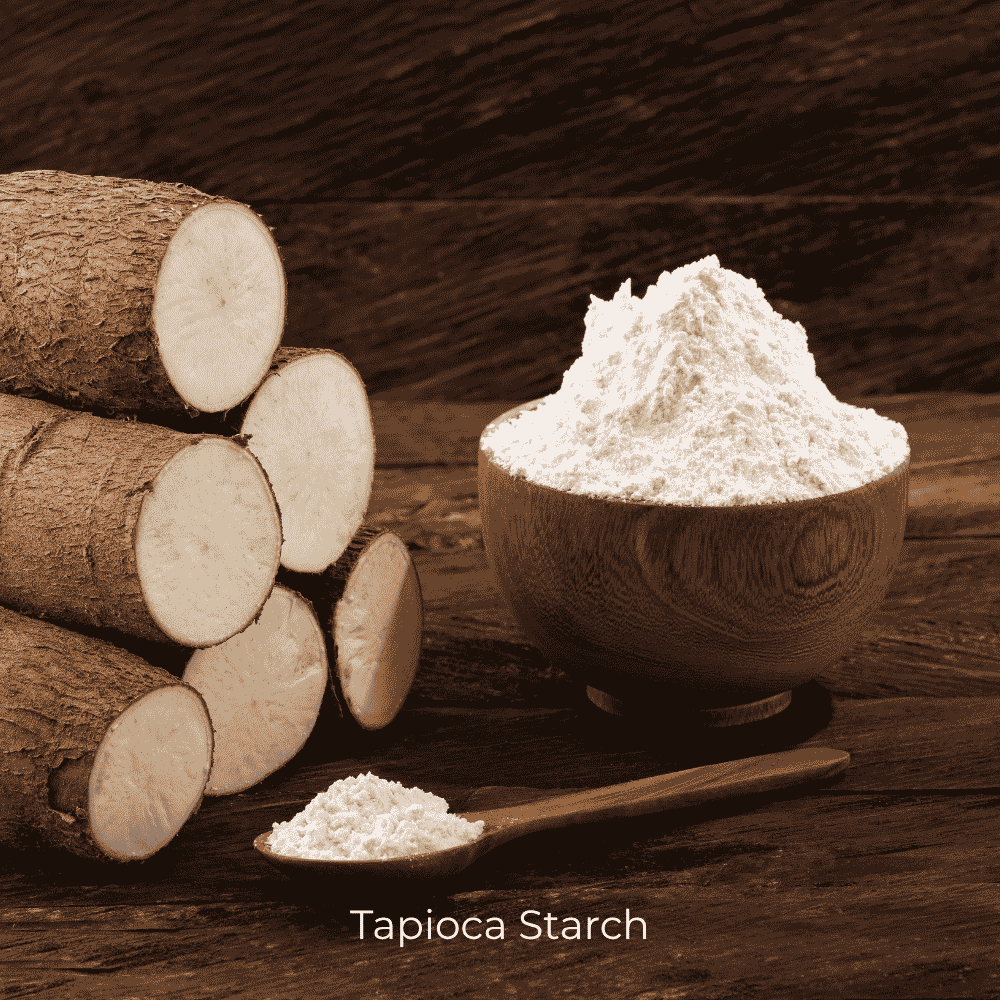
Tapioca starch is sold in two broad types. Native starch is extracted from the root mechanically — washing, chopping, grinding, separating, centrifuging, drying and sieving — with no chemical treatment. Modified starch has been treated further to change how it behaves under heat, acid or freezing.
Within native starch, the next decision is food grade or industrial grade. Food-grade native starch is used in noodles, vermicelli and rice paper; snacks, crackers and extruded products; bakery and gluten-free blends; sauces, soups and fillings; and as a binder in meat products. The same starch type also serves paper, textile sizing and adhesives, where the food-safety limits matter less.
SVC supplies food-grade native tapioca starch and five modified starches — oxidised starch (E 1404), distarch phosphate (E 1412), acetylated distarch phosphate (E 1414), acetylated starch (E 1420) and acetylated distarch adipate (E 1422) — plus RS4 resistant starch, a heat-stable dietary fibre. The native starch profile is on the SVC tapioca starch page; modified starches are quoted against their own specifications.
Step 2 — Which specification should you agree?
A specification turns “good quality” into numbers that a laboratory can check. These are the core parameters in SVC’s food-grade specification, each with its test method:
| Parameter | Method | Limit |
|---|---|---|
| Starch | AOAC 945.37 | 85.00% min |
| Moisture | AOAC 925.10 | 13.00% max |
| Whiteness | Whiteness meter | 92.00% min |
| pH | AOAC 943.02 | 5.00–7.00 |
| Fineness (through 100 mesh) | ASTM sieves | 98% min |
| Viscosity | Brabender viscometer | 700 BU min |
| Ash | AOAC 923.03 | 0.20% max |
| SO2 | AOAC 990.28 | 10 ppm max |
The full specification also covers odour, pulp, sand and silica, microbiology and heavy metals. Ask any supplier to quote the test method next to each figure: two results are only comparable when they were measured the same way.
Step 3 — Which bag size, and how much fits in a container?
The bag size decides the container load and how the starch is handled at your plant:
| Packing | Load per 20ft | Bags per 20ft | Best for |
|---|---|---|---|
| 25 kg PP/PE bag, or kraft paper bag (open-mouth or valve) | 18 MT | 720 | Manual handling, smaller production runs |
| 50 kg PP/PE bag with liner | 18.5 MT | 370 | Fewer bags, mechanical handling |
| 850 kg jumbo bag | 17 MT | 20 | Silo or automatic feeding; forklift handling |
A jumbo bag cuts handling time but loads about 1 MT less per container than 25 kg bags. Kraft paper bags come in open-mouth and valve versions; valve bags suit automatic filling and emptying lines. Write the bag type, net weight per bag and the number of bags into the contract, so the quantity cannot be disputed.
Step 4 — What should you check on food safety?
SVC’s tapioca starch is produced by a partner mill in Tay Ninh Province and sold under an SVC export contract. The mill is certified to FSSC 22000, ISO 22000 and HACCP, with ISO 9001 for quality management and ISO 14001 for environmental management; the food safety certificates cover both native and modified tapioca starch. With any supplier, ask for current certificates and check three things: the scope covers the product you are buying, the address is the mill that will produce your order, and the expiry date is after your shipment.
Halal certificates are issued under specific schemes that are recognised in specific markets, so check that the scheme on the certificate covers your destination. Then agree the limits that matter for your market:
- Hydrocyanic acid (HCN) — the EU sets a maximum of 10 mg/kg for cassava flour and tapioca flour, under Regulation (EU) 2022/1364, applied since 1 January 2023 and now part of Regulation (EU) 2023/915. The regulation does not define whether “tapioca flour” includes starch, so for EU-bound lots, ask for an HCN result on the certificate of analysis.
- Sulphur dioxide (SO2) — SVC’s limit is 10 ppm max. In the EU, sulphites must be declared as an allergen above 10 mg/kg, expressed as total SO2, so the limit matters for labelling.
- Microbiology — total plate count, yeast and mould, coliforms, E. coli and Salmonella, each with a method.
- Heavy metals — arsenic, cadmium, lead and mercury limits.
Step 5 — Which terms and documents apply?
Agree the Incoterm and named port — FOB, CFR or CIF from a Vietnamese port — and who books freight and insurance; our guide to FOB vs CIF explains the difference. SVC ships tapioca starch with:
- Commercial invoice and packing list
- Bill of lading
- Certificate of origin
- Phytosanitary certificate
- Certificate of analysis against the specification
Under good storage — cool, dry and off the floor — SVC’s tapioca starch has a shelf life of 24 months from production. Check what your own country requires at import, such as registration, labelling and any extra certificates, before the first shipment; SVC’s export documentation guide explains what each standard document proves.
Step 6 — How do you place a first order?
What should you ask any tapioca starch supplier?
- Do you produce the starch yourself, or source it from a mill? Which mill, and where?
- Which certificates does the mill hold, and do they cover tapioca starch?
- Is the starch native or modified, food grade or industrial grade?
- What are the test methods behind each figure in the specification?
- Can you provide HCN and SO2 results for my market?
- Which bag sizes do you offer, and how many tonnes fit in a 20ft container for each?
- Which documents come with each shipment?
We tell buyers upfront that our tapioca starch is made by a partner mill, not in our own factory. What SVC adds is the export contract: an agreed specification, the documents, and one point of contact from order to arrival.
Planning to import tapioca starch from Vietnam? Request a quotation →
Article tools
Continue reading