
Cashew manufacturer vs trader: a manufacturer processes raw nuts into kernels in its own factory; a trader buys kernels from factories and resells them. Both are legitimate, but they carry different risks. You can tell which one you are dealing with in about a day: check the business registration, the site address on the food safety certificate, the name on the export documents and a live view of the factory.
What is the difference between a manufacturer and a trader?

A cashew manufacturer (often called a processor) buys raw cashew nuts, steams, shells, dries, peels, grades and packs them in its own factory. It controls the process, the quality checks and the packing, and it holds the food safety certificates for that site.
A cashew trader buys finished kernels from one or more factories and sells them on. Some traders add real value: they consolidate small lots, blend grades, offer credit or handle documents in the buyer’s language. Others simply resell the same goods at a margin.
Vietnam has hundreds of cashew exporters, and the line between the two is not always obvious from a website. Many trading companies describe themselves as factories, and some factories also trade kernels from other plants when their own production is sold out.
When is buying from a trader the right choice?
A good trader can be the better option when:
- Your volume is small — less than a full container, or several grades in one container.
- You need several origins — Vietnamese, Indian and African kernels from one counterparty.
- You need credit or local services — payment terms, warehousing or customs support at destination.
- You buy spot — occasional lots where price matters more than consistency between shipments.
The point is not to avoid traders but to know which one you are dealing with, so you can ask the right questions and price the risk.
What can go wrong when you don’t know who made the goods?
- Quality drifts between shipments — each lot may come from a different factory, with a different colour, breakage or moisture.
- Certificates don’t cover the goods — a certificate is valid for one site; if the goods were packed elsewhere, it does not apply.
- Corrective action is slow — when there is a problem, the trader has to go back to a factory it does not control.
- The price looks better than it is — a low offer may hide a lower grade, a different colour class or a lighter carton; see why some offers sit below market price.
How do you check who you are buying from?
None of these checks takes long, and a genuine manufacturer will usually welcome them. If a supplier cannot show a site address that matches its certificate, treat it as a trader until it can.
Manufacturer or trader: what to expect
| Point | Manufacturer | Trader |
|---|---|---|
| Who makes the kernels | Own factory | One or more other factories |
| Food safety certificates | Issued for its own site | Belong to the producing factory |
| Consistency between lots | Set by one process | Depends on which factory supplies |
| Handling a quality problem | Directly, at source | Through the producing factory |
| Flexibility on small or mixed lots | Limited by production plan | Often higher |
| Price | Factory price | Factory price plus margin and services |
Use the table as a starting point, not a verdict. A well-run trader with long-term factory partners can be more reliable than a small factory with weak controls.
Which questions reveal the answer fastest?
- Where exactly is your factory, and which certificate covers it?
- Can I see the lines running on a video call this week?
- Who issues the certificate of analysis, and where is the lab?
- If a lot fails at destination, who investigates and how?
- Which of your products are made in your own factory, and which come from partners?
The last question matters most. Many suppliers sell several products, and the honest answer is often “some of each”. For a list of where to find Vietnamese exporters and how to check them, see the Vietnam cashew exporters list.
Where does SVC fit?
For cashew kernels, SVC is the manufacturer: raw nuts are processed in its own factory in Dong Nai Province, which is certified to BRCGS, SMETA, HACCP, FSPCA, Halal and Kosher — see SVC’s cashew factory. For tapioca starch and dried fruit, SVC works as a trading company with partner mills and processors.
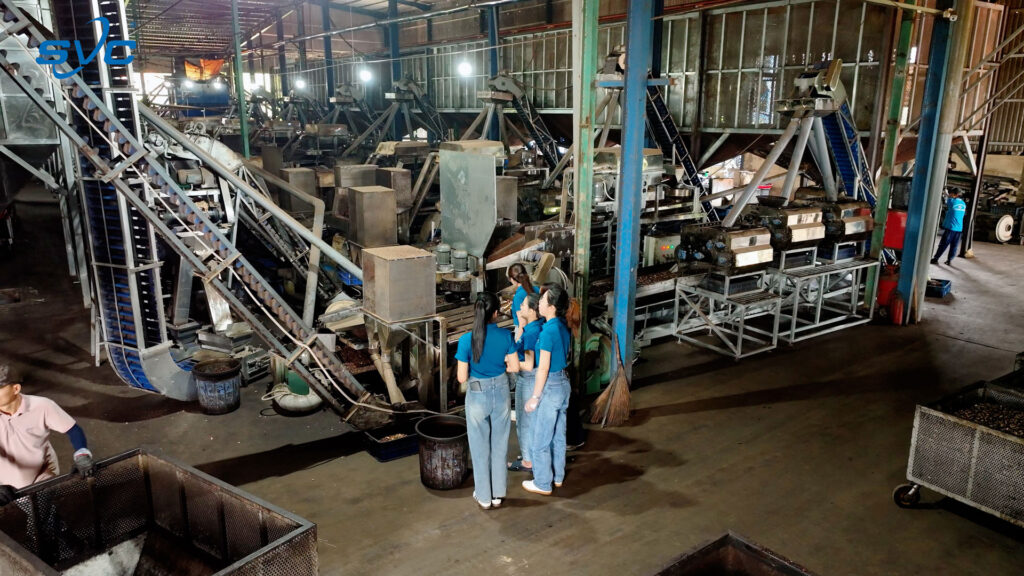
The same checks apply to us. Ask for our certificates, the factory address and a live view of the lines; the factory video is a quick first look.
Is a trader always more expensive than a manufacturer?
Not always. A trader with long-term factory contracts can sometimes buy at a good price, and its services — credit, mixed loads, local stock — may be worth the margin. Compare the full offer, not just the price per kg.
Can a factory also act as a trader?
Yes. Many factories buy kernels from other plants when their own production is sold out. Ask which lots in your order come from the supplier’s own factory.
Does an export licence prove a company is a manufacturer?
No. Trading companies can export too. The site address on the food safety certificate and a live view of the lines are better evidence.
Want to verify SVC as your cashew supplier? Request a quotation →
Article tools
Continue reading