
SVC’s cashew factory in Vietnam is at 579 Dien Bien Phu Street, Phuoc Long Ward, Dong Nai Province, in the country’s main cashew-growing region. Established in 2015, it processes more than 700 MT of cashew kernels a month — from raw nut intake to container loading — exports to more than 72 countries through Cat Lai and Cai Mep ports, and is certified to BRCGS, SMETA, HACCP, FSPCA, Halal and Kosher.
Where is the factory?
The factory is at 579 Dien Bien Phu Street, Hung Lap Quarter, Phuoc Long Ward, Dong Nai Province. The area sits in southern Vietnam’s cashew belt — the former provinces of Binh Phuoc and Dong Nai are the country’s main cashew farming centres.
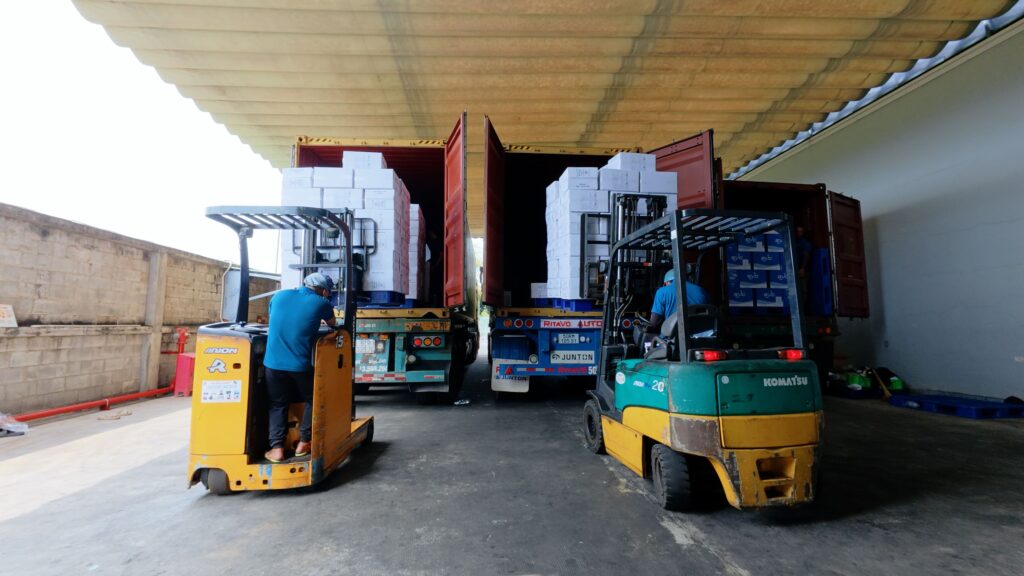
Export containers leave through Cat Lai port in Ho Chi Minh City and Cai Mep port, which handles direct mainline services. SVC’s commercial team works from offices in Ho Chi Minh City (Blue Sky Office Building, 1 Bach Dang Street), Singapore (SVC Foods Pte. Ltd., Bugis Cube) and Birmingham in the United Kingdom.
Where do the raw nuts come from?
Like the rest of the industry, SVC processes both domestic and imported raw cashew nuts. Vietnam grows only a fraction of what its factories need: domestic production covers about 10% of processing demand, according to the Vietnam Cashew Association. The rest is imported, mainly from Cambodia, Côte d’Ivoire, Tanzania and Ghana, as reported by VietnamPlus.
Raw nut origin matters to buyers because it affects outturn, kernel size and colour. Each incoming lot is inspected before it enters production, and lots that fail inspection are held for re-testing or rejected.
How does a raw nut become an export kernel?

The factory runs the full chain in six stages:
Each stage is described in more detail, with photographs, in inside SVC’s cashew processing facility.
What does the factory produce?
| Product family | Grades and formats |
|---|---|
| Raw cashew kernels | White wholes WW180, WW210, WW240, WW320, WW450; scorched and dessert wholes; pieces LP, SP, BB |
| Roasted and salted cashews | Including A grades — whole kernels roasted and salted with the skin on (A180, A240, A320) |
| Flavoured cashews | Flavours such as cheese, garlic chilli, wasabi and tom yum |
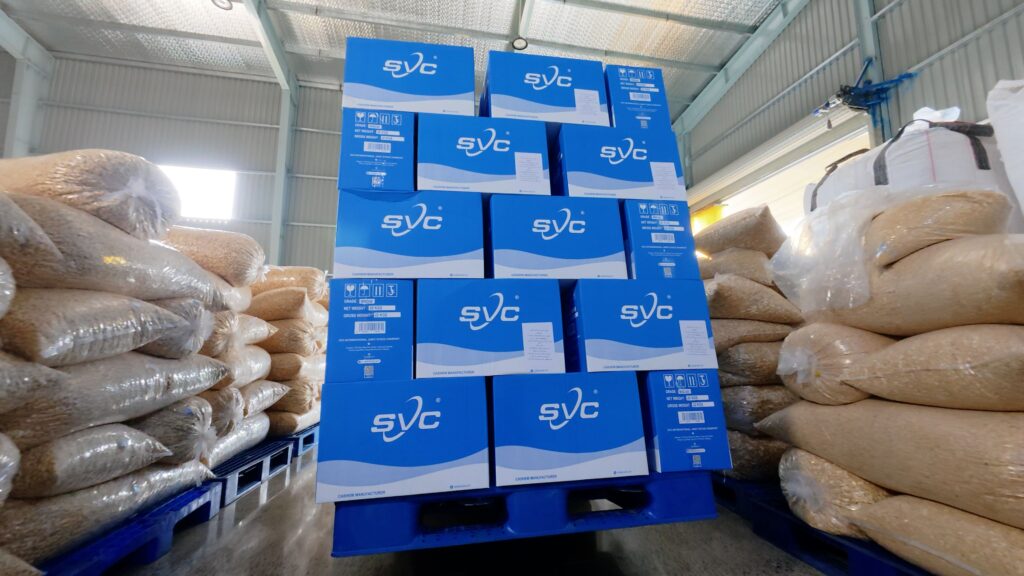
| Packing | Vacuum bags of 20 kg, 22.68 kg and 50 lb; tin boxes of 10 kg and 11.34 kg; retail jars and pouches |
Retail packs can be produced under the buyer’s brand — see private label cashew manufacturing at SVC.
How is quality controlled?
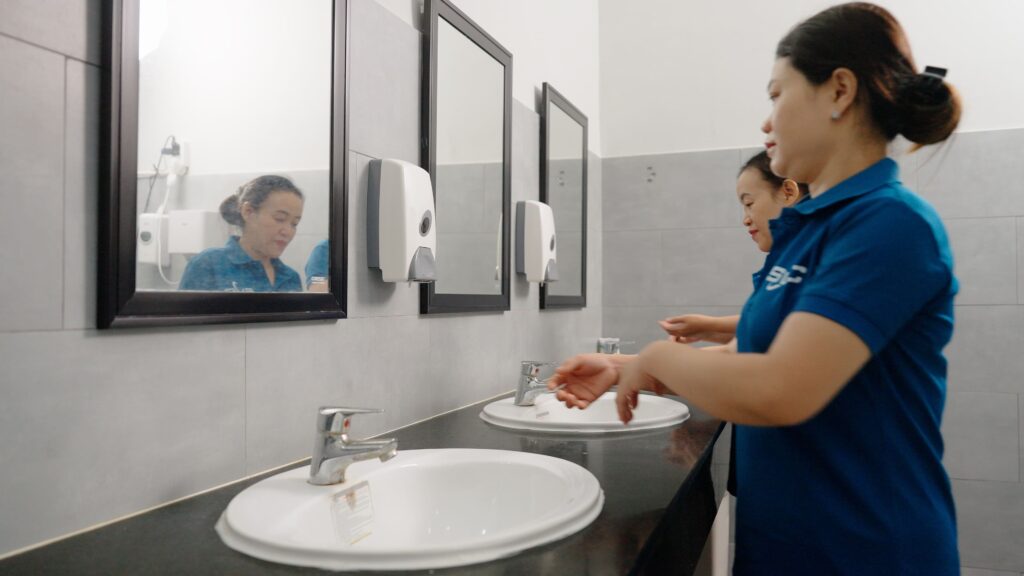
- Moisture is tested at raw nut intake, after drying, after peeling and before packing.
- Colour and defects are checked after grading, with a final manual inspection.
- Microbiological tests follow the BRCGS and HACCP schedule, alongside environmental swabbing.
- Vacuum bag seals are checked after packing, and packed bags are held in a temperature-controlled warehouse.
- Each container is pre-inspected, its carton count verified and its condition checked before the doors are sealed.
- Each shipment carries a certificate of analysis, with the certificate of origin, phytosanitary certificate and packing list cross-checked before release.
Aflatoxin is tested against the limit of the destination market, which differs sharply between the EU and the US — see aflatoxin in cashew nuts. Independent inspection by SGS or Vinacontrol can be arranged for any shipment.
What does each certification cover?
| Certification | What it covers |
|---|---|
| BRCGS | Food safety and quality management, audited annually by an approved certification body |
| SMETA | Ethical trade audit covering labour standards, health and safety, environment and business ethics |
| HACCP | Hazard analysis and critical control points for food safety |
| FSPCA | Training in the US FDA’s preventive controls rules, supporting US-bound shipments |
| Halal | Compliance with Islamic dietary requirements, needed for many Middle East and Southeast Asian buyers |
| Kosher | Compliance with Jewish dietary requirements |
Ask for current certificates with any quotation and check the site address on each. For BRCGS, the BRCGS Directory shows the certification status of certificated sites, and certificate data can only be entered by the certification body, not by the audited company.
Which markets does the factory ship to?
SVC supplies more than 72 countries across Europe, the Middle East, Asia, the United States, South America and Canada. Each market has its own rules on contaminants, labelling and documentation; our checklists for the EU market and the US market set out what the factory and the importer each need to provide.
What goes into a supplier-approval file?
Most buyers’ QA teams approve a new supplier from a standard file. This is the information SVC provides for it:
| Item | Details |
|---|---|
| Legal entity | SVC International JSC |
| Factory address | 579 Dien Bien Phu Street, Hung Lap Quarter, Phuoc Long Ward, Dong Nai Province, Vietnam |
| Established | 2015 |
| Capacity | 700+ MT of kernels a month |
| Products | Raw kernels, roasted and salted (including A grades), flavoured, private label |
| Quality standard | AFI specification |
| Certifications | BRCGS, SMETA, HACCP, FSPCA, Halal, Kosher |
| Documents per shipment | Certificate of analysis, MSDS, certificate of origin, phytosanitary certificate, packing list |
| Export ports | Cat Lai and Cai Mep |
| Samples | Free, under 1 kg |
Ask for current copies of the certificates and a product specification for each grade you plan to buy; check the expiry date and site address on every certificate.
How can buyers see or audit the factory?
Watch the SVC factory video for a walk-through of the line. Buyers’ quality teams can audit the factory in person or by video, and certification bodies audit it on their own schedules.
If you are preparing an audit, our guide to how global buyers audit a cashew factory before their first order lists what auditors usually ask to see.
We invite buyers to judge the factory by its records as much as by its photos: certificates with the factory address, a certificate of analysis for each lot, and a loading check for each container.
Want to audit the factory or see current certificates? Request a quotation →
Article tools
Continue reading