
Modified tapioca starch is native tapioca starch that has been treated — by oxidation, cross-linking, acetylation or a combination — so it holds up to heat, acid, shear or freezing better than native starch. SVC supplies six food-grade types from a partner mill in Tay Ninh Province, Vietnam: E 1404, E 1412, E 1414, E 1420, E 1422 and resistant starch RS4, packed in 25 kg bags or jumbo bags and shipped with a certificate of analysis.
What is modified tapioca starch?
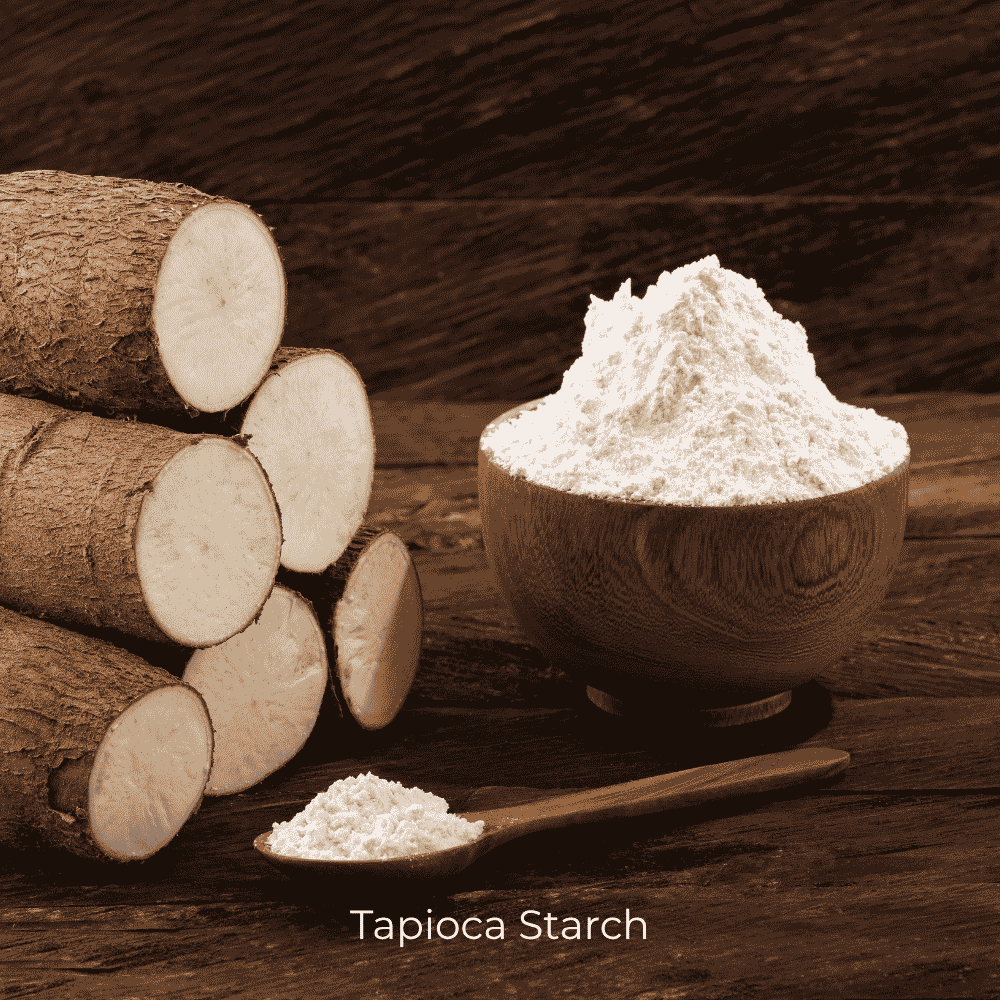
Native tapioca starch is extracted from fresh cassava roots, washed, dried and milled. It thickens well and has a clean taste, but in many factory processes it breaks down: it thins under long cooking or high shear, weeps water after freezing, and loses viscosity in acid sauces.
Modification changes the starch molecule in a controlled way so it keeps its function through the process. Cross-linking makes it resist heat and shear; acetylation improves clarity and freeze-thaw stability; oxidation gives clear, adhesive, film-forming pastes. The differences between native and modified starch are covered in native vs modified tapioca starch.
Which types are available?
| Code | Name | Function | Typical uses |
|---|---|---|---|
| E 1404 | Oxidised starch | Film-forming; glossy, smooth, high-clarity gels with good adhesion | Paper industry and food |
| E 1412 | Distarch phosphate | Stabilises, thickens and gels; improves hydration and process resistance | Foods that must resist breakage and cooking loss, such as noodles |
| E 1414 | Acetylated distarch phosphate | Thickens, stabilises and texturises; process resistance and freeze-thaw stability; reduces syneresis | Frozen foods, sauces, creamy textures |
| E 1420 | Acetylated starch | Better stability, texture and moisture retention; lower gelling point, improved transparency, higher viscosity | A wide range of foods |
| E 1422 | Acetylated distarch adipate | Process resistance and moisture retention; soft, creamy texture | Dairy products, meat products, sauces |
| RS4 | Resistant starch | Heat-stable dietary fibre; gluten-free | Low-calorie and prebiotic foods; fibre enrichment |
Each type can be supplied in different viscosity ranges. Tell us the application and the process — cooking temperature, time, pH, shear, freezing — and we will propose a type and send a sample.
How do you choose the right type?
- Noodles and products that must not break during cooking — start with E 1412.
- Frozen meals, sauces and fillings that are frozen and thawed — E 1414 for freeze-thaw stability.
- Dairy desserts, yoghurt, meat products — E 1422 for a soft, creamy texture and water holding.
- Clear glazes, coatings and batters — E 1404 or E 1420 for clarity and film forming.
- Fibre enrichment and reduced-calorie foods — RS4 resistant starch.
Run a pilot trial at your own process conditions before switching a production line. Dosage often needs adjusting even between suppliers of the same E-number.
How is modified starch regulated?
In the EU, chemically modified starches are food additives authorised under Regulation (EC) No 1333/2008, and their purity criteria are set in Regulation (EU) No 231/2012. In the US, food starch-modified is covered by 21 CFR 172.892, which lists the permitted treatments.
Check how your market requires modified starch to appear in the ingredient list, and ask for a certificate of analysis that reports against the purity criteria your authority applies.
What should the specification include?
Agree these points before the first shipment:
- Type — E-number or name, and the viscosity range.
- Physical and chemical limits — moisture, pH, whiteness, fineness and ash.
- Microbiology — total plate count, yeast and mould, coliforms, E. coli, Salmonella.
- Heavy metals — arsenic, cadmium, lead and mercury.
- Cyanide — if your market sets a limit for cassava products, such as the EU’s hydrocyanic acid limits, ask for a test.
Each line, with the native starch values, is explained in the tapioca starch specification guide.
The partner mill is certified to FSSC 22000, ISO 22000, ISO 9001, ISO 14001 and HACCP. Its Halal certificate is issued under an Indonesian Halal scheme; if your market requires a specific Halal body, check that it accepts this certificate before ordering.
How is it packed and shipped?
| Packing | Load per 20ft |
|---|---|
| 25 kg PP/PE woven bag or paper bag (open mouth or valve) | 18 MT |
| 50 kg bag | 18.5 MT |
| 850 kg jumbo bag | 17 MT |
Shelf life is 24 months in the original bags, stored in a cool, dry place off the floor. Documents and terms follow the same pattern as native starch — see how to import tapioca starch from Vietnam.
How do you order?
Native starch, the full range and current availability are on the tapioca starch page.
Do you need modified starch at all?
Not always. Native tapioca starch works well where the product is cooked briefly, eaten soon and not frozen — many bakery items, bubble tea pearls and simple sauces. Modified starch earns its place when the process is harsh or the product must keep its texture over a long shelf life.
| If your product… | Consider |
|---|---|
| Is cooked briefly and eaten fresh | Native |
| Is cooked for a long time or under high shear | E 1412 or E 1422 |
| Is acidic, such as fruit fillings or dressings | A cross-linked type |
| Is frozen and thawed | E 1414 |
| Needs a clear, glossy finish | E 1404 or E 1420 |
| Needs added fibre | RS4 |
Is modified starch genetically modified?
No. “Modified” refers to the physical or chemical treatment of the starch, not to the plant. Cassava starch is not genetically modified.
Can I get several types to trial?
Yes. Tell us the application, and we will propose two or three types and send samples of each.
Need a modified tapioca starch for your process? Request a quotation →
Article tools
Continue reading