

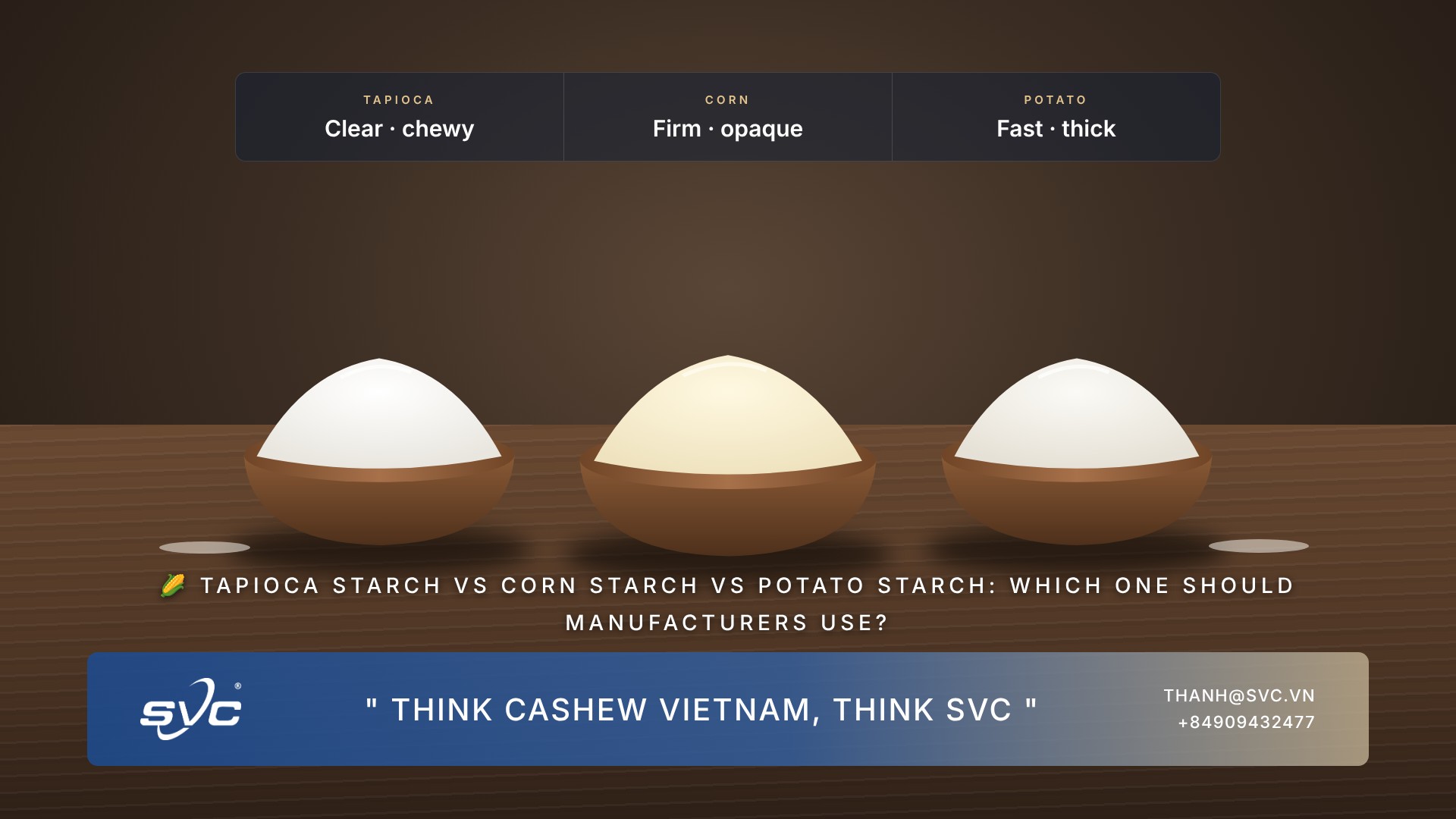
Tapioca starch vs corn starch: tapioca gives a soft, clear, glossy paste and a neutral taste; corn starch sets into a firm, opaque gel; potato starch has the largest granules and swells fastest. Choose tapioca for clarity, chewiness and clean flavour, corn for firm set gels and puddings, and potato where very high initial thickening is needed. Many manufacturers switch between them for supply or labelling reasons — always with a trial.
What is the difference at a glance?
| Property | Tapioca | Corn (regular) | Potato |
|---|---|---|---|
| Source | Cassava root | Maize kernel | Potato tuber |
| Amylose | About 17% | About 25% | — |
| Granule size | 5–25 µm | 5–20 µm | 15–75 µm |
| Paste or gel | Soft, clear, glossy paste | Firm, cuttable, opaque gel | Very high initial thickening |
| Taste | Very bland | — | — |
| Gluten | Gluten-free | Gluten-free | Gluten-free |
Amylose, granule size and paste character from a technical review in Supply Side Journal. Larger granules generally swell faster, which is why potato starch thickens so quickly. Gelatinisation measurements depend on the method: in one calorimetry study, corn and tapioca starch began to gelatinise at almost the same temperature, about 65°C, but tapioca finished at a higher temperature, 84.6°C against 77.5°C.
When is tapioca starch the better choice?
- Clarity and gloss — fruit fillings, glazes, clear sauces.
- Chewy, elastic texture — noodles, tapioca pearls, some snacks.
- Neutral flavour — dairy, desserts and delicately flavoured foods.
- Gluten-free baking — expansion and crisp crust with rice or sorghum flour.
The applications, with the native and modified types for each, are set out in tapioca starch uses in food manufacturing.
When is corn starch the better choice?
Regular corn starch forms a firm, cuttable gel as it cools, so it is the traditional choice for set puddings, custards and products that need to hold their shape. Waxy corn starch, which has virtually no amylose, behaves differently: it is cohesive and does not gel.
When is potato starch the better choice?
Potato starch has the largest granules of the three, from 15 to 75 microns, and swells quickly to a high viscosity. It is used where fast, strong thickening is wanted, and in some meat and noodle applications. Its high initial viscosity can fall under prolonged heating and shear, so many industrial users choose modified grades.
What changes when you switch to tapioca?
Where the process is harsh, a modified tapioca starch often does the job that native corn or potato starch could not — see modified tapioca starch and native vs modified tapioca starch.
What about supply and price?
Vietnam exported more than 3.9 million tonnes of cassava and cassava products in 2025, earning about US$1.26 billion, according to the Ministry of Industry and Trade. China takes most of it. For buyers elsewhere, that means a large processing base and established export logistics, but also prices that move with Chinese demand and the cassava harvest.
SVC supplies food-grade native and modified tapioca starch from an FSSC 22000-certified partner mill in Tay Ninh Province, in 25 kg, 50 kg or jumbo bags. The full specification is on the tapioca starch page.
Which starch suits which product?
| Product | Usual first choice | Why |
|---|---|---|
| Fruit fillings and glazes | Tapioca | Clear, glossy paste |
| Set puddings and custards | Regular corn | Firm gel on cooling |
| Noodles | Tapioca or potato | Elastic, chewy texture |
| Gluten-free bread and crusts | Tapioca, blended with other flours | Expansion and crisp crust |
| Frozen sauces and meals | Modified tapioca (E 1414) | Freeze-thaw stability |
| Dairy desserts | Tapioca or modified tapioca (E 1422) | Neutral taste, creamy texture |
Treat the table as a starting point for trials, not a rule. Recipes, processes and local preferences vary, and the right answer is the one that works on your line.
What about labelling?
All three starches are naturally gluten-free. Labelling rules for starch and modified starch differ by market, so check how each must be named in the ingredient list where you sell. Some buyers choose tapioca for simpler sourcing declarations; ask your supplier for the declarations your customers require.
Can tapioca replace corn starch one-for-one?
Sometimes for thickening, but the texture will be softer and clearer. Trial before changing the recipe.
Is tapioca starch more expensive than corn starch?
It depends on the market and the season. Compare delivered prices for the same grade and packing, and include the cost of any recipe change.
Considering a switch to tapioca starch? Request a quotation →
Article tools
Continue reading