
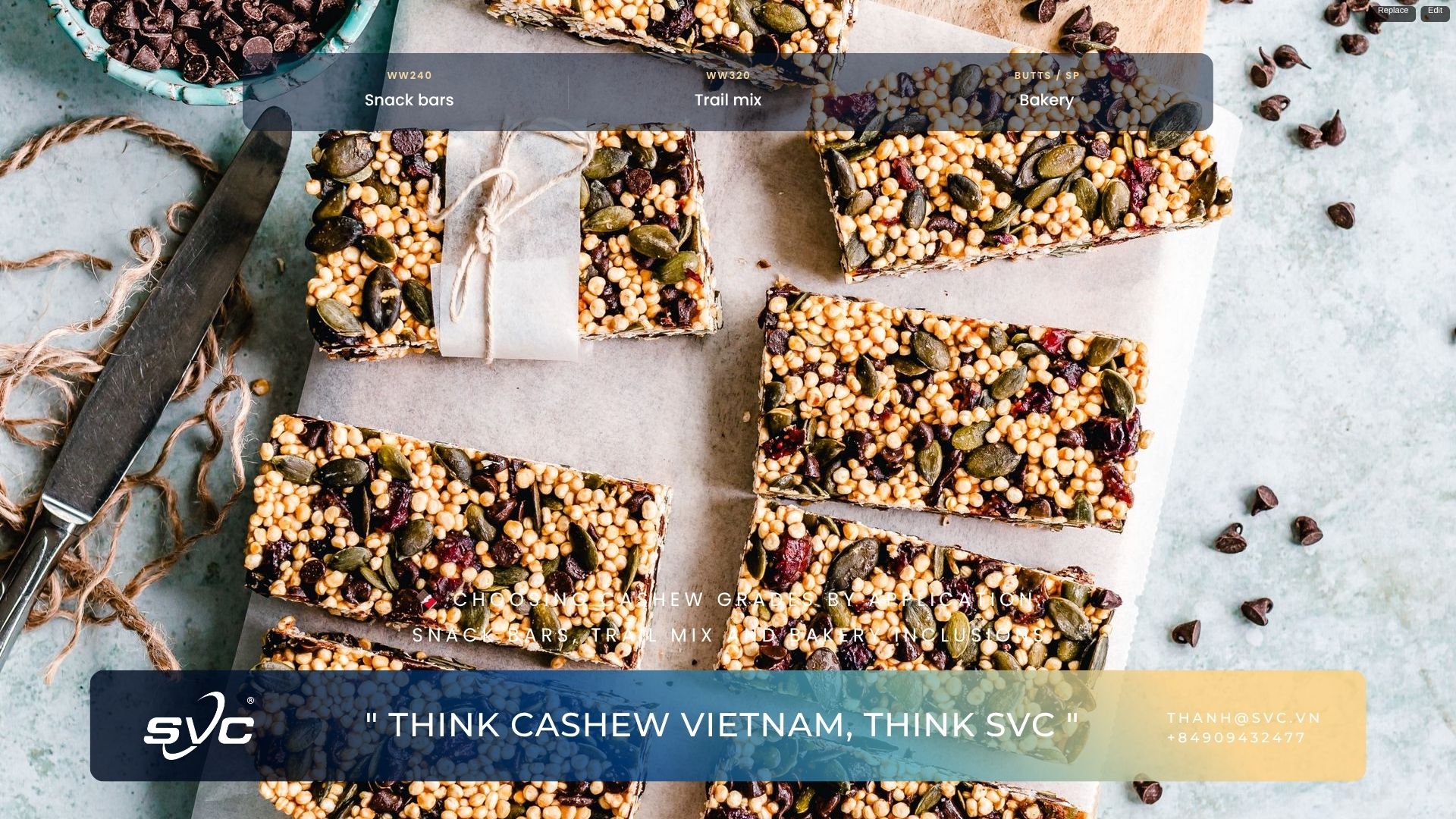
Product developers building snack bars, trail mix, or bakery products often default to whole kernel grades (WW320, WW240) out of habit, without realising that broken and piece grades — DW320, SP, LP, SK — are specifically produced for exactly these applications, at meaningfully lower cost, with no compromise in the finished product.
This article breaks down grade selection specifically for three ingredient-use categories, where kernel appearance matters far less than in retail whole-kernel formats.
Cashews in bars are bound into a matrix with binders, other nuts, and dried fruit. The kernel is rarely visible as a whole piece once cut and packaged. Broken grades (DW320 — broken whites) and split grades (SP, LP) deliver the same nutritional and flavour profile as whole kernels at 25–35% lower cost, since the price premium for whole kernels reflects visual presentation, not taste or nutrition.
| Best for | Cost-optimised bars, private label, high-volume production |
| Avoid if | Bar is cut to expose visible whole kernels as a marketing feature |
| Typical FOB range (H2 2026) | DW320: $5.00–5.30/kg · SP: $4.90–5.20/kg |
In a mix of nuts, dried fruit, and often chocolate or seeds, cashews are one visual and flavour component among several. Smaller whole grades (WW450) or large pieces (LP) blend naturally without looking noticeably different from whole WW320 once mixed with other ingredients — while costing meaningfully less per kilogram of finished blend.
| Best for | Value-tier trail mix, bulk snack blends, private label mixes |
| Avoid if | Cashews are the dominant visual ingredient in a premium-positioned mix |
| Typical FOB range (H2 2026) | LP: $4.90–5.20/kg · WW450: $6.30–6.60/kg |
Cashews baked into cookies, granola, or bread are typically chopped or embedded before baking — kernel shape and size uniformity have essentially zero impact on the finished product. This is where the lowest-cost grades (SK — small kernels, TPW — testa pieces white) deliver full value: same cashew flavour and nutrition, at the most cost-efficient price point in the entire grade range.
| Best for | Granola, cookies, bread inclusions, any application where kernels are chopped or embedded |
| Avoid if | Product specification requires a minimum piece size for regulatory or labelling reasons |
| Typical FOB range (H2 2026) | SK: $4.10–4.40/kg · TPW: $3.90–4.20/kg |
Why Broken And Piece Grades Are Not "Lower Quality"
A common misconception among new product developers is that broken and piece grades are somehow inferior. They are not. AFI grading separates cashews by shape and size, not by flavour, nutrition, or origin quality. A broken piece from a premium-quality kernel is still premium-quality cashew — it is simply not a whole, uniform piece.
The price difference between whole and broken/piece grades reflects visual presentation value, which matters enormously for retail whole-kernel formats and essentially not at all for ingredient applications where the cashew is mixed, chopped, or embedded in a finished product.
Quick Reference: Matching Grade To Application
Read next
Article tools
Continue reading