
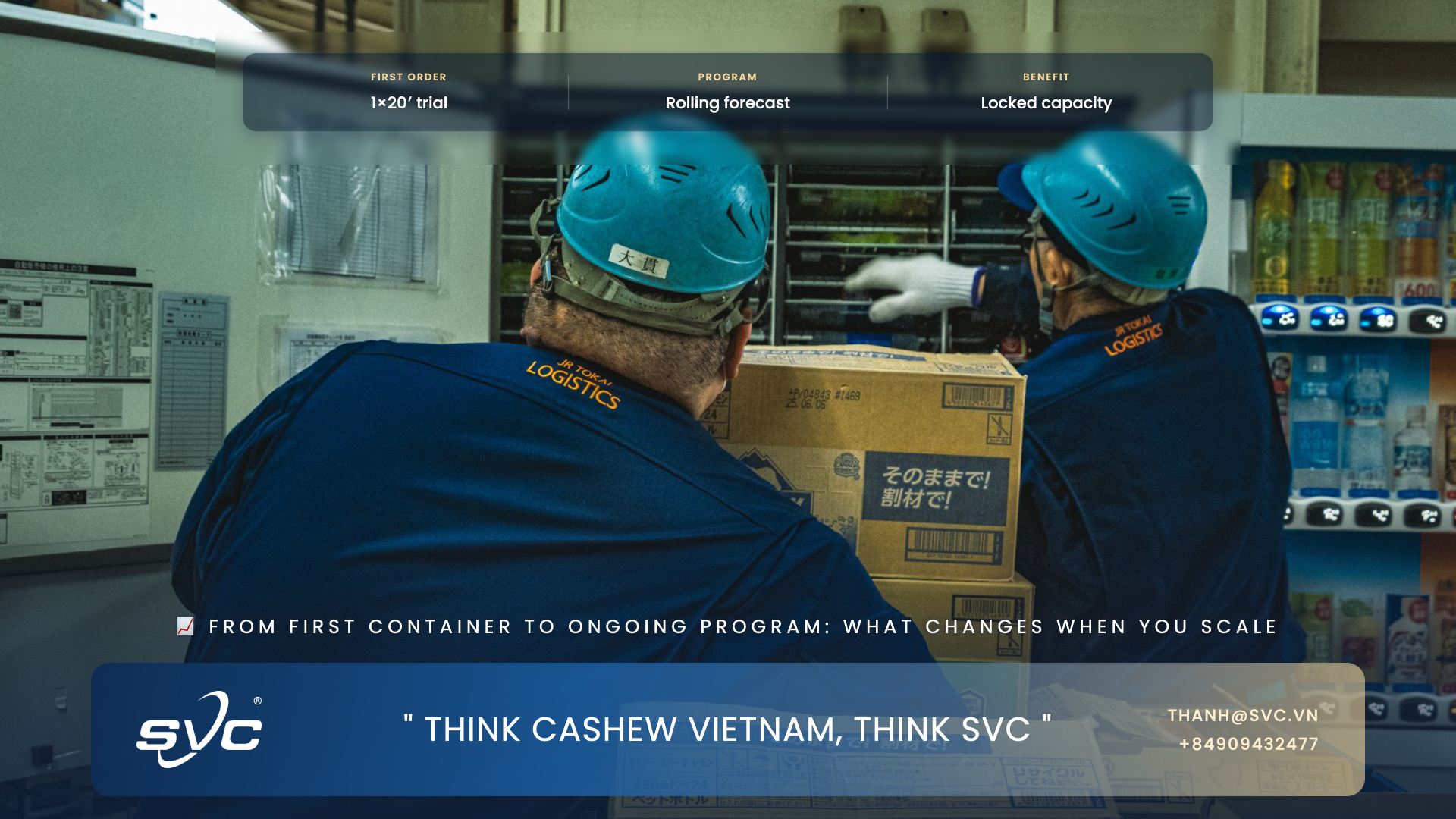
The first container is a test. The tenth container is a program. Buyers who succeed with their first OEM order sometimes expect that reordering the same way, at larger volume, is simply more of the same process. In practice, several things change structurally once a relationship moves from a single transaction to an ongoing supply program — and buyers who anticipate those changes make the transition more smoothly than buyers who discover them one at a time.
⚖️ What actually changesFour Structural Shifts Between First Order And Ongoing Program
What A Useful Rolling Forecast Actually Looks Like
A forecast does not need to be precise to be useful — it needs to be directionally honest and updated regularly. The manufacturer is not holding the buyer to the number; the forecast is an input to raw material and capacity planning that improves as real orders confirm or revise it.
| Forecast horizon | Typical precision expected | What it's used for |
|---|---|---|
| 0–4 weeks | Firm, confirmed order | Active production scheduling |
| 1–3 months | High confidence estimate | Raw material commitment, capacity allocation |
| 3–6 months | Directional range | Long-lead sourcing decisions, seasonal capacity planning |
Buyers sometimes hesitate to share a forecast for fear of being held to it. The opposite is usually true in practice: a manufacturer with visibility into likely future demand can secure better raw material terms and more reliable capacity, which flows back to the buyer as more consistent pricing and delivery performance.
Why Origin Diversification Becomes A Program-Level Question
A first container is a small enough volume that its raw material almost certainly came from whatever the processor had on hand — the question of where it originated barely registers. A full annual program is a different exposure entirely.
If a manufacturer sources primarily from a single RCN origin, and that origin experiences a poor harvest, export restriction, or logistics disruption — a pattern this year's market coverage has flagged repeatedly across African supply — a program-scale buyer is exposed to that single point of failure in a way a one-off buyer never was. At scale, it is worth asking directly how diversified the manufacturer's own sourcing is, and how that diversification has actually performed during a difficult season.
📋 Quality at scaleConsistency Becomes The Real Test
A single production run either meets specification or it does not. A program running monthly for a year is really being tested on consistency — whether every run lands in the same place, not just whether any individual run passes. This is where the batch-level Certificate of Analysis discipline covered in our CoA guide earns its value: tracking moisture, colour grade and defect rate across dozens of runs, not just checking each one individually, is what surfaces drift before it becomes a customer-facing problem.
How Payment And Contract Structure Typically Evolves
First orders are commonly transacted on a per-shipment basis — deposit against a specific purchase order, balance against shipping documents. As a relationship matures into a genuine program, buyers and manufacturers frequently move toward a framework agreement: standing terms covering price mechanism, volume commitment ranges, and payment terms that apply across a series of shipments rather than being renegotiated each time.
This is not automatic, and it should not be assumed — but it is worth raising directly once volume and order frequency justify it. The conversation is easier to have from a position of established performance than to request upfront before any track record exists.
💬 CEO PerspectiveRead next
Article tools
Continue reading