
Cashew kernels for plant-based milk, cheese and butter are usually bought as pieces, not wholes: the kernel is blended or ground, so its shape is lost, and pieces cost much less per kg. What matters instead is the colour class, the microbiological and oxidation results, and consistency from lot to lot. In SVC’s bulletin of 4 September 2026, LP pieces were US$1.90/kg below WW320 wholes — about US$30,000 per 20ft container.
Why do plant-based manufacturers buy pieces?
Cashew milk, cheese, cream and butter are made by soaking, blending or grinding the kernel. Once that happens, nobody can tell whether it started as a whole or a piece. The cashew technical information sheet published by cashews.org lists milk among the applications for cashew kernels and cashew paste or butter among the uses for the finest particle sizes.
Paying for whole-kernel appearance therefore adds cost without changing the product. The table shows the gap in SVC’s last bulletin that quoted pieces:
| Grade | US$/kg | Difference to WW320 | Difference per 20ft (15,876 kg) |
|---|---|---|---|
| WW320 (white wholes) | 7.00 | — | — |
| DW320 (dessert wholes) | 5.20 | −1.80 | −US$28,577 |
| LP (large white pieces) | 5.10 | −1.90 | −US$30,164 |
Whole grades have risen since — WW320 was US$7.15/kg on 7 October — while the last two bulletins did not quote pieces. Ask for a current LP quote before you budget; the latest whole-grade prices are on our price update page.
Which piece size suits which product?
The AFI specification sizes pieces on square-mesh wire sieves. Each size passes one sieve and is retained on the next:
| Piece grade | Passes sieve | Retained on sieve |
|---|---|---|
| Large pieces | 8.00 mm | 6.30 mm |
| Small pieces | 6.30 mm | 2.80 mm |
| Chips | 2.80 mm | 2.36 mm |
| Baby bits | 2.36 mm | 1.70 mm |
| Fine grains | 1.70 mm | 1.18 mm |
| Fines | 1.18 mm | — |
- Milk and drinks — the kernel is blended and filtered or milled fully, so any sound piece size works. The choice usually comes down to price and how the size handles in your soaking and dosing equipment.
- Cheese, cream and spreads — pieces, in the size that suits your soaking and blending process. Trial two sizes before fixing a specification.
- Butter and paste — grinding removes all form, so the smallest sound pieces are usually the most economical choice.
SVC supplies LP, SP and BB. See the full range, with packing and current prices, in our guide to Vietnam cashew nuts in bulk.
Does kernel colour matter?

For a white milk, cream or cheese, yes. The AFI specification separates first-quality kernels — white, light yellow or pale ivory — from scorched kernels, which may be yellow, light brown, light ivory, light ash-grey or deep ivory, and from dessert kernels, which can be deep yellow, brown, amber or blue. Lightly blemished pieces may show brown lines or swirls on up to 20% of the pieces.
Scorched and dessert pieces cost less, but they can shift the colour of a neutral base. Products that are flavoured, roasted or dark — chocolate drinks, roasted cashew butter — can often use them. Write the colour class into the specification alongside the size: “white large pieces” and “scorched large pieces” are different ingredients.
How is cashew milk made, and where does the kernel come in?
One equipment supplier, Making.com, describes the main steps: the kernels are soaked, blended with water at a ratio of around one part kernel to ten parts water, refined in a colloid mill, treated with enzymes to improve digestibility, then homogenised and pasteurised.
The kernel specification affects each stage. Colour carries through to the finished product. Oxidation — measured as free fatty acids and peroxide value — shows up as off-flavour, which is hard to mask in a mild, neutral drink. And the microbiological load of the kernels is what the heat treatment has to deal with, which is why the AFI pathogen limits matter even for a pasteurised product.
Which quality results matter most?

| Parameter | AFI limit | Why it matters in plant-based products |
|---|---|---|
| Free fatty acids | Max 1.5% as oleic acid | Early sign of oil breakdown and rancid flavour |
| Peroxide value | Max 5 meq/kg | Oxidation that shows up as off-flavour |
| Moisture | 3–5% | Higher moisture shortens storage life |
| Salmonella | Negative per 375 g | Pathogen control before heat treatment |
| Listeria monocytogenes | Negative per 125 g | Critical for chilled products such as cheese |
| E. coli / S. aureus | Non-detectable / <10 CFU/g | Hygiene indicators |
| Aflatoxin | Limit of the country of sale | EU limits are far lower than US levels |
For the aflatoxin figures by market and how they are tested, see aflatoxin in cashew nuts. Cashew is a tree nut allergen, and the AFI specification requires an allergen marking on every carton.
What should an ingredient specification include?
- Grade and colour class — for example, white large pieces (first quality).
- Piece size, with the sieve sizes and the tolerance for undersize.
- Moisture, free fatty acids and peroxide value, with the test methods.
- Microbiological limits agreed with your QA team.
- The aflatoxin limit for your market, tested per lot.
- Packing format and labelling, including the allergen marking.
- A certificate of analysis for every shipment — SVC provides one as standard.
Our guide to reading a cashew certificate of analysis explains each number on the certificate and what to check against your specification.
How should ingredient kernels be packed and stored?
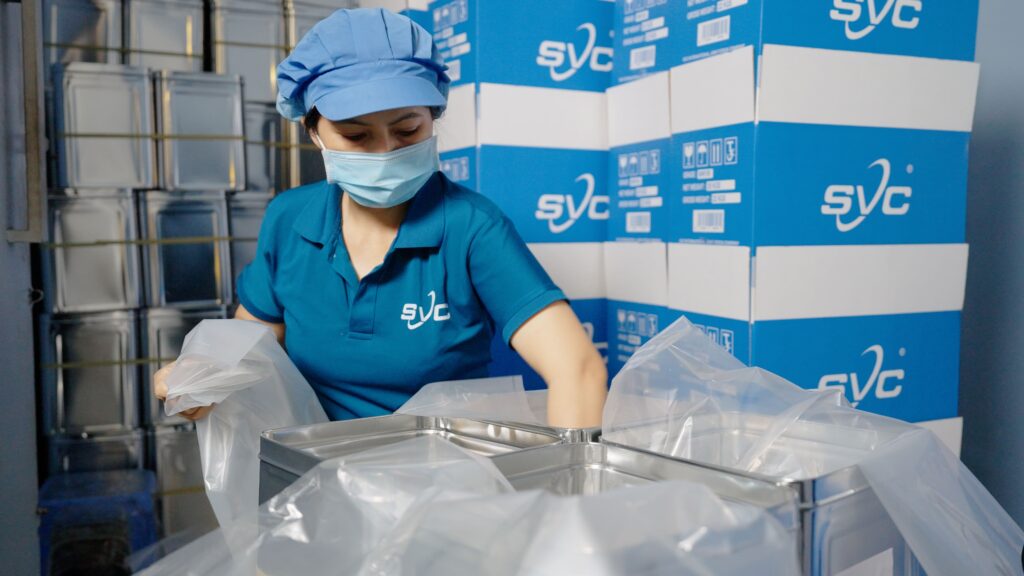
Most processing lines take 22.68 kg (50 lb) vacuum bags in cartons; SVC also packs 20 kg vacuum bags. Under the AFI specification, kernels keep for about 24 months at 0–10°C and 55–70% relative humidity. Once a vacuum bag is opened, oxidation speeds up, so plan bag sizes around how much a batch uses and reseal or use the remainder quickly.
How do you trial a new cashew ingredient?
Switching from wholes to pieces, or from one supplier to another, is a reformulation in all but name. A short, structured trial avoids surprises on the production line:
Keep a retained sample of the trial lot. If a later delivery behaves differently, it is the fastest way to show what changed.
For ingredient buyers, the saving on pieces is only worth having if every lot behaves the same in your process. Tell us how you use the kernels and we will match grade, colour class and testing to it.
Sourcing cashew kernels for a plant-based line? Request a quotation →
Article tools
Continue reading