

Tapioca starch uses in food manufacturing include noodles, bakery and gluten-free products, sauces and dairy desserts, processed meat, frozen foods, snacks and bubble tea pearls. Manufacturers choose it for its bland taste, clear and glossy paste and easy thickening. Native starch suits simple recipes; modified types such as E 1412, E 1414 and E 1422 are used where the product must survive long cooking, freezing or acid.
Why do food manufacturers use tapioca starch?
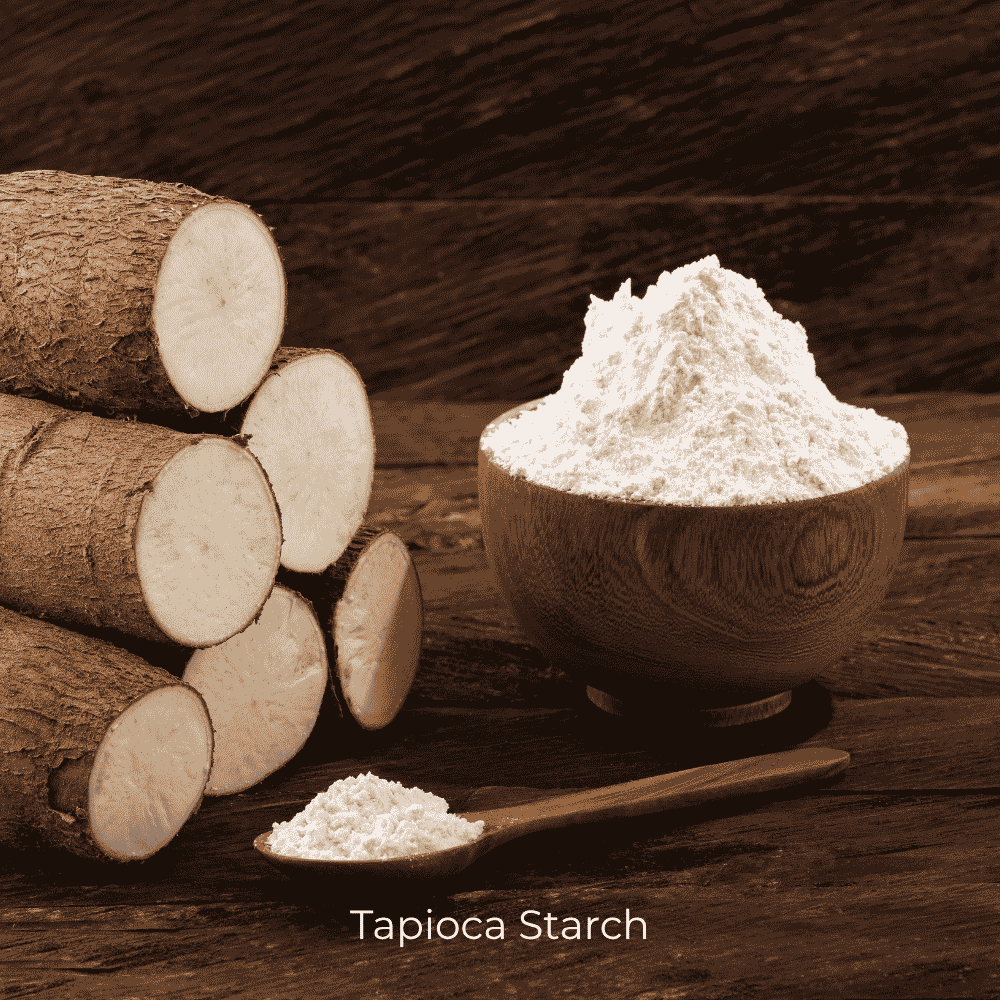
Tapioca starch is extracted from cassava roots. Its granules contain about 17% amylose, compared with about 25% in regular corn starch, and range from 5 to 25 microns in size, according to a technical review in Supply Side Journal. The lower amylose content is one reason tapioca forms a soft, translucent paste rather than the firm, opaque gel of corn starch.
- Bland taste — it does not mask delicate flavours.
- Clear, glossy paste — useful in glazes, fillings and sauces.
- Chewy, elastic texture — the basis of tapioca pearls and many Asian noodles.
- Thickening power — similar to comparable corn starches at similar dosage.
Which applications use tapioca starch?
| Application | What tapioca starch does | Typical type |
|---|---|---|
| Noodles | Elasticity; resists breakage and cooking loss | Native or E 1412 |
| Bakery and gluten-free | Structure, expansion and a crisp crust | Native |
| Sauces, soups and fillings | Thickens; holds viscosity in heat and acid | E 1414 or E 1420 |
| Dairy desserts and yoghurt | Soft, creamy texture; reduces syneresis | E 1422 |
| Processed meat | Binds water and improves texture | E 1422 |
| Frozen meals | Freeze-thaw stability | E 1414 |
| Bubble tea pearls and desserts | Chewy, translucent texture | Native |
| Fibre-enriched foods | Dietary fibre without a gummy texture | RS4 |
The modified types and their E-numbers are described on the modified tapioca starch page.
How is it used in noodles?
Tapioca starch is added to wheat and rice noodles to make them more elastic and less likely to break, and it is the main ingredient in some clear and chewy noodles. In noodles that are boiled, steamed or fried, the starch has to resist breaking down during cooking; distarch phosphate (E 1412) is used for products that must resist breakage and cooking loss.
For noodles, the key lines in the specification are viscosity, whiteness and fineness — see what each number in the specification means.
How is it used in bakery and gluten-free products?
In gluten-free baking, tapioca starch is combined with rice, sorghum or potato flour to give structure and expansion. Specialty tapioca starches are used in gluten-free mixes, pizza crusts, cookies, waffles, muffins and wraps, according to the same review. Tapioca is naturally gluten-free, which makes it a common base for these products.
In conventional baking, small additions improve crust crispness and help keep moisture in the crumb.
How is it used in sauces, dairy and meat?
Native starch thins out in long cooking, acid or high shear, so most sauce, dairy and meat producers use modified types. Acetylated distarch phosphate (E 1414) thickens and stabilises and reduces weeping (syneresis); acetylated distarch adipate (E 1422) gives the soft, creamy texture used in dairy products, meat products and sauces and helps hold moisture.
Because tapioca has a bland taste, it suits dairy and meat products where a cereal note would be noticed. The choice between native and modified is explained in native vs modified tapioca starch.
What about frozen foods, snacks and pearls?
- Frozen foods — E 1414 keeps sauces and fillings smooth through freezing and thawing.
- Snacks and crackers — tapioca starch helps expanded snacks puff and stay crisp.
- Bubble tea pearls and desserts — native tapioca starch gives the chewy, translucent texture.
- Fibre enrichment — resistant starch (RS4) adds heat-stable dietary fibre.
How do you choose the right grade?
Packing, container loads and documents are covered in how to import tapioca starch from Vietnam. SVC supplies food-grade native and modified tapioca starch from an FSSC 22000-certified partner mill in Tay Ninh Province.
What should the specification say for each use?
| Application | Lines to watch |
|---|---|
| Noodles | Viscosity, whiteness, fineness, cooking loss in your trial |
| Bakery and gluten-free | Moisture, fineness, microbiology |
| Sauces and frozen foods | Type (E-number), viscosity range, freeze-thaw result in your trial |
| Dairy and meat | Type, viscosity, microbiology, heavy metals |
| Bubble tea pearls | Whiteness, viscosity, starch content |
For every use, agree the microbiological limits — total plate count, yeast and mould, coliforms, E. coli and Salmonella — and the test method for each. Where your market sets a limit for cyanide in cassava products, ask for a test.
Is tapioca starch the same as tapioca flour?
The names are often used for the same product in trade, but some suppliers use “tapioca flour” for whole dried cassava flour, which contains fibre. Check the starch content on the specification — SVC’s native starch is 85% min.
Can one starch cover several products?
Sometimes. A factory making noodles and sauces may use native starch for one and a modified type for the other. Trial each product separately.
Tell us your application and we will suggest a starch. Request a quotation →
Article tools
Continue reading