🌐 Vietnam Cashew Authority · Supporting
📅 20 July 2026 ·
🕐 9 min read ·
📍 SVC Group, Vietnam
38%
Vietnam global export value share
Largest single origin
5.5%
India global export value share
Declining from prior years
19%
Ivory Coast export value share
Growing as processing scales
1,300kg
Vietnam yield per hectare
Vs India's 760kg/ha
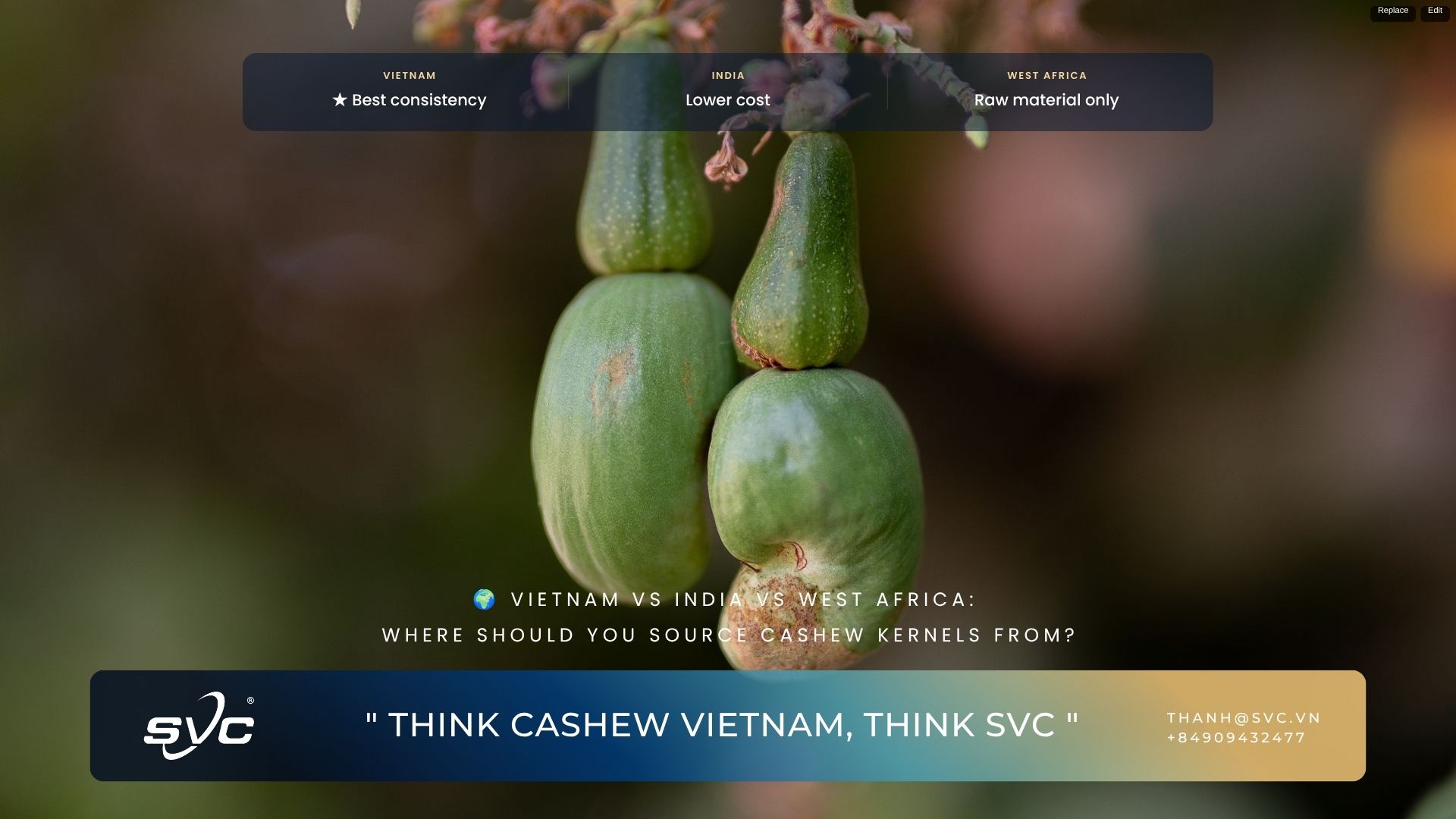
Buyers evaluating cashew sourcing eventually face the same question: should we source directly from Vietnam, from India, or increasingly from West African countries that are building their own processing capacity? Each origin has a genuinely different value proposition — and the right answer depends on what you are buying, at what volume, and for which market.
This article compares the three major sourcing paths on the factors that actually matter for a purchasing decision: processing infrastructure, cost structure, certification maturity, and reliability.
🌐 Three sourcing paths
Vietnam, India, And West Africa At A Glance
🇩🇪
Vietnam
Processing hub
Global export value share~38%
Yield per hectare~1,300kg
Mechanised processing~60%
RCN self-sufficiency~10%
🇮🇳
India
Legacy processor
Global export value share~5.5%
Yield per hectare~760kg
Mechanised processing~18%
RCN self-sufficiency~50%
🇩🇦
West Africa
Emerging processor
Global export value share~19% (CI)
RCN production share~26% (CI alone)
Domestic processing rate~18.8%, rising
Processing utilisation~40–45%
🏭 Processing infrastructure
Where The Real Difference Lies: Processing Capability
The most decisive difference between these three origins is not raw material access — it is processing infrastructure and how mechanised it is.
Vietnam built a highly mechanised processing sector over three decades. Automated shelling, drying, and colour-sorting lines allow Vietnamese processors to run at scale with consistent quality and lower per-unit labour cost. This is the single biggest reason Vietnam captures 38% of global export value despite growing only a fraction of the world's raw cashew.
India remains heavily manual: over 82% of Indian cashew processing units are manual, compared to roughly 40% in Vietnam. This creates a structural cost disadvantage that is difficult to offset even with India's deep processing heritage and strong domestic consumption base. India also imports roughly half its raw material, competing directly with Vietnam for the same African RCN supply.
West African countries — led by Ivory Coast, Benin, and Ghana — are investing heavily in new processing capacity, but utilisation remains low: current capacity utilisation across the region averages only 40–45%, constrained by irregular RCN supply and working-capital shortages. The direction of travel is clear (domestic processing share rising from 16.4% in 2024 to a projected 26.4% in 2026), but the infrastructure is still maturing.
For buyers who need volume, consistency, and predictable lead times today, Vietnam's processing maturity is the practical advantage. West Africa's growing capacity is a trend worth watching for the next 3–5 years, but is not yet a reliable primary source for large OEM programs.
Cost Structure Comparison
| Factor | Vietnam | India | West Africa |
|---|
| RCN self-sufficiency | ~10% (imports 90%) | ~50% (imports rest) | High — grows own RCN |
| Labour cost structure | Mechanised, moderate cost | Manual, rising labour cost | Manual, lower cost base |
| Yield per hectare | ~1,300 kg | ~760 kg | ~1,000–1,150 kg (CI) |
| Freight to EU/US | Established routes, competitive | Suez Canal exposure | Shorter to EU, longer to Asia |
| Kernel export volume | ~800,000 T (2026 target) | ~79,000 T (FY24) | Growing, still processing-limited |
📋 Certification & compliance
Certification Maturity By Origin
Vietnam
Established certification infrastructure. BRC, SMETA, Halal, Kosher, HACCP, and FSPCA certification is common among established exporters, with recognised certification bodies operating locally. Buyers can typically source certified product without difficulty from mid-size and large processors
India
Strong certification history for larger exporters, given India's decades of export relationships with the US, EU, and Middle East. Smaller and manual processing units may have less consistent certification coverage
West Africa
Certification infrastructure is developing alongside processing capacity. Buyers sourcing from newer West African processors should verify certification status carefully — it is less uniformly established than in Vietnam or India
🎯 Decision guide
Which Origin Fits Your Sourcing Need?
Large-volume, consistent OEM or private label programs: Vietnam's mechanised processing and mature certification infrastructure make it the lowest-risk choice for programs requiring reliable monthly volume and consistent specification
Buyers already established in India with existing relationships: India remains viable, particularly for buyers with long-standing supplier relationships — but should factor in rising cost pressure from manual processing and Suez Canal freight exposure
Buyers exploring diversification for supply chain resilience: West African direct sourcing is an emerging option worth monitoring, but currently better suited to supplementary volume than primary supply given processing capacity constraints
Buyers prioritising cost above all else: No origin currently offers meaningfully lower landed cost without a corresponding trade-off in consistency, certification, or lead time — the cost differences between origins are narrower than they were five years ago
💬 CEO Perspective
💬 CEO Perspective
We do not tell buyers that Vietnam is the only answer — it isn't, for every use case. But we do think buyers deserve an honest comparison rather than marketing claims. Vietnam's advantage was built over thirty years of processing investment. That advantage is real, and it is durable, and it is why we are confident recommending it even when we know a buyer is actively comparing us against other origins.
— 𝐂𝐄𝐎, 𝐒𝐕𝐂 𝐈𝐧𝐭𝐞𝐫𝐧𝐚𝐭𝐢𝐨𝐧𝐚𝐥 𝐉𝐒𝐂
🏭
About SVC Group
BRC · SMETA · Halal · Kosher · HACCP · FSPCA · 700+ MT/month · 72+ countries · Dong Nai Province, Vietnam
Read next
Vietnam Cashew Authority · Hub
Buyer Psychology · Conversion