
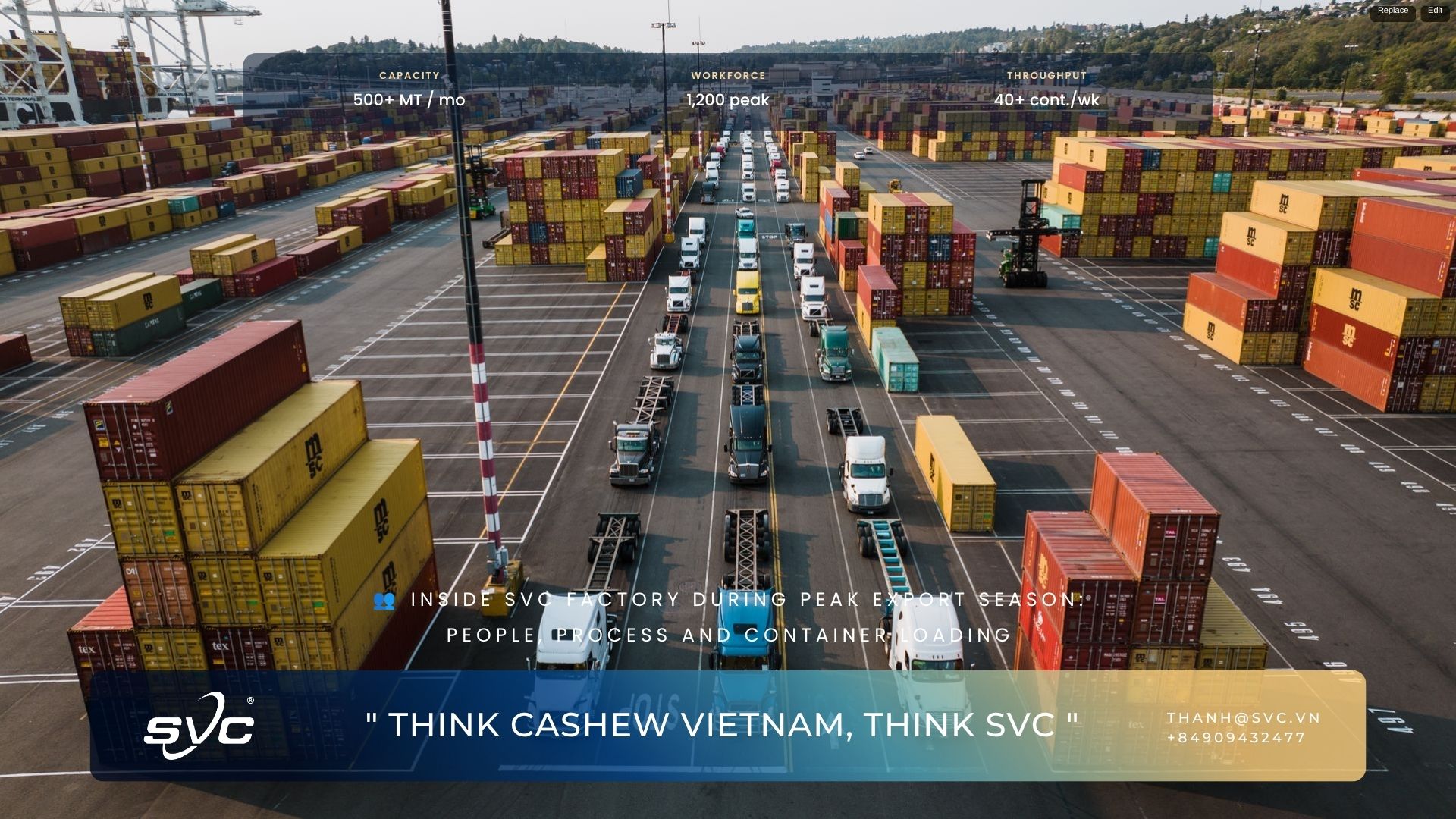
👥 Factory & Certification Authority · Supporting
👤 The people
📦 Container loading in practice
💬 CEO Perspective
700+
Tonnes processed this month
Peak Q3 export season
200+
People across shifts
Production, QC, logistics
2
Production shifts running
To meet August delivery windows
Daily
Container loadings this month
Cat Lai & Cai Mep port
Most of what buyers see from a cashew supplier is a spreadsheet, a photo, and a certificate. What they rarely see is what a factory actually looks like when it is running at real volume, under real time pressure, with real people making the decisions that determine whether a shipment goes out correctly.
This article is exactly that — a look inside SVC's Dong Nai facility during the current peak export period, as August delivery bookings fill the production schedule.
⏰ A day at the facilityWhat Peak Season Looks Like, Shift By Shift
6:00 AM
Morning Shift Begins
RCN intake team starts moisture and outturn testing on the day's incoming raw material batches before processing lines start up
7:30 AM
Processing Lines Active
Steaming, shelling, and drying lines running at full capacity. QC checkpoints active at each stage transition
10:00 AM
First Container Loading
Pre-inspected cartons from yesterday's production loaded under supervision, carton count verified against packing list
2:00 PM
Grading & Packing Peak
Optical sorting and manual inspection tables at highest throughput of the day, running parallel across multiple grade lines
6:00 PM
Shift Handover
Production and QC logs reviewed and handed to evening shift. Any anomalies flagged for immediate follow-up, not left until morning
10:00 PM
Evening Shift Documentation
CoA compilation for the day's completed batches. Export documentation prepared ahead of next-day container loading
During peak season, the schedule does not change the standard — it just means more people and more shifts holding the same quality checkpoints, more often, on more volume.
Who Keeps The Factory Running At This Pace
QC Laboratory Team
Running moisture, aflatoxin, and colour analysis continuously across every production run — the pace of testing scales with the pace of production, never slower
Line Supervisors
Monitoring shelling, drying, and grading equipment in real time, adjusting for the specific batch of raw material running through that day
Manual Inspection Sorters
Trained staff at inspection tables catching visual defects that automated colour sorters miss — this human layer does not get skipped during peak volume
Export Documentation Team
Compiling CoA, Certificate of Origin, phytosanitary, and buyer-specific documents for every outbound container, cross-checked before release
What Happens Before A Container Leaves The Gate
Pre-loading inspection: Every carton scheduled for loading is checked against the packing list before it enters the container — not just counted, but verified against the specific order
Container condition check: Interior inspected for cleanliness, odour, and structural condition before any product is loaded — a contaminated or damaged container is rejected before loading starts
Loading pattern verification: Cartons loaded in a documented pattern that maximises stability and airflow, particularly relevant during Vietnam's hot season
Final documentation cross-check: CoA, packing list, and certificates verified against the actual loaded cargo before container doors are sealed and the seal number recorded
Departure confirmation: Buyer notified with shipping documents and container/seal numbers as soon as the container departs SVC's facility for port
💬 CEO Perspective
Peak season is where a factory's real standards get tested — not during a scheduled audit, but during the ordinary pressure of running more volume through the same systems. Our answer to that pressure has never been to relax a checkpoint. It has been to add people and shifts so the checkpoint holds no matter how much volume moves through it.
— 𝐂𝐄𝐎, 𝐒𝐕𝐂 𝐈𝐧𝐭𝐞𝐫𝐧𝐚𝐭𝐢𝐨𝐧𝐚𝐥 𝐉𝐒𝐂
Want To See The Factory Yourself?
In-person or virtual factory visits are welcome any time — including during peak production, so you can see exactly what is described here.
Read next
Article tools
Continue reading