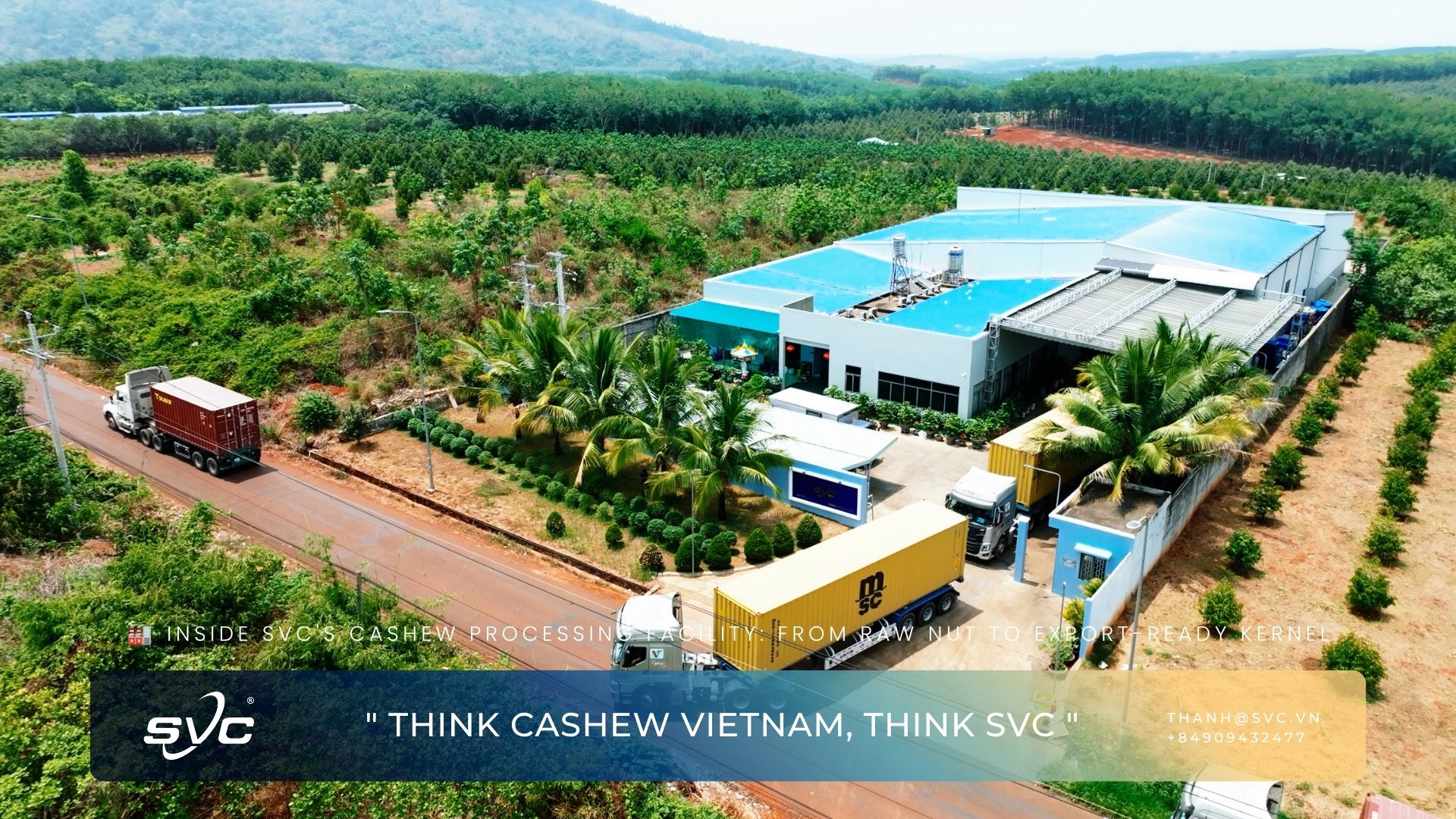
🏭 Factory & Certification Authority · Hub
📅 03 July 2026 ·
🕐 9 min read ·
📍 SVC Group, Dong Nai, Vietnam
700+
MT processed monthly
Dong Nai facility
6
Active certifications
BRC · SMETA · Halal · Kosher · HACCP · FSPCA
6
Processing stages
RCN intake → container loading
72+
Export countries
Cat Lai & Cai Mep port
“A BRC certificate tells you a factory was compliant on a specific date. What buyers actually need to know is whether it operates at that standard every day — across every production run, for every shipment.”
Most buyers never see the factory. They receive a price quote, a sample, a set of certificates. What happens in between — the decisions made at every step of processing, the systems that catch problems before they become shipments — remains largely invisible.
This article makes it visible. Here is how cashew processing actually works at SVC’s facility in Dong Nai Province — from the moment raw cashew nuts arrive at the gate to the moment an export-ready container leaves for port.
📋 Overview
6 Stages From Raw Nut To Export-Ready Kernel
SVC’s processing facility handles the complete production chain — from incoming raw cashew nut inspection through to sealed container loading. Each stage has defined quality checkpoints, documented parameters, and traceability records.
Stage 1
RCN Receiving & Inspection
Moisture, outturn, defect and aflatoxin testing before any nut enters production
Stage 2
Steam Sterilisation & Shelling
Controlled steam softens shells, reduces pathogens. Italian & Korean machinery
Stage 3
Drying & Moisture Control
Temperature & humidity-controlled zones. Target: 3.5–5.0% moisture for export grade
Stage 4
Peeling & Grading
Optical colour sorting + size grading + manual inspection. Full grade range WW180–WW450
Stage 5
Specialised Processing Lines
Dedicated roasting, organic and allergen-free lines — physically separated for product integrity
Stage 6
Packaging & Container Loading
Vacuum 20/22.68kg, retail PL, tin canisters. Container pre-inspection + full documentation package
🌿 Stage 1
Raw Cashew Nut Receiving And Inspection
Every production run at SVC begins at the receiving gate — before a single nut is shelled. RCN arrives from Cambodia, Ivory Coast, Tanzania, Ghana, and domestic Vietnamese supply. Each origin has different moisture profiles, outturn rates, and defect patterns and is treated accordingly.
Moisture testing: Acceptable RCN moisture 8–10%. Above threshold → quarantine and re-test before acceptance decision
Outturn rate: Edible kernel recovered per weight of raw nut. Typical quality RCN: 48–52%. Low outturn lots priced and processed accordingly
Visual inspection: Discolouration, insect damage, contamination checked at intake. Origin-specific defect benchmarks maintained from years of sourcing data
Aflatoxin screening: On-site lateral flow testing for higher-risk origins + confirmatory HPLC at accredited external lab for EU-bound lots (limit: ≤10ppb total, ≤2ppb B1)
Only batches that pass incoming inspection move to the processing line. This is the first real quality gate — where many potential problems are eliminated before reaching the production floor.
Steam Sterilisation And Shell Removal
Steaming serves two critical functions: it softens the cashew shell for efficient mechanical shelling, and the heat eliminates surface pathogens under HACCP protocols. Steam parameters — temperature, pressure, duration — are controlled and logged for every batch as part of traceability documentation.
After steaming, nuts proceed to mechanical shelling using equipment sourced from Italy and South Korea. Lines are calibrated by nut size, as oversized or undersized nuts run at different tolerances to minimise breakage. Whole kernel recovery is tracked per production run — it is one of the internal KPIs the factory team is accountable for.
💧 Stage 3
Drying And Moisture Control
Under-dried kernels risk mould in storage or transit. Over-dried kernels become brittle, increasing breakage at subsequent stages. SVC conducts drying in temperature- and humidity-controlled zones, measuring kernel moisture at multiple checkpoints throughout the process.
Target moisture range for export-grade kernels: 3.5–5.0% (varies by grade and destination market). Every batch is tested before leaving the drying stage. Moisture control is one of the most commonly mismanaged variables in cashew processing — it directly affects shelf life, texture, and the CoA results buyers rely on to verify specification.
⚙️ Stage 4
Peeling And Grading
Dried kernels still carry the seed coat. Peeling removes this to produce the white or ivory kernel that reaches retail and industrial buyers. SVC operates both mechanical and manual peeling lines, with a greater manual component for premium grades (WW180, WW240) to minimise breakage on high-value pieces.
Three-layer grading system
Electronic colour sorting: Optical sorters identify and reject discoloured kernels with precision exceeding manual sorting at production scale. Calibrated per grade and per customer requirement
Size grading: Separates by count per pound — WW180 through WW450 and broken grades (LP, SP, BB). SVC produces the full standard grade range
Manual inspection tables: Final visual check. Trained sorters catch edge cases automated systems miss. Grade cards produced per run: kernel count, colour sort rejection rate, manual inspection results
🔥 Stage 5
Specialised Processing Lines
Beyond standard kernel processing, SVC operates dedicated lines for value-added products — physically separated from the main processing area for allergen management and product integrity.
Roasting & Flavouring
A320 Salted · Honey-Roasted · Custom OEM
Controlled-temperature drum roasters. Roast profile documented and repeatable for batch-to-batch colour and flavour consistency
Organic Line
EU Organic · Dedicated Segregation
Full chain of custody from RCN intake to finished product. Documented records aligned with EU Organic and equivalent standards
Allergen-Free
EU & UK Retail Compliance
Line cleaning verification, equipment swabbing and record-keeping to support allergen declarations on customer product labels
Private Label
Full OEM Packaging Line
Artwork compliance checking, label printing verification, pre-production packaging approval before line start
📦 Stage 6
Packaging And Container Loading
Container loading is not simply a logistics function — it is the final quality checkpoint. Each container is pre-inspected before loading, carton count verified, and container temperature checked before doors are sealed.
Vacuum bags — 20kg & 22.68kg: Multi-layer bags rated for transit time and storage conditions per destination. Seal integrity checked post-packing. Temperature-controlled warehouse storage before loading
Tin canisters — 10kg & 11.34kg: In 5-layer master cartons, SVC standard design or customer specification
Retail private label: Full packaging management including artwork compliance, label printing verification, pre-production approval
Documentation package: CoA, Certificate of Origin, phytosanitary certificate, packing list — compiled and cross-checked before container release. FSMA/FDA records for US-bound shipments
🔬 On-site laboratory
What Gets Tested, And When
Testing at SVC is not a final-output checkpoint. It happens at multiple points across the production chain to catch drift within a run rather than discover problems at the destination.
| Test | When conducted | Standard / Limit |
|---|
| Moisture | RCN intake · post-drying · post-peeling · pre-packing | 3.5–5.0% finished kernel |
| Aflatoxin | RCN intake (high-risk origins) + finished product EU lots | EU: ≤10ppb total · ≤2ppb B1 |
| Colour & defect | Post-grading per production run | AFI grade specifications |
| Microbiological | Per BRC & HACCP testing schedule + anomaly triggers | TPC, yeast/mould, Salmonella, Listeria |
| Environmental | Scheduled surface swabs per BRC protocol | Production environment contamination control |
📜 Certifications
What Each Certification Means In Practice
BRC Food Safety
Audited annually. Covers kernel processing, roasted/flavoured products and private label. Required by UK supermarkets and increasingly EU retail chains
SMETA
Sedex ethical trade audit. Covers labour, health & safety, environment, business ethics. Required for EU supply chain due diligence compliance
Halal
Internationally recognised body. Enables supply to Middle East, Muslim-majority markets and Halal retail channels in Europe and Southeast Asia
Kosher
Certified for Jewish dietary law compliant buyers. Growing Kosher retail sections in US and European supermarkets
HACCP
Foundational food safety management. Covers all Critical Control Points with documented monitoring, corrective action and verification procedures
FSPCA
FDA FSMA preventive controls compliance for US market. SVC’s FSPCA-qualified personnel ensure US-bound shipments meet all FDA requirements
❓ Buyer guide
Questions To Ask When Evaluating Any Cashew Factory
A factory that answers these questions with documentation rather than verbal assurance has built quality into its operations — not bolted it on for audit purposes.
On raw material
Where does your RCN come from, and how diversified is your supply base?
What is your incoming inspection protocol? Can you provide RCN supplier approval records?
What is your aflatoxin testing protocol for EU-bound product specifically?
On processing & quality
What is your target moisture range at each processing stage? How is drying monitored and logged?
Can you provide CoA results from the last six production runs for the grade I am buying?
What is your procedure when a production run fails internal specification?
On certifications
When was your last BRC audit, and what was the grade? Can you share the report?
For EU-bound product: can you provide your SMETA audit report and corrective action log?
On OEM & private label
How do you manage artwork approval and label compliance for my target market?
What is your allergen management protocol for lines that handle multiple products?
🏭 Our position
SVC Is A Manufacturer, Not A Trader
✓Full traceability. We process in our own factory. Every CoA reflects what our own laboratory measured on your specific production run — not a third-party supplier’s claim.
✓Direct corrective action. When something is wrong, we fix it ourselves — on the same production floor, with the same team. No intermediary, no delay, no confusion about accountability.
✓Audit-ready at all times. BRC-approved auditors, SMETA auditors and buyer quality teams from Europe, the US and the Middle East audit our facility. We welcome unannounced visits.
✓Factory visit open. In person or virtually — if you want to see the facility before placing your first order, that conversation is welcome.
💬 CEO Perspective
Any supplier can list certifications on a website. What we invite buyers to evaluate is not our certificate list — it is what happens inside the building every day. The systems, the people, the discipline of running 700 tonnes a month to a consistent standard across 72 markets. Come and see it.
— 𝐂𝐄𝐎, 𝐒𝐕𝐂 𝐈𝐧𝐭𝐞𝐫𝐧𝐚𝐭𝐢𝐨𝐧𝐚𝐥 𝐉𝐒𝐂
🏭
About SVC Group
BRC · SMETA · Halal · Kosher · HACCP · FSPCA · 700+ MT/month · 72+ countries · Dong Nai Province, Vietnam
Read next
OEM & Private Label · Market Insight
Market Intelligence · Flagship