
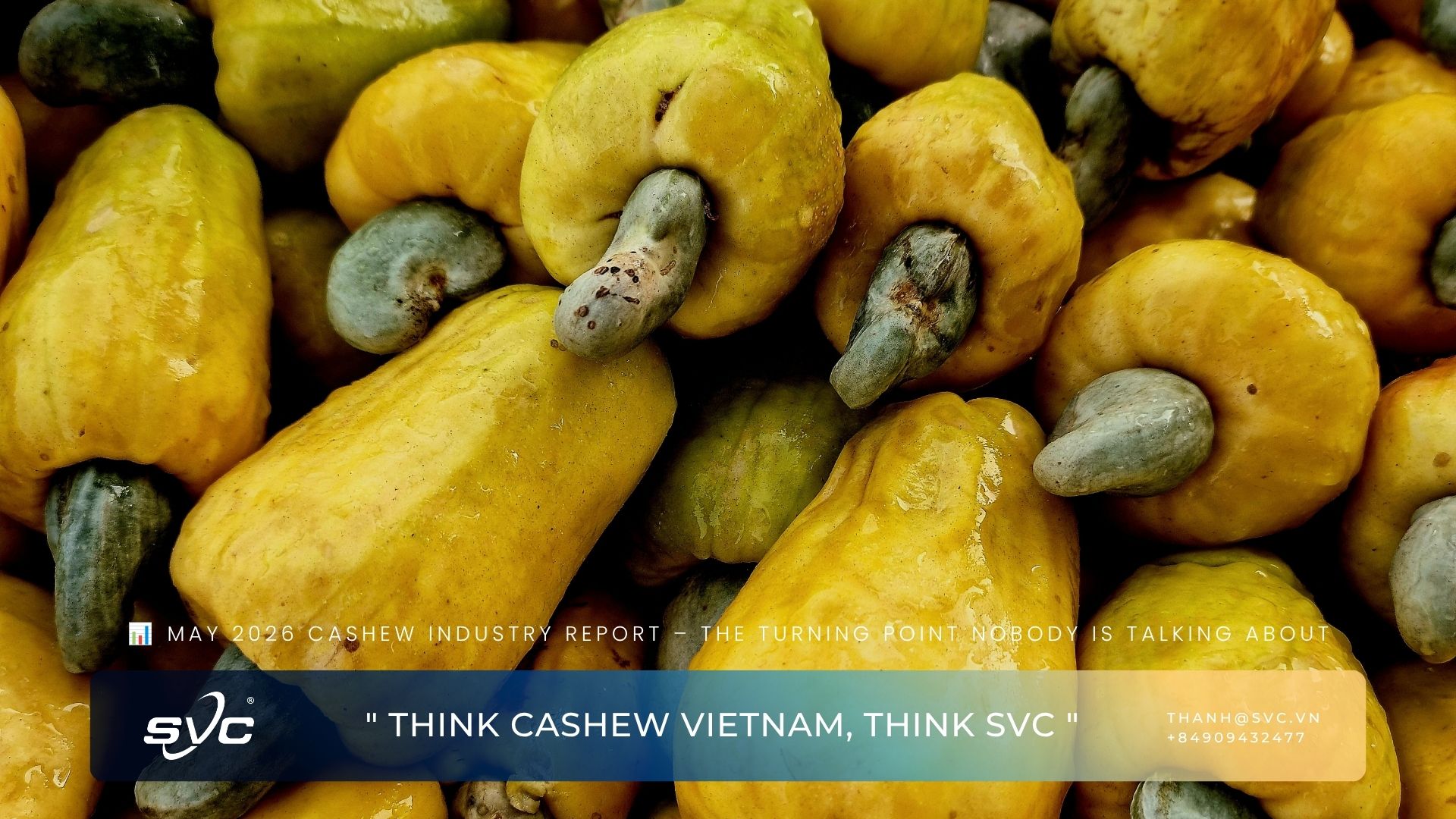
The global cashew industry entered 2026 under considerable pressure.
The first quarter was characterized by cautious purchasing, inventory reductions and widespread uncertainty across multiple markets. Buyers delayed procurement decisions, traders became increasingly conservative and processors faced one of the most challenging operating environments in recent years.
By the end of May, however, a subtle but important shift had begun to emerge.
It was not a dramatic increase in prices.
It was not a sudden surge in demand.
It was not a supply shortage.
Instead, the industry’s turning point came from something far more important: a gradual return to planning.
For the first time in several months, buyers across major markets started focusing less on waiting and more on preparing.
That change may ultimately become the most significant development of May 2026.
🌎 The Industry Moved Beyond The “Wait And See” Phase
For much of the first quarter, market participants shared a common strategy.
Wait.
Wait for lower prices.
Wait for more clarity.
Wait for economic conditions to improve.
Wait before committing to future purchases.
This mindset dominated procurement decisions throughout the supply chain.
Importers postponed contracts.
Distributors reduced inventories.
Retailers became increasingly cautious.
The result was a market driven more by uncertainty than by actual consumption.
May marked the beginning of a different conversation.
Rather than asking whether they should buy, many importers began asking how much coverage they needed for the second half of the year.
That distinction is critical.
A market focused on postponement behaves very differently from a market focused on planning.
📦 Inventory Reduction Is No Longer The Main Story
One of the most important trends during the first half of 2026 was inventory correction.
Many buyers entered the year with sufficient stock levels and prioritized inventory management over new purchasing.
This strategy made sense.
However, inventory reduction is not a permanent business model.
Eventually, distributors must replenish.
Retailers must prepare seasonal programs.
Brands must secure manufacturing schedules.
Food service operators must maintain continuity.
During May, signs of this transition became increasingly visible.
Procurement discussions became more focused on future requirements rather than immediate market conditions.
This does not necessarily indicate aggressive buying activity.
It indicates something arguably more important:
The industry is beginning to think forward again.
🏭 OEM And Private Label Continue Expanding
Another development that received less attention than it deserves is the continued expansion of OEM and private label programs.
Across Europe, North America and the Middle East, retailers remain under pressure to improve margins and strengthen customer loyalty.
Private label products continue providing an effective solution.
This trend is creating opportunities throughout the cashew supply chain.
Rather than sourcing generic products, many buyers are increasingly focused on:
• Customized packaging
• Brand development
• Retail differentiation
• Long-term manufacturing partnerships
• Product innovation
As a result, value-added capabilities are becoming more important than simple production volume.
The competitive landscape is gradually shifting.
🌍 Value-Added Products Are Gaining Strategic Importance
Historically, discussions within the cashew industry often centered on raw kernels.
That remains an important segment.
However, May highlighted another trend.
Many buyers are increasingly interested in finished and semi-finished products that provide stronger commercial value.
Examples include:
• Roasted cashews
• Flavored cashews
• Retail-ready packaging
• Snack products
• Mixed nut concepts
• Private label solutions
These categories allow importers and retailers to capture greater margins while differentiating themselves in increasingly competitive markets.
As a result, the future growth of the industry may be driven as much by innovation and branding as by kernel volume.
🇻🇳 Vietnam’s Competitive Advantage Is Evolving
Vietnam remains the dominant processing center within the global cashew industry.
However, the country’s competitive advantage is changing.
For many years, scale and efficiency were the primary strengths.
Today, buyers increasingly evaluate suppliers using different criteria.
They want:
• Supply reliability
• Food safety compliance
• Traceability
• OEM capability
• Product development support
• International certifications
• Long-term partnership potential
This evolution favors suppliers capable of providing complete solutions rather than simply offering competitive prices.
The industry is becoming more sophisticated, and sourcing decisions are becoming more strategic.
🚢 Supply Chain Stability Matters More Than Price Volatility
One of the most underestimated developments of 2026 is the growing importance of supply chain stability.
The disruptions experienced throughout recent years changed buyer priorities.
Many importers now place greater emphasis on:
• Consistent supply
• Predictable lead times
• Reliable logistics
• Manufacturing continuity
• Partnership security
These factors may not receive the same attention as market prices, but they increasingly influence purchasing decisions.
For many buyers, avoiding disruption has become more valuable than achieving the lowest possible price.
📈 The Biggest Risk In H2 May Not Be Price
Most discussions within commodity markets focus on pricing.
Yet the most important risk entering the second half of 2026 may not be price-related.
It may be positioning.
Companies that spend too long waiting for ideal market conditions often discover that availability, lead times and production capacity become more important than price itself.
As demand gradually normalizes, competition for reliable suppliers could increase.
In that environment, strategic procurement becomes more valuable than reactive purchasing.
🌍 The Turning Point Nobody Is Talking About
The most important development of May was not a headline.
It was not a price movement.
It was not a production figure.
It was a change in market psychology.
The industry began shifting from uncertainty toward preparation.
Buyers started planning again.
Retailers started forecasting again.
Importers started evaluating future coverage again.
That change is subtle.
But historically, it is often the first signal that a market is moving beyond correction and toward a more stable phase.
For that reason, May 2026 may ultimately be remembered as a much more important month than current market discussions suggest.
🌏 Global Supply Partnerships
Whether you are sourcing premium cashew kernels, developing a private label brand or securing long-term supply contracts, SVC supports buyers with reliable sourcing solutions, OEM manufacturing and international export expertise.
📩 thanh@svc.vn
📱 (+84) 909 432 477
🏭 Factory: Dong Nai Province, Vietnam
🏢 Representative Office: Ho Chi Minh City, Vietnam
Sources
• Vietnam Cashew Association (VINACAS)
• International Trade Centre (ITC)
• International Nut & Dried Fruit Council (INC)
• SVC Market Intelligence
• Global Importer Feedback Network