🗺️ Vietnam Cashew Authority · Supporting
📅 19 August 2026 ·
🕐 7 min read ·
📍 SVC Group, Vietnam
>50%
Binh Phuoc share
Of national cultivation
~1,300kg
Vietnam yield per ha
Among the highest globally
Feb–Jun
Domestic harvest window
All growing regions
~10%
Domestic share of processing
90% imported RCN
Vietnam is the world's largest cashew kernel exporter but only a modest raw cashew producer — roughly 10% of what its factories process comes from domestic orchards. Still, understanding where Vietnamese cashew is grown, and where it is processed, helps buyers make sense of supply logistics, lead times, and why certain factories are located where they are.
🌱 Growing regions
Where Vietnamese Cashew Is Actually Grown
The heartland
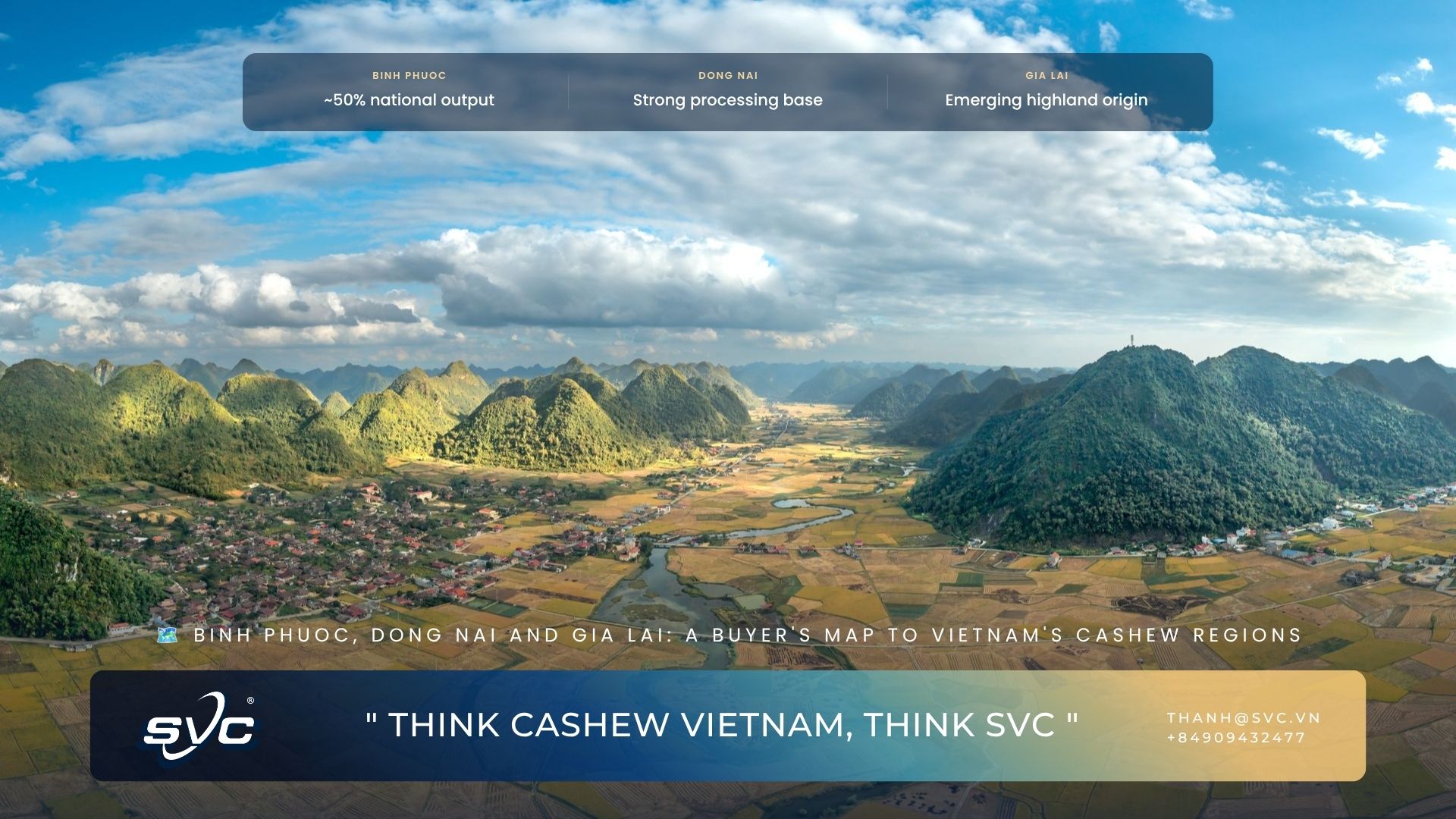
Binh Phuoc
More than half of Vietnam's cultivation area and output. Red basalt soil and a suitable dry season make it the country's defining cashew province. Widely referred to as Vietnam's cashew capital
Central Highlands
Dak Lak & Gia Lai
Secondary growing regions with meaningful volume. Often cultivated alongside coffee and pepper. Yields vary more with rainfall patterns than in Binh Phuoc
Southeast region
Dong Nai & Ba Ria–Vung Tau
Some cultivation, but far more significant as the processing and export corridor given proximity to Ho Chi Minh City and deep-water ports
A distinction worth understanding: where cashew is grown and where it is processed are different maps. Binh Phuoc dominates cultivation. Dong Nai and Binh Duong dominate export-oriented processing, because port access matters more than orchard proximity when 90% of raw material arrives by sea anyway.
Why Factories Cluster Around Ho Chi Minh City
Vietnam's export-oriented cashew processing is concentrated in the southeast, and the logic is straightforward:
Port access: Cat Lai and Cai Mep handle the large majority of Vietnam's container export volume. Proximity reduces inland transport cost and transit risk for both incoming RCN and outgoing kernels
Imported RCN logistics: With ~90% of raw material arriving by sea from Africa and Cambodia, factory location near the port matters more than location near domestic orchards
Infrastructure and utilities: Reliable power, industrial zoning, and cold-chain infrastructure are better developed in the southeast industrial corridor
Labour and technical skills: Concentration of food processing expertise, QC personnel, and certification support services in the greater Ho Chi Minh City area
Buyer access: International buyers visiting for factory audits fly into Ho Chi Minh City. A facility within reasonable driving distance is materially easier to audit
📆 Seasonality
The Domestic Harvest Window
Vietnam's domestic cashew harvest runs roughly February to June, in line with Cambodia and the West African main crop. This means domestic supply arrives during the same window as imports, and does not provide counter-seasonal relief during the July–October lean period.
For buyers, the practical implication is that Vietnamese processing capacity is not insulated from the global lean season by domestic production — the domestic crop follows the same calendar as the imports it supplements.
💬 CEO Perspective
💬 CEO Perspective
Buyers sometimes assume a Vietnamese factory is buying its cashew from the field next door. In reality, our raw material arrives from Cambodia, West Africa and domestic sources, and our location is chosen for port access and audit accessibility. Understanding that map helps buyers ask better questions about where their product actually comes from.
— 𝐂𝐄𝐎, 𝐒𝐕𝐂 𝐈𝐧𝐭𝐞𝐫𝐧𝐚𝐭𝐢𝐨𝐧𝐚𝐥 𝐉𝐒𝐂
🏭
About SVC Group
BRC · SMETA · Halal · Kosher · HACCP · FSPCA · 700+ MT/month · 72+ countries · Dong Nai Province, Vietnam
Read next
Vietnam Cashew Authority · Hub
Vietnam Cashew Authority · Supporting