
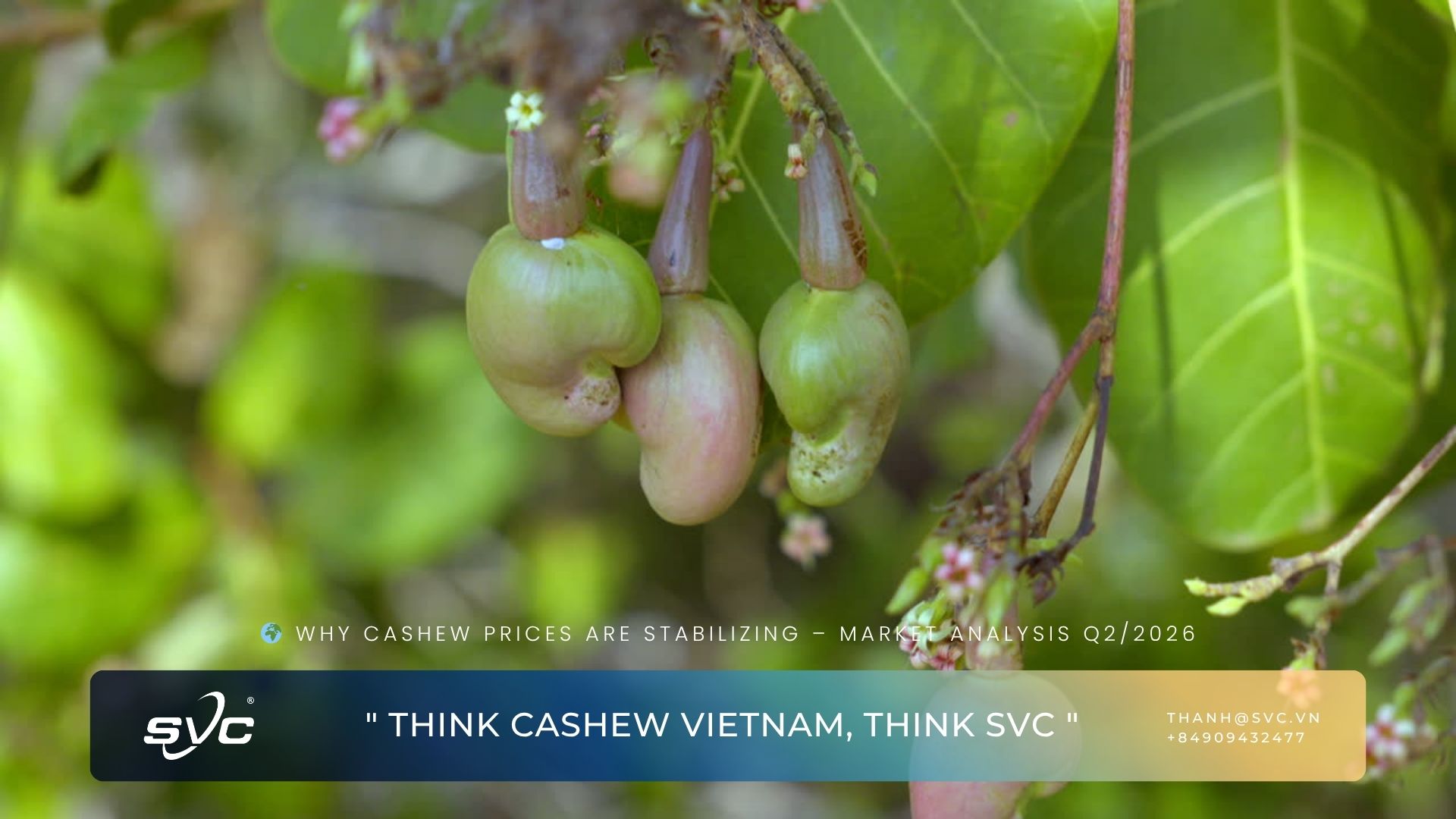
The global cashew market entered Q2/2026 with noticeably different conditions compared to the volatility seen during the first quarter of the year. After months of aggressive price corrections, cautious buyer activity and inventory pressure, the market is now showing increasing signs of stabilization.
For importers, distributors and OEM buyers, the key question is no longer whether prices will continue falling, but rather why the market is becoming more stable and what this means for future purchasing strategy.
Understanding the current stabilization phase is critical because markets rarely move directly from decline to sharp recovery. They typically transition through a period of balance where supply, demand and buyer psychology begin realigning.
📊 Latest Vietnam Cashew Prices – 11 May 2026
White Cashew Kernels (FOB Ho Chi Minh)
| Grade | Price (USD/kg) | Market Position |
|---|---|---|
| WW180 | 9.30 | stable |
| WW240 | 7.65 | stable |
| WW320 | 7.10 | stable |
Roasted Cashew – Salted with Skin
| Grade | Price (USD/kg) | Market Position |
|---|---|---|
| A180 | 8.20 | stable |
| A240 | 7.00 | stable |
| A320 | 6.80 | stable |
Quality: AFI Standards
Delivery: End of May / Early June shipment
👉 Live Price Update:
https://svc.vn/cashew-price-update-svc-official/
📈 Q1 Correction Phase Is Ending
To understand why prices are stabilizing now, it is important to examine what happened during Q1/2026.
During the first quarter, the market experienced:
• aggressive buyer hesitation
• inventory reduction across multiple regions
• weaker spot demand
• cautious purchasing behavior
• strong downward pricing pressure
Many importers delayed purchases while waiting for lower prices, creating a temporary imbalance between supply availability and buying activity.
As a result:
• prices corrected downward
• negotiations became slower
• suppliers faced stronger competition
However, by late Q1 and early Q2, several market dynamics began changing simultaneously.
🌍 Demand Is Gradually Returning
One of the most important reasons for market stabilization is the gradual return of demand across key importing regions.
Europe
European buyers who reduced inventory aggressively earlier in the year are beginning to re-enter the market.
Current activity shows increasing interest in:
• retail-ready kernels
• roasted products
• OEM snack production
Importers are becoming more active because inventories are no longer excessively high.
United States
The US market remains cautious but inquiry activity is improving steadily, especially for:
• WW240
• WW320
• retail snack applications
More buyers are discussing medium-term sourcing rather than short-term spot purchasing alone.
Middle East
The Middle East continues demonstrating stable demand for:
• roasted cashew
• flavored products
• premium retail packaging
This region remains one of the strongest support factors for overall market stability.
📦 Supply Conditions Are Balanced
Another major reason behind price stabilization is that the market is not experiencing oversupply.
Current supply observations indicate:
• factories continue operating steadily
• raw material availability remains controlled
• processing output is stable but not aggressively expanding
This is important because excessive supply would continue pushing prices lower.
Instead, the market currently reflects a more balanced structure where:
• supply is available
• but not excessive
• demand is improving gradually
This naturally reduces volatility.
🚢 Buyer Psychology Is Changing
One of the strongest signals in Q2 is the shift in buyer behavior.
Compared to Q1, buyers are increasingly:
• requesting quotations more frequently
• discussing forward shipments
• locking partial volumes earlier
• monitoring strategic grades more closely
This psychological shift matters because commodity markets are heavily influenced by confidence and timing expectations.
When buyers stop expecting continuous price declines, the market usually begins stabilizing.
📊 Why WW240 and WW320 Remain Key Indicators
WW240 and WW320 continue acting as the most important benchmark grades in the global cashew market because they are widely used across:
• supermarkets
• snack manufacturing
• wholesale distribution
• private label retail programs
Current pricing levels for these grades suggest that:
• the market has likely established a temporary floor
• suppliers are becoming less flexible on aggressive discounts
• buyer activity is supporting stable negotiations
These grades are often the earliest indicators of future market direction.
💰 Freight & Cost Conditions Are Supporting Stability
External cost factors are also helping reduce market volatility.
Compared to previous periods:
• freight conditions are more stable
• export logistics are functioning more efficiently
• processing costs remain relatively controlled
This creates an environment where suppliers are not forced into major price adjustments.
Stable operational costs typically support more predictable export pricing.
🌏 Why the Market Is Not Recovering Aggressively Yet
Although stabilization signals are becoming clearer, the market has not yet entered a strong upward cycle.
Several factors continue limiting aggressive price growth:
• buyers remain cautious after previous volatility
• global economic uncertainty still exists
• importers continue managing inventory carefully
As a result, the current phase is best described as:
balanced stabilization rather than rapid recovery.
This type of market environment is often healthier because it allows:
• gradual rebuilding of buyer confidence
• more sustainable pricing structures
• improved supply-demand balance
📈 Strategic Implications for Importers
For importers, the stabilization phase creates an important strategic opportunity.
When markets stabilize:
• supply remains available
• prices become more predictable
• negotiation flexibility still exists
However, waiting too long may create risks if demand strengthens further during Q2 and Q3.
Many experienced buyers are therefore adopting balanced strategies such as:
• securing partial volume now
• monitoring weekly price updates
• prioritizing key grades earlier
This approach reduces exposure to future market tightening while preserving flexibility.
🚀 SVC Market Perspective
From SVC’s market observation, the current environment reflects a transition from correction toward stabilization.
Key indicators supporting this view include:
• reduced price volatility
• improving buyer activity
• balanced supply conditions
• stronger inquiry frequency
SVC continues supporting partners through:
• transparent price updates
• stable export planning
• OEM and bulk supply solutions
• flexible shipment scheduling
This allows buyers to make sourcing decisions based on real market conditions rather than speculation.
📊 Outlook for Q2/2026
Looking ahead, the most likely scenario for Q2 remains:
• stable to gradually firmer pricing
• continued improvement in buyer activity
• tighter availability for strategic grades over time
The market does not currently show signs of aggressive price spikes, but it increasingly suggests that the strongest downward pressure has already passed.
This makes the current phase particularly important for strategic procurement planning.
📧 Contact for Market Update & Supply
📩 thanh@svc.vn
📱 (+84) 909 432 477
Request updated quotations, shipment planning and OEM support.
Article tools
Continue reading